Quick answer: Cornwall’s storytelling tradition runs from the Celtic bards through the fireside tales of miners and fishermen to the festivals and pub storytelling nights of today — giants and piskies, mermaids and wreckers, King Arthur and Tristan and Iseult. To hear the old stories told live, look to the Cornwall Folk Festival, Falmouth’s Sea Shanty Festival, Golowan and Montol in Penzance, and the storytelling nights and guided story-walks run across the county. The origins, the tales, where to hear them — and a note for anyone trying to book a storyteller — below.
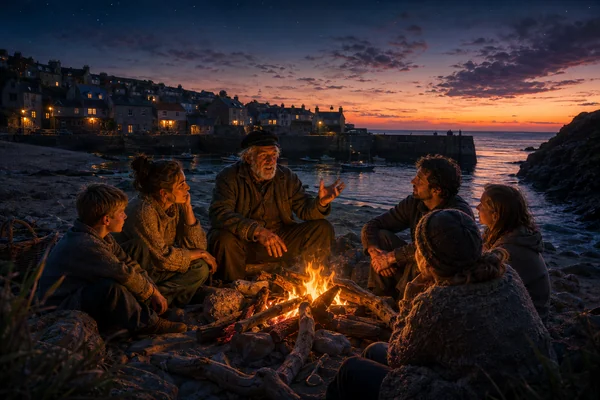
Imagine a fire on a Cornish shore at dusk, faces lit, and someone who knows the old stories telling one — a giant, a mermaid, a ship that shouldn’t have been there. Storytelling in Cornwall is not a museum piece; it’s a living tradition that moved from the bard’s hall to the miner’s croust-time to the harbour pub, and it’s still moving. This guide covers where it came from, the tales themselves, and where to hear them told now — with a word about the fireside, which is where our family’s storytelling still happens.
Table of Contents
- The origins of Cornish storytelling
- Traditional Cornish tales
- Fireside tales
- Storytelling festivals and events
- Contemporary storytellers
- Looking to book a storyteller?
- Personal insights and experiences
- FAQ
- References and resources
The origins of Cornish storytelling
Celtic roots
Cornwall is a Celtic nation with its own language, and its stories begin with the bards — the Bardh Kernow — who carried history, genealogy and legend in verse and song long before anyone wrote them down. The great romance of Tristan and Iseult is Cornish at its root: Tristan, nephew of King Mark of Cornwall, the Irish princess, the potion, the doomed love — a tale that travelled to every court in medieval Europe and is still told here, with a “Tristan Stone” standing near Fowey to prove the point.
Miners and fishermen
Cornwall’s two great trades were both dangerous and both full of waiting — underground at croust-time, ashore when the weather kept the boats in — and both bred stories. The mines gave the knockers, the small spirits heard tapping in the dark who could lead a miner to ore or warn of a collapse; the sea gave ghost ships, drowned bells and lights on the cliffs. Fishermen along the north coast still tell of a spectral vessel seen before storms. These weren’t just entertainment: they were the way people made sense of luck, loss and the land.
Traditional Cornish tales
Legends of King Arthur
Cornwall claims Arthur’s beginning: conceived at Tintagel by Uther Pendragon’s magic-assisted deception, taken as an infant from Merlin’s Cave beneath the castle. The stories of the sword, the round table and the last battle belong to all of Britain, but the Cornish thread — Tintagel, Dozmary Pool on Bodmin Moor where Excalibur was returned, the belief that Arthur lives on as a chough — is the county’s own. Our Tintagel guide tells it properly.
The giants of Cornwall
Cornwall was giant country. Cormoran built St Michael’s Mount and was killed by Jack, the local lad who became Jack the Giant Killer; Bolster strode across St Agnes in a single step and was tricked by the clever St Agnes herself into bleeding to death into a hole in the cliff at Chapel Porth, which runs red to this day. Every headland, it seems, was thrown there by someone.
Piskies and spriggans
The small people of Cornish lore: piskies, mischievous rather than malicious, who lead travellers astray on the moor (“pisky-led”) until they turn a coat inside out to break the spell; and spriggans, their nastier cousins, guardians of the old stones and buried treasure, who swap babies and swell to giant size when crossed. The moors and the ancient sites of West Penwith are thick with them still, if you ask the right people.
Fireside tales
The art of fireside storytelling
Before festivals there were hearths, and the fireside is still where the tradition truly lives — the tale told, not read; the pauses; the listener’s face in the light. The best Cornish tellers work with the room and the weather, and the same story is different every time.
Famous fireside stories
The Mermaid of Zennor — the beautiful stranger who came to church to hear a young man sing and led him away to the sea, whose likeness is carved on a bench-end in Zennor church still. The wreckers — the dark tales of false lights on the cliffs luring ships onto rocks, more legend than history but told with relish. Jan Tregeagle — the wicked steward condemned to empty Dozmary Pool with a limpet shell, whose howling is the wind on the moor. Hear any of these by a fire and you’ll understand why they lasted.
Storytelling festivals and events
- Cornwall Folk Festival — Wadebridge, August bank holiday: music, dance and storytelling in the folk tradition, with tales told alongside the tunes.
- Falmouth International Sea Shanty Festival — June: hundreds of shanty crews on the harbour, and the maritime stories that come with the songs.
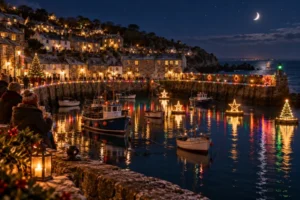
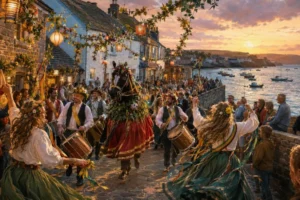
- Golowan and Montol — Penzance’s midsummer and midwinter festivals, where the old customs, masks and processions carry the stories into the streets.
- Storytelling nights and story-walks — pubs, arts centres and heritage sites across Cornwall run tellings through the year, and guided folklore walks take you to the places the tales happened. Listings change; check what’s on where you’re staying.
- The great gardens and open-air venues host storytelling and theatre in summer — see our theatre guide.
Contemporary storytellers
Cornwall has a working community of professional storytellers who perform at festivals, schools and events and keep the repertoire alive — some in Cornish as well as English — and projects mapping the county’s folklore to the places it belongs, so a walk becomes a story-walk. The tradition has also fed Cornwall’s theatre: Kneehigh’s wild, physical retellings of Tristan and Iseult and the old tales took Cornish storytelling to the world.
Looking to book a storyteller?
A surprising number of people find this page while trying to hire a Cornish storyteller for an event — a wedding, a school, a festival — so, to save you an email: we’re a family blog, not a storyteller for hire. But Cornwall has excellent professional tellers; the folk festivals above are where you’ll meet them, arts centres and heritage sites often know who’s performing locally, and searching for “Cornish storyteller” plus your town will turn up the people who do this for a living. Good luck — and ask them for the Mermaid.
Personal insights and experiences
Our storytelling happens by a fire. I’m happiest sitting by a campfire — it’s on my About page, and it’s true — and with six children and now grandchildren, a fire in the garden or on a campsite is where the family’s stories get told and retold: the holidays that went wrong, the pasty my uncle replaced, the gale that flattened the neighbours’ tents. Not Cornish legend, exactly, but that’s how the tradition actually works — a family’s stories, told at a fire, until they’re the stories. The Mermaid of Zennor started that way too.
If you want to feel the tradition rather than read about it, that’s my advice: a fire, a beach or a field, dusk, and someone willing to tell. Cornwall does the rest.
FAQ
Q: What are the most famous Cornish folk tales?
A: Tristan and Iseult, the giants Cormoran and Bolster (and Jack the Giant Killer), the Mermaid of Zennor, the piskies and spriggans of the moors, Jan Tregeagle, and the Arthurian tales rooted at Tintagel.
Q: Where can I hear Cornish storytelling?
A: The Cornwall Folk Festival in Wadebridge, Falmouth’s Sea Shanty Festival, Golowan and Montol in Penzance, and storytelling nights and story-walks at pubs, arts centres and heritage sites through the year.
Q: What are piskies?
A: The small, mischievous folk of Cornish legend who lead travellers astray on the moors — “pisky-led” — until they turn a coat inside out to break the spell.
Q: Can I hire a Cornish storyteller?
A: Not from us — we’re a blog — but Cornwall has professional storytellers who perform at festivals, schools and events; the folk festivals and local arts centres are the place to find them.
References and resources
- Cornwall Folk Festival: www.cornwallfolkfestival.com
- Falmouth International Sea Shanty Festival: www.falmouthseashanty.co.uk
- Golowan Festival, Penzance: www.golowanfestival.org
- Visit Cornwall — myths and legends: www.visitcornwall.com