Quick answer: Tintagel Castle, on a rocky headland on Cornwall’s north coast, is the legendary birthplace of King Arthur — a story first written down by Geoffrey of Monmouth in the 1130s — and a genuinely important early-medieval site whose ruins are managed by English Heritage. Cross the dramatic footbridge to the island, find Merlin’s Cave beneath, and don’t skip the village, which leans gloriously into the legend. Book timed entry ahead in summer, and pair it with Boscastle. Myths, history, and how to visit — with or without the climb — below.
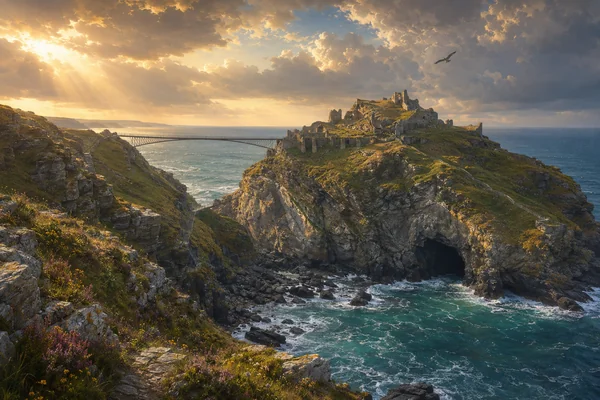
Few places carry a story as heavily as Tintagel. Stand on the mainland cliff and look across the gorge to the island — the ruined walls, the bronze figure on the ridge, the Atlantic working at the black mouth of the cave below — and it is very easy to believe that Arthur was conceived here, that Merlin waited in the cave, that Camelot is somewhere just out of sight. The truth is stranger and, in its way, better: a real seat of Dark Age power, a medieval earl’s romantic folly, and eight centuries of storytelling laid over both. This guide covers the myths, the history behind them, and how to make the most of a visit — including how we did it the year my wife couldn’t manage the climb.
Tintagel is one chapter in a much longer tale. For where it fits in Cornwall’s past, from the Stone Age to the lithium mines, see The Story of Cornwall.
Table of Contents
- The legend of King Arthur
- The real history of Tintagel
- Visiting Tintagel Castle
- Tintagel without the climb
- The village, and Boscastle
- Personal insights and experiences
- FAQ
- References and resources
The legend of King Arthur
The Arthur–Tintagel connection begins with Geoffrey of Monmouth’s History of the Kings of Britain, written around 1136. In his telling, Uther Pendragon, King of Britain, falls for Igraine, wife of Gorlois, Duke of Cornwall. Gorlois hides her at Tintagel — impregnable, joined to the mainland only by a narrow neck of rock — and Merlin, by magic, transforms Uther into Gorlois’s likeness so he can enter the castle and Igraine’s bed. Arthur is conceived that night; Gorlois dies in battle the same evening; Uther marries Igraine. Later writers, from Malory to Tennyson, embroidered from there — Merlin taking the infant from the cave beneath the castle, the sea-washed birth — until Tintagel became, in the popular imagination, Camelot’s cradle if not Camelot itself.
Is any of it true? Almost certainly not as told — Geoffrey was a storyteller, not a historian. But he chose Tintagel for a reason, and archaeology has since shown he was pointing at somewhere real.
The real history of Tintagel
- A Dark Age stronghold. Excavations have found the remains of dozens of buildings on the island from the 5th–7th centuries — a settlement of real importance for post-Roman Britain — along with vast quantities of Mediterranean pottery: wine and oil amphorae from as far as the Aegean and North Africa. Someone powerful lived here, trading tin for luxuries, at exactly the time an Arthur, if he existed, would have.
- The “Arthur stone.” In 1998 a slate inscribed with the name Artognou was found on the island. Not Arthur — but a tantalising 6th-century Cornish name, and proof of literate high-status occupation.
- The medieval castle. The ruins you see were built in the 1230s by Richard, Earl of Cornwall — brother of Henry III — who seems to have built at Tintagel not for its military value (it has little) but for the legend, already famous a century after Geoffrey wrote it. The castle was a statement: this is Arthur’s place, and I am Cornwall’s lord.
- Since then. Ruin, romance, Victorian tourists arriving by rail to see “King Arthur’s Castle,” a grand hotel built to house them, and English Heritage’s care of the site today — including the striking footbridge, opened in 2019, that reconnects the island to the mainland roughly where the original neck of land once was.
Visiting Tintagel Castle
- Book timed entry in advance through English Heritage, especially in school holidays — the site limits numbers, and the queue for the bridge on a summer afternoon is long and slow. Members are free but should still book.
- It’s a walk. From the village it’s a steep path down to the site (a Land Rover shuttle runs for those who need it), then the bridge and steps on the island. Allow two to three hours.
- What to see: the mainland courtyard, the bridge itself (look down), the island’s ruined halls and the Dark Age house footings, the bronze Gallos figure on the ridge — inspired by the legend rather than a statue “of” Arthur — and, at low tide, Merlin’s Cave on the beach below, with a face of Merlin carved into the rock at its mouth.
- Check the tide if the cave matters to you; it floods.
- Weather: fully exposed headland — see our Cornwall weather guide and bring the layers even in July.
Tintagel without the climb
Almost every guide assumes you’ll do the steps and the bridge. Not everyone can — and here’s the thing: you can have a wonderful Tintagel day without them. The village sits on the clifftop with the castle in view; the coast path either side gives superb vantage points of the island and the bridge from level ground; and the Camelot Castle Hotel — the great Victorian pile on the headland — has a terrace and public areas from which the ruins, the bridge and the whole legendary skyline are laid out in front of you. We spent an hour there watching the queue inch across the bridge, and honestly, we had the better view.
The village, and Boscastle
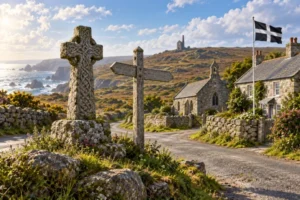
Tintagel village embraces the legend without embarrassment: shops full of Green Man carvings, King Arthur everything, swords, dragons and medieval trappings, and King Arthur’s Great Halls, a 1930s hall built by a devotee with stained-glass windows telling the story. It’s fun, and it’s a good rainy-hour. The 14th-century Old Post Office (National Trust) is the village’s genuine medieval survivor.
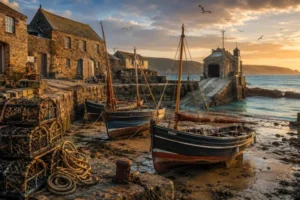
Then go to Boscastle, four miles up the coast, and don’t treat it as an afterthought — we never do. The narrow harbour between its two headlands is one of the loveliest on the north coast, and on a warm day it’s a swimming spot: locals and visitors jump from the harbour walls into the clear water, and it’s a fine place to cast a lure for bass and mackerel off the rocks. The Museum of Witchcraft and Magic sits by the harbour, and the whole village was famously rebuilt after the flood of 2004. Tintagel for the legend, Boscastle for the water — it’s the right day out.
Personal insights and experiences
Our last Tintagel visit didn’t go to plan, and it turned out to be the visit I’d recommend. We were camping up the coast, and my wife had a broken ankle that was healing slowly and hurting a lot — the castle steps were out of the question. So we did the town instead, and enjoyed it far more than I expected: the Green Man and Camelot shops, the medieval theatre of it all. Then we settled in at the Camelot Castle Hotel for an hour or so with the ruins and the bridge laid out in front of us, and watched a very long queue of people shuffle slowly across it in the sun. From up there, with a drink, it looked like the wrong way round.
Then Boscastle, as always: the harbour, the swimmers launching themselves off the wall, a rod in my hand on the rocks. If your legs are good, do the castle — it’s extraordinary. If they aren’t, or the queue is, know that the legend is perfectly visible from the top of the hill, and that the best of the day might be four miles up the road anyway.
FAQ
Q: Is Tintagel really King Arthur’s castle?
A: The legend was written down by Geoffrey of Monmouth around 1136, naming Tintagel as Arthur’s conception place; the visible ruins are a 13th-century castle built on the strength of that story. But archaeology shows a genuinely important Dark Age stronghold here — real power at the right time.
Q: Is Tintagel Camelot?
A: No — in the legends Tintagel is where Arthur was conceived and born, not where he ruled. Camelot has no agreed location; the village happily borrows the name anyway.
Q: Do I need to book Tintagel Castle in advance?
A: Strongly advised — English Heritage uses timed entry and summer slots sell out; members should book too.
Q: Can I visit Tintagel if I can’t manage steps?
A: The castle itself involves steep paths and steps, but the village, the coast path viewpoints and the Camelot Castle Hotel all give excellent views of the ruins and bridge from level ground.
Q: Who was Gorlois?
A: Duke of Cornwall in Geoffrey of Monmouth’s tale, husband of Igraine, and lord of Tintagel — the man Uther Pendragon was magically disguised as on the night Arthur was conceived.
References and resources
- English Heritage — Tintagel Castle: www.english-heritage.org.uk
- National Trust — Tintagel Old Post Office and Boscastle: www.nationaltrust.org.uk
- Museum of Witchcraft and Magic, Boscastle: museumofwitchcraftandmagic.co.uk