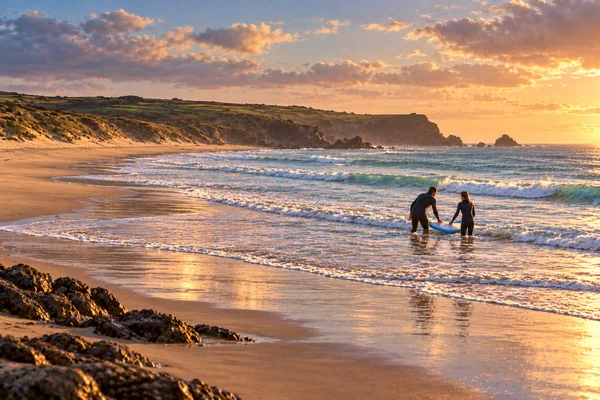
Quick answer: surf therapy is a real thing, and it started here. The Wave Project ran its first course at Watergate Bay near Newquay in September 2010 — twenty young people, six weeks, paid for by the NHS in Cornwall — and has since grown into a community interest company operating in London, North Yorkshire, Scotland, Wales and Northern Ireland, with its head office still in Newquay. It takes referrals from the NHS, GPs, mental health services and schools. The evidence is encouraging and largely charity-produced, which is worth knowing. And you do not need a referral to get some of the benefit — a beginner lesson in October does more than people expect.
Cornwall exports surfing culture, and it also exported something less obvious: the idea that putting a struggling young person on a surfboard, with the same volunteer, every week for six weeks, is a treatment worth funding. That idea began on a Cornish beach and is now running across the UK. This covers what surf therapy is, what the evidence actually says, and how an ordinary visitor gets the wellbeing part without any of the clinical framing. Our wild swimming guide covers the cold-water side of the same question.
Table of Contents
- What surf therapy actually is
- It started at Watergate Bay
- What the evidence says, honestly
- Why cold water keeps coming up
- Getting the benefit as a visitor
- If you want to support it
- FAQ
- References and resources
What surf therapy actually is
Not a surf lesson with nice words attached. The format is specific and the specifics are the point.
- A course, not a session. The standard shape is six weekly sessions, so the thing being built is a routine and a relationship, not a single good afternoon.
- One-to-one volunteer support. Each participant is paired with a trained volunteer who is in the water with them, which is what separates it from a group lesson.
- Referral-led. People arrive through the NHS, social services, mental health services, GPs, family support services, counsellors and children’s charities rather than by booking.
- Aimed at young people. The usual range is 8 to 18, and in West Cornwall the charity funds places for 18 to 24-year-olds as well.
- Surfing is the vehicle, not the goal. Nobody is being coached towards competence for its own sake.
The underlying argument is that cold water, hard physical effort, an environment demanding full attention and a reliable adult alongside you add up to something more than their parts — and that it reaches young people who will not sit in a room and talk.
It started at Watergate Bay
September 2010. Twenty young people, a six-week course at Watergate Bay near Newquay, and — the detail that matters — the NHS in Cornwall paid for it. It was a pilot, and it was commissioned, not improvised.
The Wave Project has since become a community interest company with operations in London, North Yorkshire, Scotland, Wales and Northern Ireland, while keeping its head office in Newquay. Our Newquay guide covers the town, which is better known for the other kind of surfing.
It also runs one of the more quietly clever fundraising ideas in Cornish charity: a pre-loved wetsuit scheme, taking in outgrown and unwanted wetsuits and reselling them, which raised a record £98,000 across its first two years. In a county that gets through a great many wetsuits, that is the right idea in the right place.
What the evidence says, honestly
This is where a wellbeing article usually overclaims, so here is the careful version.
The findings are positive. A 2026 evaluation compared the 2025 season’s data from 302 young people surfing at 22 UK beaches with 58 at two inland wave pools. Every outcome measured improved significantly in both settings. Wellbeing gains were larger at the beach; on the other four measures there was no significant difference between sea and pool.
And here are the limits. That evaluation is charity-led rather than independent peer-reviewed research. Earlier work, funded through the National Lottery, used pre- and post-course self-assessment with no comparison group — which means it can show that participants improved, but not that the surfing is what caused it.
Why we are saying so. Surf therapy does not need to be oversold. “Promising, measured, and studied mostly by the people running it” is an honest description and still a good one — and the beach-versus-pool comparison is a genuinely interesting result, because it suggests the sea itself contributes something a wave pool does not.
Why cold water keeps coming up
Surf therapy sits inside a wider Cornish pattern — sea swimming, sea saunas, winter dipping — and the common ingredient is cold water and an environment you cannot be distracted in.
- Attention. You cannot ruminate while catching a wave or entering cold water. For anyone whose difficulty is an overactive head, that enforced interruption is the mechanism people describe most often. Our wild swimming guide goes into this properly.
- Routine and company. Both surf therapy and the sea-swimming groups that have spread along this coast work partly because they are a standing appointment with other people.
- Effort. Paddling is hard work, and the effect of hard physical work on mood is the least controversial part of any of this. Our walking for wellness guide makes the same case on land.
- The warm-up afterwards is not incidental — the rise of the wood-fired sea sauna has given cold-water groups somewhere to sit afterwards, which is where the social part happens. See our sea saunas guide.
The safety caveat is not optional. Cold water shock is a genuine danger, Cornish beaches have rips, and there are no lifeguards on any beach through the winter. Enter gradually, go with somebody, and pick a lifeguarded beach in season.
Getting the benefit as a visitor
You cannot book surf therapy — it is referral-led and aimed at young people who need it. But the ordinary version is available to anyone and is underrated.
- Take a beginner lesson out of season. A two-hour lesson in October, in a thick wetsuit, on an empty beach, is a completely different experience from August. Our off-season guide covers what is still running.
- Pick a forgiving beach. The long, gently shelving north-coast beaches are where the surf schools are, for good reason. Our family beaches guide covers which beaches suit which group.
- Do not buy anything first. Schools provide the board and the suit, and the suit they give you will be thicker and better than the one you would have bought.
- Stay somewhere that expects wet kit. Our surf accommodation guide covers places with a drying room and an outside tap, which matters more in November than any other feature.
- If the surf is too big, walk instead. Our coast path guide covers a stretch that works in almost any weather, and the storm watching guide covers the days when the sea is the show rather than the venue.
And manage the expectation. You will mostly not stand up, you will be cold, and you will be tired in a way that is unusually good. Our weather guide covers what to wear for the rest of the day.
If you want to support it
Two things that cost nothing much and are specific to this county.
- The pre-loved wetsuit scheme takes outgrown and unwanted wetsuits. If you have one in a garage, it is worth more to them than to you.
- Volunteering is the model’s bottleneck — the one-to-one pairing is what makes it work, and that is people giving up weekly sessions.
If you want the spa-and-treatment version of Cornish wellbeing instead, our spa breaks guide covers it. This is the other end of the same county.
FAQ
Q: What is surf therapy?
A: A structured course, typically six weekly sessions, pairing a participant with a trained volunteer in the water. It is referral-led rather than booked, usually aimed at young people aged 8 to 18, and uses surfing as the vehicle rather than aiming at surfing competence.
Q: Where did surf therapy start?
A: At Watergate Bay near Newquay in September 2010, when The Wave Project ran a six-week course for twenty young people funded by the NHS in Cornwall. The organisation is now a community interest company operating across the UK, with its head office still in Newquay.
Q: Does surf therapy actually work?
A: The findings are positive but the research is mostly charity-produced. A 2026 evaluation of 302 young people at 22 UK beaches and 58 at two inland wave pools found significant improvement on every measure in both settings, with larger wellbeing gains at the beach. Earlier National Lottery-funded work used self-assessment with no comparison group, so it cannot show cause.
Q: How do you access surf therapy in Cornwall?
A: By referral, not booking. Referrers include the NHS, GPs, social services, mental health services, family support services, counsellors and children’s charities. The usual age range is 8 to 18, and in West Cornwall places are also funded for 18 to 24-year-olds.
Q: Can an adult visitor try surfing for wellbeing?
A: Yes, through an ordinary beginner lesson, and out of season is better than summer. Schools provide the board and a thick wetsuit, the beaches are empty and the experience is quite different from a busy August lesson. It is not therapy, but the attention, effort and cold water are the same ingredients.
Q: Is cold water swimming safe in Cornwall?
A: With care. Cold water shock is a real danger, Cornish beaches have rip currents, and there are no lifeguards on any beach through the winter. Enter gradually, never go alone, and in season choose a lifeguarded beach between the flags.
Q: What is the pre-loved wetsuit scheme?
A: A Wave Project fundraising scheme that takes in outgrown and unwanted wetsuits and resells them. It raised a record £98,000 over its first two years, which in a county that gets through a lot of wetsuits is a well-matched idea.
References and resources
- The Wave Project: www.waveproject.co.uk
- NHS — mental health support for children and young people: www.nhs.uk
- RNLI — beach safety: rnli.org
- Outdoor Swimming Society — cold water: www.outdoorswimmingsociety.com