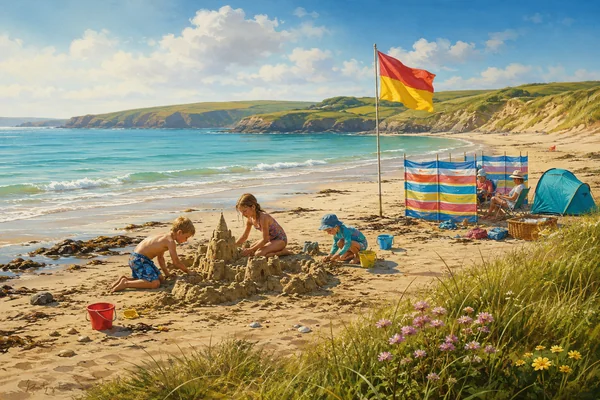
Quick answer: Cornwall’s most family-friendly beaches combine gently shelving sand, seasonal RNLI lifeguards, and easy access to parking, toilets and food. Porthminster, Gyllyngvase, Par Sands, Summerleaze and Polzeath are hard to beat — the details, and what to pack, are below.
Cornwall has hundreds of beaches, but anyone who has carried a windbreak, three bags and a tired child across soft sand knows that not all of them are built for family days out. After years of beach days with six children — in every season and every kind of weather — we’ve learned exactly what separates a stress-free family beach from a beautiful-but-impractical one. This guide covers our tried and tested favourites, what makes each one work for families, and the safety essentials every parent should know.
Table of Contents
- What makes a beach family-friendly
- The beaches
- Safety essentials
- Personal insights and experiences
- FAQ
- References and resources
What makes a beach family-friendly
Our checklist, refined over many years: gently shelving sand so little ones can paddle safely; seasonal lifeguard cover; parking that doesn’t involve a cliff descent with a cool box; toilets; somewhere to buy an emergency ice cream; and enough space that you’re not defending your windbreak territory by mid-morning. A sheltered aspect helps too — Cornwall’s weather can change quickly, and a beach that works in a stiff breeze is worth two that don’t.
The beaches
Porthminster Beach, St Ives
Sheltered, south-facing and blessed with calm, shallow water, Porthminster is about as safe as Cornish swimming gets for small children. The soft white sand is perfect for sandcastle engineering projects, the beach café is genuinely good, and the train into St Ives along the coast is an adventure in itself.
Gyllyngvase Beach, Falmouth
Falmouth’s main town beach is flat, sandy and easy: level access, seasonal lifeguards, rock pools at low tide, and a popular café right on the sand. Being on the sheltered south coast, it’s often calm when the north coast is churning — a reliable plan B on blustery days.
Par Sands, Par
Our family’s old faithful — and mine before that. I holidayed at Par with my own family as a child, and it remains the beach I have visited more than any other in Cornwall: the same sands, a generation on. It offers a huge, flat expanse of sand with shallow water that stays paddling-depth a long way out, dunes for shelter, a lake behind the beach with ducks to feed, and parking close enough that the windbreak convoy is mercifully short. It rarely feels crowded even in August.
Summerleaze Beach, Bude
Summerleaze’s trump card is the famous Bude Sea Pool — a part-natural, part-built tidal pool beneath the cliffs where children can swim safely whatever the Atlantic is doing beyond the wall. Add big sands at low tide, beach huts, and a town a two-minute walk away, and it’s a full family day out.
Polzeath Beach
For families with older kids ready to try surfing, Polzeath is the classic nursery: a wide, flat beach with slow, forgiving waves, several surf schools offering children’s lessons, and enough space for the non-surfing half of the family to spectate in comfort.
Gwithian Towans, near Hayle
Three miles of golden sand backed by grassy dunes, with some of Cornwall’s best rock pooling at low tide around Godrevy. It’s wilder than the town beaches — pick a calm day and check the tide times — but for space, nature and that end-of-the-world feeling, nowhere beats it. Dogs are welcome year-round on much of this stretch, making it a favourite for families holidaying with their dog.
Safety essentials
- Swim between the red and yellow flags — that’s the lifeguarded zone. RNLI lifeguards patrol Cornwall’s busiest beaches in season; check the RNLI website for current cover before you go.
- Learn the flags: red and yellow means lifeguarded swimming area; black and white chequered means watercraft only; a plain red flag means do not enter the water.
- Check tide times. Some beaches shrink to nothing at high tide, and incoming tides can cut off coves. A free tide-times app is the most useful thing on a parent’s phone.
- Sun protection beats sun cure. The sea breeze hides how quickly children burn — hats, high-factor cream, and a windbreak or beach tent for shade.
- Agree a meeting point the moment you arrive. Big Cornish beaches are wonderful and enormous in equal measure.
Personal insights and experiences
With six children, our beach days were never minimalist affairs. Over the years we evolved a standard kit: two windbreaks (one as a wind shield, one as a privacy wall for wetsuit changes), a beach towel that has never once dried anyone but works perfectly as a roof, and a strict one-bag-per-child carrying rule that has been broken on every single visit.
Par Sands earned its place as our old faithful precisely because it forgives the chaos: the walk from the car is short, the water stays shallow enough for mixed-age paddling, and when heavy showers interrupted one glorious day, our reconfigured windbreak-and-towel shelter kept the sandcastle production line running while other families retreated to their cars. Passing walkers looked genuinely envious of our engineering. The kids still talk about it.
FAQ
Q: Which Cornish beach is safest for toddlers?
A: Porthminster in St Ives is our pick: sheltered, gently shelving and calm, with facilities close by. Par Sands is an excellent quieter alternative with very shallow water.
Q: When do lifeguards patrol Cornwall’s beaches?
A: RNLI lifeguards cover the main beaches during the season, typically from Easter or May through to September, with the busiest beaches patrolled daily in summer. Always check the RNLI website for current cover.
Q: Can I take my dog to these beaches?
A: Rules vary: many popular beaches restrict dogs in the daytime during summer months, while stretches like Gwithian are more relaxed. Check the beach’s current rules before you travel.
Q: What should we pack for a Cornish beach day?
A: Windbreak, layers and waterproofs (whatever the forecast says), high-factor sun cream, water, and swim shoes for rockier coves. Cornwall rewards the over-prepared.
References and resources
- RNLI beach safety and lifeguarded beaches: rnli.org/safety/beach-safety
- Visit Cornwall — beaches: www.visitcornwall.com
- Bude Sea Pool: www.budeseapool.org
- Tide times: www.tidetimes.org.uk