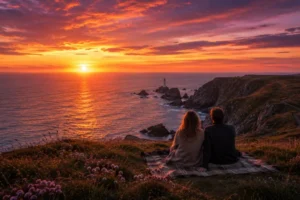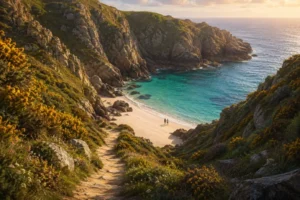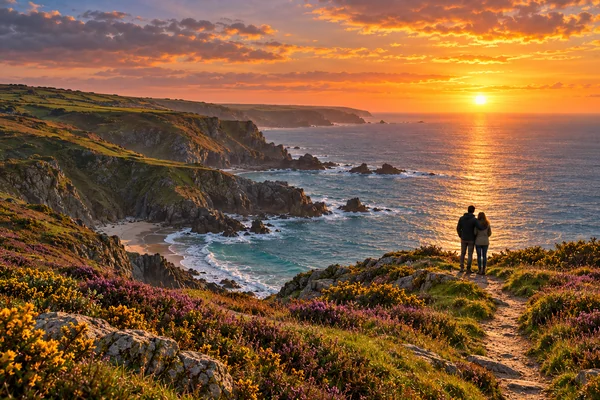
Quick answer: Cornwall is close to ideal for this, and the thing that goes wrong is never the location — it is the logistics. The Minack takes timed booking slots only, with tickets released about two months ahead, so you cannot simply turn up. Private drones are never permitted over it. Beaches cut off on a rising tide. Clifftop car parks fill by mid-morning in summer and close at dusk. The best advice is to go out of season, go early in the day or at sunset, pick somewhere you can reach on foot, and have a second location in your pocket for the weather.
If you are going to ask someone to marry you, Cornwall gives you more good options than almost anywhere in Britain: clifftops, coves you have to walk to, subtropical gardens, a theatre cut into a headland. What it also gives you is wind, tides, one-lane villages and a car park that shuts. This is the practical version — where works, when to do it, and the specific things that ruin plans. Our sunset spots guide and secluded spots guide cover the locations in more depth, and our couples guide covers where to base yourselves.
Table of Contents
- Get the logistics right and the location looks after itself
- The Minack: read this before you plan it
- Where actually works
- When to do it
- The small things that matter
- FAQ
- References and resources
Get the logistics right and the location looks after itself
Almost every proposal that goes wrong in Cornwall goes wrong for one of five reasons, and all five are avoidable.
- The tide. Cornish beaches cut off. A cove that is a wide empty beach at low water is a cliff and some rocks three hours later, and people are rescued from this every year. Check the tide table for the specific beach and the specific day, and plan around a falling tide, not a rising one.
- Parking. In summer, coastal car parks fill by mid-morning and many lock at dusk, which is a problem if your plan is sunset. Our parking guide covers the system, including which car parks close and why St Erth and the park-and-rides exist.
- The weather, and the wind in particular. A clifftop in a gale is not romantic, it is loud, and nobody can hear anything. Our weather guide covers what to expect month by month.
- Opening times. Gardens close, castles close, and several of the best places are seasonal. Our off-season guide covers exactly what is open between November and March.
- Other people. The famous spots are famous. If privacy matters, that is a reason to walk twenty minutes or go in February, not to pick somewhere worse.
The Minack: read this before you plan it
It is the most-asked-about location in Cornwall for this, and it has the most rules.
- Admission is by timed booking slot only. You cannot turn up. Advance booking is described as essential in holiday periods and strongly advised at all other times.
- Visit tickets are released roughly two months in advance. Plan backwards from that.
- Private drones are never permitted from or over the Minack, at any time. Commercial drone use requires a media contract with the theatre. If drone footage is part of your plan, it is not happening here.
- A performance is a different proposition from a visit. During a show you are one of several hundred people in a tight auditorium, which suits some plans and ruins others.
If it matters to you, phone the box office and say what you are planning. Nothing in the theatre’s published information covers proposals specifically, so ask rather than assume — they will know whether your slot is a good one. Our Cornish theatre guide covers the Minack and Cornwall’s other open-air venues.
Where actually works
Grouped by what you want the moment to be.
Big and dramatic
- The far west clifftops — Gwennap Head, Porthgwarra, Land’s End’s quieter neighbours. Huge, exposed, and at their best in low winter light.
- Tintagel, for the castle, the bridge and the Atlantic beneath it. It is steep, step-heavy and ticketed, so read our Tintagel guide first.
- Kynance Cove on the Lizard, which is as good as Cornish scenery gets — and is tidal, and has a car park that fills early.
Quiet and private
- A cove you have to walk to. Twenty minutes on the coast path removes most people. Our secluded spots guide is the method for finding one, and the coast path guide covers a stretch with several.
- The Helford — creekside woodland, water, and almost nobody. The greenest and softest option, and reachable by the seasonal ferry: see our ferries guide.
- The Roseland, where the lanes go nowhere in particular and that is the attraction.
Sheltered, in case of weather
- A subtropical garden. Trebah or Heligan in spring gives you tree ferns, magnolias and shelter, which is a serious advantage in March. Our great gardens guide covers which are open when.
- A harbour at dusk — Fowey, St Mawes, Mousehole — where you are out of the wind and there is somewhere warm thirty seconds away.
- A pub with a fire, which is an underrated answer and the only one that works in any weather at all. Our cosy pubs guide has the ones worth the drive.
After dark
Bodmin Moor has genuinely dark skies, and a clear winter night there is extraordinary. It is also cold, unlit and easy to get lost on. Our stargazing guide covers doing it properly.
When to do it
Out of season, and at either end of the day. That is the whole answer, and it solves privacy, parking and cost at once.
| When | What you get | Watch out for |
|---|---|---|
| October to March | Empty beaches, dramatic light, cheap stays, no crowds | Some gardens and attractions closed; short days |
| April to May | Gardens at their peak, long light, still quiet | Easter and half-term spikes |
| June to August | Warm sea, everything open | Crowds everywhere, car parks full by mid-morning |
| September | Warmest sea of the year, quieter than August | Still busy in the first half |
Sunrise is the underrated option. Even in August, a famous Cornish beach at six in the morning is empty, and the light on the north coast is better then than at any other time. Sunset is the obvious choice and our sunset spots guide covers where to be — but it is also when everyone else turns up, and when car parks lock.
For a winter trip built around this, our romantic winter breaks guide covers where to stay when the county is at its emptiest and cheapest.
The small things that matter
- Have a plan B, and make it specific. Not “somewhere else” — an actual named indoor or sheltered alternative within fifteen minutes.
- Do not carry the ring loose in a coat pocket on a clifftop. This is said as a joke and it is not one. Wind, pockets and granite are a bad combination.
- Think about the walk back. The moment is the easy part; forty minutes of returning up a cliff path in the dark is worth having a torch for.
- Book dinner before, not after. Good Cornish restaurants book out, many close midweek in winter, and a village may have exactly one option. Decide this before you decide the clifftop.
- Check whether the site is ticketed and timed, as the Minack is, and whether the car park closes at dusk.
- If you want photographs, either ask a stranger, use a small tripod, or book a photographer — but check the venue’s rules first, and remember drones are banned outright in some places and need permission in most others.
FAQ
Q: Where is the best place to propose in Cornwall?
A: It depends what you want the moment to be. For drama, the far west clifftops, Tintagel or Kynance Cove. For privacy, a cove twenty minutes’ walk along the coast path, or the Helford. For shelter and a weather fallback, a subtropical garden, a harbour at dusk or a pub with a fire.
Q: Can you propose at the Minack Theatre?
A: Nothing in the theatre’s published information prohibits it, but admission is by timed booking slot only and tickets are released roughly two months in advance, so it has to be planned. Phone the box office and tell them what you are planning rather than assuming.
Q: Can you fly a drone at the Minack Theatre?
A: No. Private individuals may not fly drones from or over the Minack at any time, and commercial drone use requires a media contract with the theatre. If drone footage is part of the plan, choose somewhere else.
Q: When is the best time of year to propose in Cornwall?
A: October to March for empty beaches, dramatic light and cheap accommodation, or April to May for the gardens at their peak with long light and few people. Summer is the hardest, with crowds everywhere and coastal car parks full by mid-morning.
Q: What goes wrong with Cornish proposals?
A: Tides cutting off a cove, car parks that fill by mid-morning or lock at dusk, wind loud enough that nobody can hear, seasonal closures at gardens and castles, and crowds at the famous spots. All five are avoidable with planning.
Q: Is sunrise or sunset better?
A: Sunrise is the underrated choice. Even in August a famous beach is empty at six in the morning, and the north coast light is at its best. Sunset is lovely but it is also when everyone else arrives and when many coastal car parks lock their gates.
Q: Do you need permission to propose at a National Trust site?
A: Nothing published suggests a simple proposal needs permission, but organised shoots, drones and anything involving equipment generally do, and sites have opening hours and parking charges that affect the plan. Contact the property if your plan involves more than the two of you.
References and resources
- The Minack Theatre — plan your visit: www.minack.com
- The Minack Theatre — FAQs: minack.com
- National Trust — Cornwall: www.nationaltrust.org.uk
- UK tide times: www.tidetimes.org.uk
- South West Coast Path: www.southwestcoastpath.org.uk