Quick answer: Cornwall has the best gardens in Britain, and the season is upside down. The main event is February to May, not summer, because the Gulf Stream lets magnolias, camellias and rhododendrons flower here months before the rest of the country. Heligan and Trebah are the two to see first and both open all year. Caerhays holds a National Magnolia Collection but opens for spring only, roughly February to mid-June. Glendurgan, Trengwainton and several others close for the winter. And on a windy day any of them may shut at no notice — these are wooded valleys full of very large old trees.
Cornwall grows things that should not survive in Britain. Tree ferns, giant rhubarb, palms, South African proteas and Himalayan rhododendrons all grow outdoors here, in sheltered valleys running down to the sea, in gardens laid out by families who spent Victorian fortunes on plant-hunting expeditions. There is nothing else like it in the country, and most visitors see one garden and assume they have seen the idea. This is the proper map: which gardens, which group they belong to, what each is actually for, and — the thing almost nobody gets right — when to come. Our Eden Project guide covers the modern outlier separately.
Table of Contents
- Why the plants are different here
- The three groups, and why it matters
- The two to see first
- The rest, and what each is for
- The season is upside down
- What closes, and the thing nobody warns you about
- Practical notes
- FAQ
- References and resources
Why the plants are different here
The short version is the Gulf Stream. The warm Atlantic current keeps the far south-west frost-free in most winters, and the Great Gardens of Cornwall group puts it plainly: their gardens enjoy that warmth, and it is why they hold some of the rarest plants in the British Isles.
Three things combine, and all three are needed:
- A mild, frost-scarce winter, which lets tender subtropical planting survive outdoors rather than under glass.
- Deep sheltered valleys running down to the water. Cornwall is windy and salt-laden, and nothing exotic survives in the open — but a wooded ravine out of the wind is a different climate entirely. Almost every great Cornish garden is in a valley for this reason.
- Acid soil and high rainfall, which happen to be exactly what camellias, magnolias and rhododendrons want. The same conditions produce our temperate rainforest piece, and the tea grown at Tregothnan.
The history is Victorian and imperial: Cornish families with mining and shipping money funded plant-hunting expeditions to China, the Himalayas and South America, and planted what came back. Many of those original specimens are still standing. Our The Story of Cornwall covers where that money came from.
The three groups, and why it matters
Cornwall’s gardens are not one organisation, and knowing which group a garden belongs to tells you what your ticket, your membership and your dog can do.
| Group | What it is | Examples |
|---|---|---|
| The Great Gardens of Cornwall | A group of 14 independent gardens — private owners and garden businesses. Each is ticketed separately | Heligan, Trebah, Caerhays, Trewithen, Tregrehan, Trewidden, Tresco Abbey, Tremenheere, Bonython, Lamorran, Antony, Tregothnan, the Minack garden, Eden |
| National Trust | Free to members, paid for everyone else. Several close for the winter | Glendurgan, Trelissick, Trengwainton, Lanhydrock, Cotehele |
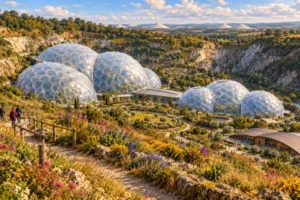
| The Eden Project | In the Great Gardens group, but a different proposition entirely — a built landscape in a clay pit | Eden |
The practical consequence: a National Trust membership gets you into five of these for nothing and none of the others. If you are planning several garden days, work out which group you are visiting before buying anything.
Note that the Minack Theatre counts as a garden here, which surprises people — its cliff planting is a serious piece of coastal horticulture, not decoration. And Eden, despite being in the group, belongs in a different mental category: it is engineered rather than grown, which is why we treat it separately in our Eden Project guide.
The two to see first
The Lost Gardens of Heligan, near Mevagissey
The most famous garden in Cornwall, and the story is genuinely as good as the gardening. The Tremayne family’s gardens declined after the First World War — the gardeners who had maintained them largely did not come back — and the site was left to the brambles for seventy years.
In 1990 Tim Smit, then a record producer, was introduced to the overgrown estate by John Willis, a member of the family. What they found underneath became one of the great restoration projects in British horticulture, reopening to the public in the early 1990s. Smit went on to build the Eden Project a few miles away.
- Around 200 acres, which is a great deal more than people expect, split between the Victorian productive gardens, the pleasure grounds, the Jungle and a wider estate.
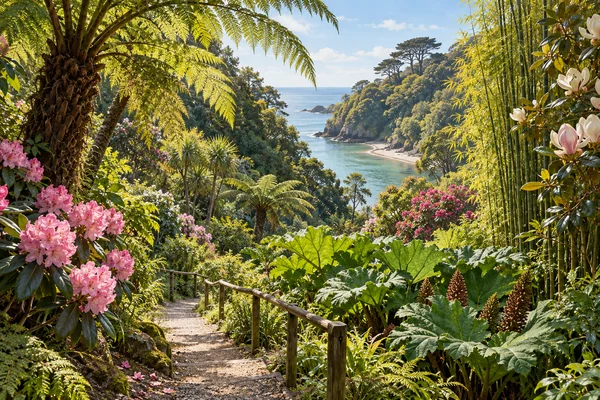
- The Jungle is the subtropical valley with the rope bridge — tree ferns, bamboo and giant rhubarb in a steep ravine.
- The productive gardens are the restoration’s real achievement: walled kitchen gardens, pineapple pits and melon frames, worked as they were in the 1890s.
- Open all year round, which makes it a genuine winter option.
- Dogs are welcome all year on a lead at all times — firmly, because Heligan keeps rare livestock and poultry. Dogs on leads are allowed inside the Heligan Kitchen and The Steward’s House. Note there is no shaded parking, and the garden advises against leaving a dog in a vehicle.
Heligan also runs a proper seasonal programme — see our Halloween guide and Christmas guide guides for the events end of it. Our permaculture guide and growing space guide come at the productive side from the practical direction.
Trebah Garden, Mawnan Smith
The other essential, and the better one for a single visit if you only have an afternoon. Trebah is a subtropical ravine garden running down a steep valley to its own beach on the Helford River — which means you walk down through tree ferns and hydrangeas and come out on sand.
The history at the bottom of the garden is worth knowing before you go. In 1944 the garden was requisitioned by the US Army, used as an ammunition store, and the beach at its foot — Polgwidden Cove — was the embarkation point for around 7,500 men of the 29th US Infantry Division, who left on 1 June 1944 for the assault on Omaha Beach. There is a memorial slab at the beach. It is a strange and quiet thing to stand on, with a garden full of flowers behind you.
Trebah is open every day of the year, weather permitting, and it is the most thoroughly dog-friendly garden in Cornwall: dogs throughout the garden and on the beach all year on a short lead, water bowls around the site, free compostable bags, designated dog-friendly café tables inside and out, and dog ice cream at the beach café. Our dog-friendly Cornwall guide covers the wider picture.
The rest, and what each is for
Having done those two, these are the ones worth planning a day around.
- Caerhays Castle, near Gorran — the plantsman’s garden, and the reason serious gardeners come to Cornwall in March. It holds a National Magnolia Collection, and the magnolias here are the main event of the Cornish spring. Spring only: the 2026 season ran from the end of winter to 14 June, with the castle and gardens opening in late February and early March. The 2027 dates had not been published when this was written, so check before travelling.
- Glendurgan, Mawnan Smith — National Trust, immediately next door to Trebah, and a different character: a wooded valley running down to the Helford at Durgan village, with a famous laurel maze. Dogs on short fixed leads in the garden, but assistance dogs only in the maze, the orchard and the Schoolroom. Steep slopes, steps and cobbles, with a step-free purple route and a Tramper available to book.
- Trelissick, Feock — National Trust, on the headland above the King Harry Ferry, and the easiest of the big gardens: year-round, with parkland and river views as much as planting.
- Trengwainton, near Penzance — National Trust, walled gardens built to the dimensions of Noah’s Ark, growing things that survive nowhere else in mainland Britain. Closed for the winter.
- Trewithen, Probus — a serious plantsman’s garden, strongest in spring.
- Tremenheere Sculpture Gardens, near Penzance — the modern one: subtropical planting with major contemporary sculpture and installations through it.
- Tresco Abbey Garden, Isles of Scilly — the extreme version. Frost-free enough that a great many species flower in midwinter, in the ruins of a Benedictine abbey. It requires a trip to Scilly, and it is worth one.
Lanhydrock and Cotehele are the other year-round National Trust properties with significant gardens, and both pair a garden with a house, which makes them better wet-day options. Our off-season guide has the winter picture in full.
The season is upside down
This is the single most useful thing in this article, and almost every general travel guide gets it wrong by lumping gardens in with summer holidays.
Cornwall’s gardens peak in late winter and spring. Camellias start in January, magnolias run through February and March, and the rhododendrons and bluebells follow into April and May. By August the great valley gardens are green and quiet — pleasant, but the show is over.
| When | What is happening |
|---|---|
| January | Camellias starting; the earliest magnolias can flower before the month is out |
| February | Magnolias beginning in earnest; Caerhays opens for its season |
| March | The peak for magnolias. The best single month for a Cornish garden trip |
| April | Rhododendrons, azaleas and bluebells; everything open |
| May | Late rhododendrons, the Jungle at Heligan filling out |
| June to September | Hydrangeas and subtropical foliage; quieter horticulturally, busier with people |
| October to December | Autumn colour, then structure. Several gardens closed |
Our January guide, February guide and March guide guides cover the weather in those months, and our April guide guide covers the bluebell end of it. The short version: March is the month, and almost nobody plans a Cornish holiday for March.
What closes, and the thing nobody warns you about
Two separate problems, and the second is the one that ruins days.
Winter closures
Open all year: Heligan, Trebah, Trelissick, Lanhydrock, Cotehele and Eden. Closed through the winter: Caerhays, Trengwainton and Glendurgan, among others. Our off-season guide keeps the current list.
Wind
These gardens close at short notice in high winds, and it happens more often than anyone tells you. They are steep wooded valleys planted with very large, very old, often shallow-rooted trees, and a falling branch in a ravine is a serious matter.
On the day this guide was written — an ordinary blustery October Friday, not a named storm — Glendurgan announced it was closing entirely for Friday and Saturday on the forecast alone: garden, car park, tea house and bookshop. On the same afternoon, four of the five Fal River ferries a few miles away were cancelled for the same wind.
The lesson is simply to check the garden’s own page on the morning you go, not the week before. Our weather guide covers how often Cornwall produces that kind of day, which is more often than the brochures suggest.
Practical notes
- Work out the group before you buy anything. National Trust membership covers Glendurgan, Trelissick, Trengwainton, Lanhydrock and Cotehele and none of the independents.
- Two gardens in a day is realistic; three is not. Trebah and Glendurgan are the exception — they are next door to each other at Mawnan Smith, and doing both in a day is the obvious move.
- Expect steep ground. Valley gardens are valleys. Most publish detailed access guides, offer step-free routes and some have Trampers to book in advance — call ahead rather than hoping.
- Dog rules vary sharply, from Trebah’s dog ice cream to assistance dogs only in Glendurgan’s maze. Check the specific garden, not the county.
- The tea rooms are part of the point, and several are genuinely good. Our cream tea guide covers the standard to hold them to.
- Pair a garden with a walk. Many sit on or near the coast path or in woodland — our woodland walks guide covers the inland version.
Our where to stay guide covers basing yourself: the Falmouth and Helford area puts Trebah, Glendurgan and Trelissick within half an hour, and the St Austell area covers Heligan, Caerhays, Trewithen and Eden.
FAQ
Q: What are the best gardens in Cornwall?
A: The Lost Gardens of Heligan near Mevagissey and Trebah at Mawnan Smith are the two to see first, and both open all year. After those, Caerhays for magnolias in spring, Glendurgan for its maze, Trelissick for the easiest visit and Tresco Abbey Garden on the Isles of Scilly for the most extraordinary planting.
Q: When is the best time to visit Cornwall’s gardens?
A: Late winter and spring, not summer. Camellias start in January, magnolias peak in March and rhododendrons and bluebells follow in April and May. March is the single best month, and almost nobody plans a Cornish trip for it.
Q: Why do subtropical plants grow in Cornwall?
A: The Gulf Stream keeps the far south-west largely frost-free, and the great gardens sit in deep sheltered valleys that block the salt wind. Add acid soil and high rainfall and you have the conditions camellias, magnolias and rhododendrons want. Most of the original planting was funded by Victorian families sponsoring plant-hunting expeditions.
Q: Does National Trust membership cover Cornwall’s gardens?
A: Only some of them. It covers Glendurgan, Trelissick, Trengwainton, Lanhydrock and Cotehele. Heligan, Trebah, Caerhays, Trewithen, Tresco Abbey and the other members of the Great Gardens of Cornwall are independent and ticketed separately.
Q: Which Cornish gardens are open in winter?
A: Heligan, Trebah, Trelissick, Lanhydrock, Cotehele and the Eden Project run through the winter. Caerhays, Trengwainton and Glendurgan close until spring. Caerhays opens for a spring season only, roughly from late February to mid-June.
Q: Can you take dogs to Cornwall’s gardens?
A: Often, but the rules differ. Trebah is the most welcoming, with dogs throughout the garden and on its beach all year on a short lead, plus bowls, free bags and dog-friendly cafe tables. Heligan allows dogs all year on a lead at all times because of its rare livestock. Glendurgan allows dogs on short fixed leads in the garden but assistance dogs only in the maze, orchard and Schoolroom.
Q: Why was the Lost Gardens of Heligan lost?
A: The Tremayne family’s gardens declined after the First World War, and the site was left overgrown for around seventy years. In 1990 Tim Smit was introduced to it by John Willis, a member of the family, and the restoration that followed reopened the gardens to the public in the early 1990s. Smit later founded the Eden Project.
Q: Do Cornish gardens close in bad weather?
A: Yes, and at short notice. They are steep wooded valleys full of large old trees, so high winds close them for safety. On one ordinary windy October Friday, Glendurgan closed its garden, car park, tea house and bookshop entirely on the forecast alone. Check the garden’s own page on the morning you travel.
References and resources
- The Great Gardens of Cornwall: www.greatgardensofcornwall.co.uk
- The Lost Gardens of Heligan: www.heligan.com
- Trebah Garden: www.trebahgarden.co.uk
- National Trust — Glendurgan Garden: www.nationaltrust.org.uk
- Caerhays Estate — visit: visit.caerhays.co.uk