Quick answer: March is the first month of the year that is warmer, drier and sunnier than the one before it, all three at once. Daytime averages pass 10°C, sunshine roughly doubles January’s at about four hours a day, frost all but disappears, and daylight grows by nearly two hours across the month. The great gardens hit peak magnolia and camellia, the daffodils peak on the mainland, and the seabirds come back to the cliffs. The catch in 2027: Easter is early. Good Friday falls on 26 March and the clocks go forward on Easter Sunday the 28th, so the quiet season ends on the 25th.
March is when Cornwall turns. The light is back, the gardens are at their best moment of the whole year, and the county has not yet filled up. It is also still winter in the water, which is the thing that catches people out. This follows Cornwall in February, and the full-year picture is in our weather guide.
Table of Contents
- March weather at a glance
- Spring on land, winter in the water
- The light, and the hour you lose
- St Piran’s Day, Friday 5 March 2027
- Easter is early in 2027, and it changes everything
- Peak magnolia: the best month in the Cornish gardens
- Nature: the cliffs refill
- Practical notes
- FAQ
- References and resources
March weather at a glance
| Camborne (west) | St Mawgan (north coast) | |
|---|---|---|
| Average daily high | 10.2°C | 10.4°C |
| Average nightly low | 5.4°C | 5.1°C |
| Rainfall | 72mm | 69mm |
| Days with 1mm+ of rain | about 12 | about 12 |
| Sunshine | 125 hours | 133 hours |
| Nights with air frost | 1 | 1.5 |
March beats February on every count: warmer by more than a degree in the day, 14–23mm drier, and about 41 hours sunnier. That last one is the headline. Four hours of sunshine a day against February’s three and January’s two, which is roughly double the start of the year.
Two details worth having. March is the first month of the year with an average daily maximum above 10°C at both stations, which is as close to a scientific definition of Cornish spring as you’ll get. And at Camborne, March is marginally the driest month so far, edging even April.
Spring on land, winter in the water
The sea doesn’t follow the air. Long-running coastal records put March at about 8.5°C at Newlyn and 8.2°C at Plymouth: the second-coldest month of the year, and only 0.2°C up on February’s annual low, while the air has gained more than a degree. That gap is the thing to respect.
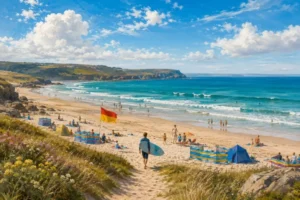
There are no lifeguards for most of March. Cover has returned at Easter in recent years, and Easter 2027 is unusually early at 26–29 March, so a handful of beaches may be patrolled right at the end of the month. Nothing is published yet, so check the RNLI’s beach finder rather than assuming. Anything below 15°C counts as cold water, cold-water shock raises heart rate and blood pressure sharply, and the advice if you get into trouble is to float: head back, ears submerged, breathing under control. Our cold-water swimming guide covers doing it properly.
The light, and the hour you lose
| Date | Sunrise | Sunset | Day length |
|---|---|---|---|
| 1 March | 07:07 | 18:02 | 10h 56m |
| 14 March | 06:39 | 18:24 | 11h 44m |
| 27 March | 06:11 | 18:45 | 12h 34m |
| 28 March (clocks forward) | 07:09 | 19:46 | 12h 37m |
| 31 March | 07:02 | 19:51 | 12h 49m |
That’s a gain of one hour fifty-three minutes across the month, more than February’s hour and a half and January’s hour. The day passes twelve hours around the 18th or 19th, a day or two before the equinox, because sunrise and sunset are measured to the top edge of the sun rather than its centre.
The clocks go forward at 1am on Sunday 28 March 2027, which is also Easter Sunday. Sunset jumps from 18:45 to 19:46 overnight, you lose an hour’s sleep on the busiest travel weekend of the spring, and by the 31st the sun sets at ten to eight. Light evenings arrive exactly as the season opens.
St Piran’s Day, Friday 5 March 2027
Cornwall’s national day, and the best weekend of the month to be here. St Piran, the story goes, came from Ireland across the Celtic Sea on a millstone, built an oratory in the dunes at Perranporth, and discovered how to smelt tin when his black hearthstone ran white: the origin of the flag, a white cross on black.
Two things happen. At Perranporth, a procession crosses Penhale Sands to the ruined oratory and the Celtic cross, black-and-white flags flying, with the St Piran Play performed on the dunes, traditionally on the Sunday nearest the day. In Truro, a parade musters on Lemon Quay around lunchtime and walks through the city to High Cross, with speeches, the Cornish anthem, a scratch brass band and a shop-window competition. Other towns hold their own.
2027 details weren’t published when we wrote this, so check locally nearer the time. Note too that Mothering Sunday falls on 7 March 2027, two days after St Piran’s Day, which makes that weekend busy in every restaurant in Cornwall. Book. Our festivals guide has the rest of the year, and the saint’s place in the bigger story is in The Story of Cornwall.
Easter is early in 2027, and it changes everything
This is the planning point that matters most. Good Friday is 26 March 2027, Easter Sunday the 28th and Easter Monday the 29th. Cornwall’s spring term ends on 25 March and the Easter holiday runs to 9 April.
Easter 2027 falls about a fortnight earlier than 2026, which pulls the whole season forward. The practical consequence for a March visit is a clean split:
- 1–25 March is the quiet window, with gardens at their peak and prices still low.
- 26 March onwards is peak season: bank holiday weekend, school holidays, and the clock change all landing together.
One hard timetable to plan around: the Eden Project has published its 2027 dates, closing 10–12 March for maintenance, then running extended hours from 24 March for the Easter run-in.
Peak magnolia: the best month in the Cornish gardens
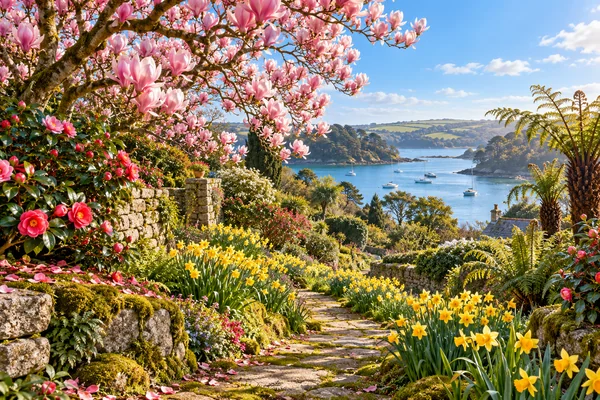
If you only come to Cornwall once for the gardens, come in March. The great woodland gardens of the south coast were planted by Victorian plant hunters with Himalayan and Chinese magnolias, rhododendrons and camellias, and March is when they go off.
- Caerhays, on the south coast, holds one of only four National Magnolia Collections in the country, and Camellia x williamsii was bred there in the 1920s. Its gardens reopen in February with the castle following a few weeks later, usually in March. The family have kept a garden diary since 1897, one page per day with every year stacked up, and it’s the best live guide there is to what’s flowering.
- Trebah is open every day of the year, and its March list runs to magnolia, camellia, rhododendron, mimosa and daffodil. March is the last month for snowdrops, witch hazel and hellebores.
- Trelissick, Lanhydrock and Cotehele are open year-round, and the seasonal National Trust gardens at Trengwainton and Glendurgan are usually open again by March. Their 2027 dates weren’t published when we wrote this.
Daffodils are the other March story. The Tamar Valley’s warm, steep, south-facing banks crop earlier than anywhere else in Britain, and Cotehele’s collection peaks this month, with wild daffodils still flowering in the hedgerows from bulbs thrown out during the war. Out on the Isles of Scilly, the scented narcissi season is ending just as the mainland peaks: two crops on two different clocks.
Bluebells, though, are April and May. In March they’re leaves. Anyone promising you Cornish bluebell woods in March hasn’t been.
Nature: the cliffs refill
March is when the seabirds come back. Razorbills and guillemots return to the cliffs from March through to July, coming ashore only to breed, with razorbills nesting lower down among the rocks and boulders. Fulmars are there all year. That makes the cliff colonies a genuinely March-onwards sight rather than a winter one.
Cornwall Wildlife Trust’s March list is worth taking out with you:
- Adders, with the first sightings of the year on early-morning coastal walks, while they’re still slow and basking.
- The hairy-footed flower bee, out before the bumblebees: males brown with a yellow face, females almost entirely black.
- St Piran’s crab, rediscovered in Cornwall in 2016 after nearly fifty years, on one of the Trust’s own shore surveys. A fitting find for the month.
- Blossom on blackthorn, willow and gorse, the first real pollen of the year.
- Woodland flowers before the canopy closes: primroses, lesser celandine, alexanders and wood anemone.
Basking sharks, before anyone asks, are a May-to-October animal: too early. Our wildlife calendar has the full year, and the seals guide covers watching responsibly.
Practical notes
- Pack lighter than February, but keep the shell. Twelve wet days out of 31 and the wind is still near winter strength, so waterproof and windproof over lighter layers.
- Take sunglasses. Four hours a day of low spring sun off wet granite and sand is a real glare, and nobody packs for it.
- Book the St Piran’s weekend (5–7 March) if you’re coming then: the national day and Mothering Sunday back to back fill the restaurants.
- Come before the 25th if you want it quiet. After that it’s Easter. If you’re coming later, our where to stay guide and hot-tub cottages piece cover booking it properly.
- Check what’s open. March is a reopening month and dates move: see what’s actually open off-season.
FAQ
Q: What is the weather like in Cornwall in March?
A: Highs of about 10°C and lows around 5°C, with roughly 70mm of rain over 12 days and 125–133 hours of sunshine, which is about four hours a day. It is warmer, drier and sunnier than February, and frost is nearly finished.
Q: Is March a good time to visit Cornwall?
A: It’s one of the best, especially before Easter. The gardens are at their peak for magnolias, camellias and daffodils, the seabirds return to the cliffs, daylight passes twelve hours mid-month, and prices and crowds stay low until the Easter holidays.
Q: When is Easter 2027?
A: Good Friday is 26 March 2027, Easter Sunday 28 March and Easter Monday 29 March. Cornwall’s school holiday runs from 26 March to 9 April, so the last week of March 2027 is peak season rather than shoulder.
Q: When do the clocks go forward in 2027?
A: At 1am on Sunday 28 March 2027, which is also Easter Sunday. Sunset in west Cornwall jumps from about 18:45 to 19:46 overnight.
Q: What happens on St Piran’s Day?
A: Cornwall’s national day falls on 5 March. A procession crosses the dunes at Perranporth to St Piran’s Oratory with the St Piran Play performed on the sands, and Truro holds a parade from Lemon Quay through the city, with other towns marking it too.
Q: Can you swim in the sea in Cornwall in March?
A: It’s cold: about 8.2–8.5°C, the second-coldest month of the year and barely above February’s low. There are no lifeguards for most of the month, though cover has recently returned at Easter, which is 26–29 March in 2027. Check the RNLI beach finder, and never swim alone.
References and resources
- Met Office — Camborne long-term averages: www.metoffice.gov.uk
- Met Office — St Mawgan long-term averages: www.metoffice.gov.uk
- Cefas — sea temperature records, Newlyn: www.cefas.co.uk
- gov.uk — when the clocks change: www.gov.uk
- Cornwall Council — school term dates: www.cornwall.gov.uk
- Eden Project — opening times: www.edenproject.com
- Caerhays — the garden diary: thediary.caerhays.co.uk
- Trebah Garden — opening times: www.trebahgarden.co.uk
- Cornwall Wildlife Trust — March spotter’s guide: www.cornwallwildlifetrust.org.uk
- Truro City Council — St Piran’s Day parade: www.truro.gov.uk
- RNLI — find a lifeguarded beach: rnli.org