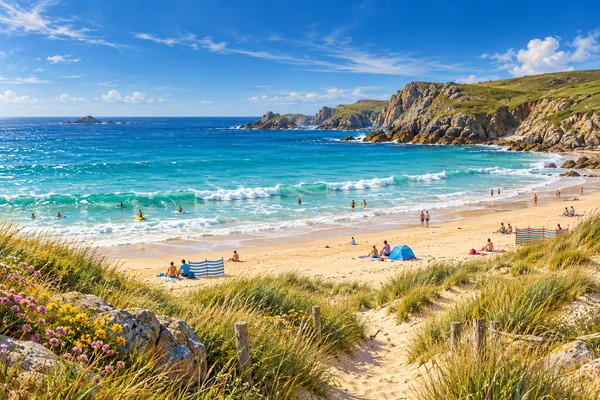
Quick answer: July is the month the sea finally becomes properly swimmable, at about 14°C, with highs of 18.7–19.1°C and seven hours of sunshine a day. It is also the first month of the year that loses daylight — an hour of it, between the 1st and the 31st. The planning point for 2027 is the split: Cornish schools break up on 23 July, so the first three weeks are term time and relatively calm, and the last week is the start of the summer crush.
July is high summer without quite being peak season, at least for its first three weeks. The water is warm enough to enjoy, the evenings are still long, and the roads have not yet filled. This follows Cornwall in June, and the full-year picture is in our weather guide.
Table of Contents
- July weather at a glance
- The sea is finally warm
- The first month that loses daylight
- The date that splits the month
- What July is for
- Practical notes
- FAQ
- References and resources
July weather at a glance
| Camborne (west) | St Mawgan (north coast) | |
|---|---|---|
| Average daily high | 18.7°C | 19.1°C |
| Average nightly low | 13.2°C | 13.5°C |
| Rainfall | 69mm | 71mm |
| Days with 1mm+ of rain | about 10 | about 11 |
| Sunshine | 199 hours | 207 hours |
| Nights with air frost | 0 | 0 |
July is warmer than June by about 1.8°C in the day and two degrees at night, and it is the second-warmest month of the year — August edges it, by a quarter of a degree at Camborne and two hundredths at St Mawgan, which is to say they are effectively the same.
But July is not the sunniest month. At 199 hours in the west and 207 on the north coast, it sits behind both May and June, and it is wetter than either. This is the thing most visitors get wrong about Cornwall: the best weather is in late spring, and July buys warmth at the cost of cloud and rain.
Nights are the warmest of the year so far at 13.2–13.5°C, which matters more than it sounds — it is the difference between a comfortable evening outside and reaching for a coat at nine o’clock.
The sea is finally warm
This is July’s real claim. The water reaches about 14°C at Newlyn on the long-run coastal record, up another degree and a half on June, and within touching distance of the 14.7°C annual peak that arrives in August and September.
Fourteen degrees is still not warm by Mediterranean standards, and it is still below the 15°C point at which cold-water shock stops being a consideration for a sudden immersion. But it is the temperature at which swimming in Cornwall becomes a pleasure rather than a challenge, and the first month when most people will happily stay in the water for a while without a wetsuit.
Lifeguard cover is at its fullest through July, though the 2027 schedule had not been published when we wrote this — check the RNLI beach finder, swim between the flags, and treat rip currents as the real risk rather than the cold. Our family beaches guide covers which beaches suit children, and the dog beaches guide explains the summer dog restrictions, which are in force through July.
The first month that loses daylight
| Date | Sunrise | Sunset | Day length |
|---|---|---|---|
| 1 July | 05:16 | 21:36 | 16h 19m |
| 15 July | 05:28 | 21:28 | 15h 59m |
| 31 July | 05:49 | 21:08 | 15h 19m |
July loses exactly an hour of daylight across the month, and it is the first month of the year to lose any at all. Nobody notices at the time, because fifteen and a half hours is still enormous and the sun is still setting after nine.
The useful version of this: early July evenings are among the best of the year, with the sun setting at half past nine and warm air for once. By the end of the month you have lost twenty-eight minutes off the back of the day. If a late beach evening is the point of your trip, come in the first half.
The date that splits the month
Cornish schools break up on Friday 23 July 2027, and that single date divides July into two quite different months.
- 1–22 July: term time. Good weather, warm sea, long evenings, and crowds well short of peak. Prices are summer prices but not August prices.
- 23 July onwards: the summer holidays begin. Roads, beaches, car parks, restaurants and prices all step up, and stay up until September.
If you are tied to school holidays, there is nothing to be done and the last week of July is no worse than August. If you are not, the first three weeks of July are the best warm-weather window Cornwall offers: sea at its near-best, days near their longest, and the county still functioning normally. English school dates vary by a few days either side, so check if it is marginal for you. Our where to stay guide covers where to base yourself.
What July is for
July is the month to use the sea and the long evenings, because they will not both be this good again.
- Swimming and the beach, properly. At 14°C with full lifeguard cover, this is the month the coast delivers what people come for — see our family beaches guide.
- Rock pooling on the big spring tides, which expose ground that is underwater for most of the month. Our rock pooling guide covers reading the tides and handling what you find.
- Open-air theatre. The Minack’s season is in full swing and the summer festivals are running — our open-air theatre guide covers planning an evening there, and what to take.
- Camping. July is the warmest-nights month so far at 13°C, which is the difference between a good night under canvas and a cold one. Our camping guide has sites by area.
- Walking the coast path early or late, avoiding the middle of the day. Our coast path walk is a good one for a long July evening.
- Basking sharks are still in Cornish water through the May-to-October window — see the wildlife calendar.
Practical notes
- Book ahead for the last week. From 23 July, restaurants and accommodation need booking rather than turning up.
- Go early or late to popular beaches. Car parks at the famous ones fill by mid-morning in the school holidays, and the light is better at either end of the day anyway.
- Dog restrictions are in force. Most seasonal beach bans run through July, typically 10am to 6pm — the detail is in our dog beaches guide.
- Still pack a waterproof. Ten or eleven wet days, and July is wetter than May or June.
- August is next, and it brings the warmest sea of the year along with the biggest crowds: Cornwall in August.
FAQ
Q: What is the weather like in Cornwall in July?
A: Highs of about 18.7–19.1°C and lows around 13.2–13.5°C, with roughly 69–71mm of rain over ten or eleven days and 199–207 hours of sunshine, about seven hours a day. It is the second-warmest month, fractionally behind August.
Q: Is the sea warm enough to swim in Cornwall in July?
A: Yes. The sea reaches about 14°C, close to the annual peak of 14.7°C in August and September, and lifeguard cover is at its fullest. It is still below the 15°C cold-water threshold, so take sudden immersion seriously, and treat rip currents as the main risk.
Q: Is July the sunniest month in Cornwall?
A: No. May is the sunniest at 216–224 hours, with June second. July records 199–207 hours and is wetter than both. July is warmer, but it buys that warmth at the cost of cloud and rain.
Q: When do Cornish schools break up in 2027?
A: Friday 23 July 2027. The first three weeks of July are term time and noticeably quieter than the last week, which is when the summer holidays and peak prices begin.
Q: When is the quietest time to visit Cornwall in July?
A: The first three weeks, before Cornish schools break up on 23 July. You get a sea near its warmest, days near their longest and full lifeguard cover, without August crowds. English school dates vary by a few days, so check if it is marginal.
Q: Do the days get shorter in July?
A: Yes. July is the first month of the year to lose daylight, dropping exactly an hour between the 1st and the 31st — from 16 hours 19 minutes to 15 hours 19 minutes at Penzance. Sunset moves from 21:36 to 21:08.
References and resources
- Met Office — Camborne long-term averages: www.metoffice.gov.uk
- Met Office — St Mawgan long-term averages: www.metoffice.gov.uk
- Cefas — sea temperature records, Newlyn: www.cefas.co.uk
- Cornwall Council — school term dates: www.cornwall.gov.uk
- gov.uk — UK bank holidays: www.gov.uk
- RNLI — find a lifeguarded beach: rnli.org
- The Minack Theatre: www.minack.com