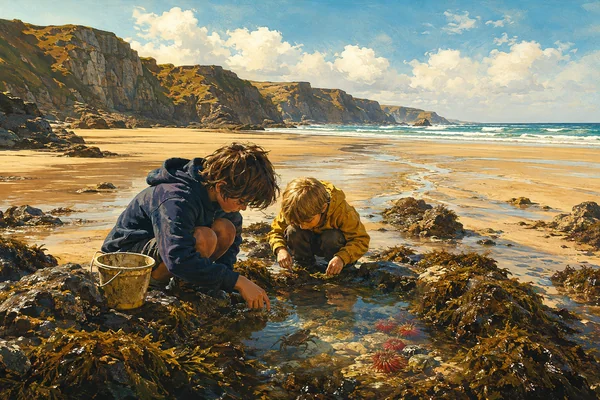
Quick answer: the best rock pooling in Cornwall happens in the two hours either side of a low spring tide — check the tide tables, arrive as the water is dropping, and head for the rocky ends of the big north-coast beaches (Perranporth’s western end, Polzeath, Treyarnon, Trevone, Godrevy) or Hannafore at Looe. For crabbing, it’s the harbour walls — Looe above all, then Padstow, Mevagissey, Fowey and Falmouth — with a weighted drop-line, a bucket of sea water, and everything back in the sea when you’re done. Kit, tides, what you’ll find, and where to go, below.
Rock pooling and crabbing are the two cheapest, most reliable days out in Cornwall — no tickets, no queues, and a three-year-old and a fifteen-year-old equally absorbed for an hour. All you need is a low tide, a bit of kit, and somewhere the rocks meet the sand. This guide covers how to read the tides, what to bring, the creatures you’ll meet and the rules for handling them, and where in Cornwall the pools and the harbours are best — with a few notes from a family that does a lot of both.
Table of Contents
- Tides first: when to go
- What to bring
- What you’ll find in a Cornish rock pool
- The rock pooling code
- Where to rock pool in Cornwall
- Crabbing: how to do it properly
- Where to go crabbing in Cornwall
- Personal insights and experiences
- FAQ
- References and resources
Tides first: when to go
- Low tide is everything. The pools you want are the ones only uncovered at low water. Check the tide table for the beach (free apps and websites list every Cornish beach) and aim to arrive an hour or two before low tide, so you follow the water out and get the deepest pools at the bottom.
- Spring tides are best. Around a full or new moon the tides run biggest — the lowest lows expose rocks that are underwater for weeks at a time, and that’s where the good stuff lives.
- Watch it turn. On the flat north-coast beaches the sea comes back in fast and can cut off rocks; when the tide turns, work back toward the beach. Our weather guide has more on Cornish conditions.
- Calm and bright makes the water clear and the pools warm; after a storm they’re churned and empty.
What to bring
- Footwear with grip — wet rock and weed are treacherous; old trainers, water shoes or wetsuit boots, never flip-flops.
- A bucket (light-coloured, so you can see what’s in it) filled with sea water, refreshed often, kept in the shade.
- A small net for gentle scooping — or better, hands, which do less damage to anemones and weed.
- A clear tub or viewer for a proper look before things go back.
- An ID guide — a laminated card or a phone app turns “a crab” into a velvet swimming crab and a child into a marine biologist.
- Sun cream, water, and layers — you’ll be bent over pools for longer than you think.
What you’ll find in a Cornish rock pool
- Crabs — the common shore crab everywhere; the velvet swimming crab with its red eyes and furious temper (handle from behind, or don’t); small edible crabs with the “pie-crust” shell; hermit crabs in borrowed whelk shells.
- Fish — blennies (the shanny, with its bulldog face), gobies, and if you’re lucky a pipefish or a tiny wrasse; they hide under weed and dart when the shadow moves.
- Prawns and shrimp — transparent, quick, and everywhere once your eyes adjust.
- Anemones — beadlet anemones like red jelly blobs on the rock, snakelocks with waving green-and-purple tentacles (they don’t sting hands, but leave them be).
- Starfish and cushion stars, sea urchins occasionally, and the whole shellfish cast — limpets, periwinkles, top shells, dog whelks and mussels.
- The oddities — a sea hare, a squat lobster under a ledge, a cuttlefish bone, mermaid’s purses (shark and ray egg cases) in the strandline.
The rock pooling code
- Put every rock back exactly as you found it — the underside is somebody’s home.
- Wet your hands before touching anything, handle briefly, and never pull an animal off a rock — anemones and limpets die if prised.
- Everything goes back where it came from, in the same pool, before you leave. Nothing comes home.
- Buckets are for looking, not keeping — minutes, in the shade, in fresh sea water.
- Leave the seals alone if they’re hauled out nearby, and keep dogs on leads on the rocks; see our Cornwall wildlife guide.
Where to rock pool in Cornwall
- Perranporth (western end) — at low tide the vast beach reveals a braided stream fanning into warm, clear, ankle-deep pools that toddlers adore, and at the western end, under the mine-riddled cliffs toward Droskyn Point, proper rock pools full of small fish and crabs. Look up at the cliffs while you’re there — those barred openings are mine adits the smugglers once used; our pirates guide has that story.
- Hannafore, Looe — the classic Cornish rockpooling site: a wide rocky shore off West Looe facing Looe Island, with a marine conservation group running summer rockpool rambles. Even the sandy edges of Looe’s beach and harbour, where the rocks meet the sand and the tide leaves pits and pools, are worth a look.
- Polzeath and New Polzeath — good rocks at both ends of the surf beach at low water; family-friendly and easy.
- Treyarnon and Trevone, near Padstow — Treyarnon has a natural rock pool big enough to swim in and rocks either side; Trevone’s rocky end is rich at low springs.
- Godrevy and Gwithian — rocks below the lighthouse point, seals offshore, and dogs allowed on much of the beach; see our dog-friendly guide.
- Maenporth and Prisk Cove, near Falmouth; Trevaunance Cove at St Agnes; Kynance on the Lizard for the dramatic version — all rewarding at a good low tide.
- Par Sands — not rock pools exactly, but at low tide the sand bars and shallow channels trap shrimp and small fish for small children with nets; see our family beaches guide.
Crabbing: how to do it properly
- Kit — a hand line with a weight and a bait bag or clip (a small mesh bag beats a bare hook — no hooks, ever); a bucket of sea water; a landing net for the ones that let go on the way up. The little wound-on-a-plastic-frame lines from the harbour shops work; a proper line and a big bait bag work much better.
- Bait — bacon is the tourist standard and it’s fine; fish heads or a chunk of mackerel from the harbour fishmonger out-fish it every time.
- Technique — lower to the bottom, wait until you feel the tug and weight, and lift slowly and steadily; crabs let go if you jerk. Net under, into the bucket, admire, count, and out again.
- The crabbing code — sea water in the bucket, changed often; no more than a few crabs at once and never piled up; bucket in the shade; back into the water gently from low down, not dropped from the wall, within a few minutes and where they were caught. Shore crabs are not for eating; keep it catch-and-release.
- Safety — harbour walls have no railings and deep water below; small children get a hand on the collar. Watch the tide on slipways.
Where to go crabbing in Cornwall
- Looe — the crabbing capital of Cornwall: the tidal pool by the main car park for small children, then the harbour walls along the river as you walk into town, with the boats coming and going and pasties within reach.
- Padstow, Mevagissey and Fowey — busy working harbours with quaysides made for a line; Padstow in summer is standing-room-only, so go early.
- Falmouth (Custom House Quay), Newquay harbour, St Ives, Porthleven, Charlestown — every harbour has its spot; look where the local children are.
- Boscastle — the harbour walls that double as jumping-off points; see our Tintagel and Boscastle guide.
Personal insights and experiences
Our rock pooling in Cornwall began, properly, only this week — at Perranporth, on the last day of a four-day camping trip. We’d arrived to eat far too early, and because I keep half an eye on the tide tables out of habit, I knew the water would be out; so we walked down to a beach so vast and freshly uncovered there was barely a dry patch to sit on, a stream fanning across it into warm, glass-clear shallows where my granddaughter paddled for an hour, and, at the western end under the mine workings, the rock pools my fifteen-year-old and I spent a happy stretch of the afternoon in — small fish, crabs, and water so clear it was like looking through nothing. Then up into the town for the meal we’d come for.
Crabbing is older habit: Looe, mostly, with proper kit that out-hauls the harbour-shop nets by an embarrassing margin, and a firm family rule that everything — crabs, fish, prawns — goes back. (The exception is prawning for the pot, which we do across the border at Mount Batten in Plymouth.) Our benchmark for rock pooling remains Wembury in Devon, which is as good as it gets in the south-west, and the honest purpose of the list above is that we’re hunting for a Cornish beach to match it. Perranporth made a strong start. If you know the one, tell me.
FAQ
Q: When is the best time to go rock pooling in Cornwall?
A: The two hours either side of low tide, ideally on a spring tide (around a full or new moon), on a calm bright day. Arrive as the tide falls.
Q: Where is the best rock pooling in Cornwall?
A: Hannafore at Looe is the classic; the western end of Perranporth, Polzeath, Treyarnon, Trevone and Godrevy are all excellent at a good low tide.
Q: Where can you go crabbing in Cornwall?
A: Looe is the best-known — the tidal pool by the car park and the harbour walls — followed by Padstow, Mevagissey, Fowey and Falmouth’s quays.
Q: What bait is best for crabbing?
A: Bacon works; fish heads or a chunk of mackerel in a bait bag work better. Never use hooks.
Q: Can you keep the crabs you catch?
A: No — shore crabs aren’t for eating and the whole point is catch-and-release: a few minutes in a bucket of sea water, then back where they came from.
References and resources
- Cornwall Wildlife Trust — rock pooling and the Seashore Code: www.cornwallwildlifetrust.org.uk
- Looe Marine Conservation Group — Hannafore rockpool rambles: www.looemarineconservation.org
- Tide times for Cornish beaches: www.tidetimes.org.uk
- Marine Conservation Society — seashore identification: www.mcsuk.org