Quick answer: Cornwall’s real pirates were less Gilbert and Sullivan and more grim: the medieval “Fowey Gallants” who raided the French coast under royal licence, the Killigrews of Falmouth who ran piracy from their own manor house, and — most terrifying — the Barbary corsairs from North Africa who raided Cornish villages and carried people off into slavery in the 1600s. The Pirates of Penzance came much later, from a comic opera, and Penzance has cheerfully embraced them ever since. Fact, fiction, and where to play pirates today, below.
Ask anyone about Cornish pirates and they’ll hum a tune from Gilbert and Sullivan. The truth is stranger, older and darker: Cornwall’s coast, jutting into the sea lanes of the Channel and the Atlantic, was for centuries both a nest of pirates and a target for them — English privateers who blurred into outright robbers, aristocrats who fenced stolen cargoes, and foreign raiders who took Cornish men, women and children as slaves. This guide separates the history from the pantomime, and then, because it’s Cornwall, tells you where to take the children to wave a cutlass anyway.
Piracy is one chapter of a much longer story. For the whole 4,000 years, see The Story of Cornwall.
Table of Contents
- The Fowey Gallants: pirates with a licence
- The Killigrews of Falmouth: piracy from the manor house
- The Barbary raids: when Cornwall was the victim
- Privateers, wreckers and smugglers
- The Pirates of Penzance: the fiction
- What you can still see
- Pirates for families today
- Personal insights and experiences
- FAQ
- References and resources
The Fowey Gallants: pirates with a licence
In the 14th and 15th centuries, Fowey was one of the most important ports in England — and its seamen, the “Fowey Gallants,” made a name raiding the French and Spanish coasts, sometimes with royal blessing during the Hundred Years’ War and sometimes very much without. When peace broke out and they carried on regardless, the Crown lost patience: in 1479 Edward IV had Fowey’s ships seized and the great chain that guarded the harbour taken away to Dartmouth. The blockhouses that held that chain still face each other across the river mouth. Fowey’s swagger has never entirely gone.
The Killigrews of Falmouth: piracy from the manor house
The Killigrews of Arwenack — the manor at the mouth of the Fal where Falmouth now stands — were Elizabethan gentry with a lucrative sideline: pirates used the Carrick Roads under their protection, and the family took a cut. Sir John Killigrew was, with magnificent cheek, appointed a Commissioner for Piracy for Cornwall — the man in charge of suppressing what he was profiting from. In 1582 his mother, Lady Mary Killigrew, was accused of organising the seizure of a Spanish ship anchored in the harbour and the disappearance of its cargo; two of her men were hanged and she was reprieved. Falmouth’s foundations were laid, in every sense, on piracy.
The Barbary raids: when Cornwall was the victim
The darkest chapter is the one least told. In the early 17th century, corsairs from the Barbary coast of North Africa — Algiers, Salé, Tunis — raided the shores of south-west England, taking ships and, worse, people, to be sold as slaves. In 1625 a raid on Mount’s Bay carried off some sixty men, women and children from around Mousehole; fishing boats were seized off the Lizard and Land’s End for decades; Lundy island was for a time a corsair base. Parish churches raised money to ransom captives, and many never came home. When Cornish people of the time spoke of pirates, this is what they feared — and it’s a useful corrective to every rum-and-parrot cliché.
Privateers, wreckers and smugglers
Through the wars with France and Spain, Cornish ports fitted out privateers — private warships licensed to take enemy shipping — which was piracy with paperwork and made fortunes in Falmouth, Fowey and Penzance. The wreckers, luring ships onto the rocks with false lights, are almost entirely legend; the smugglers who ran brandy and tea into every cove in the 18th century are entirely real, and had far more in common with the pirates than the tourist boards admit — our maritime heritage guide tells their story, from the King of Prussia to Cruel Coppinger.
The Pirates of Penzance: the fiction
Gilbert and Sullivan’s comic opera opened in 1879, and its pirates — orphans all, too soft-hearted to rob other orphans, undone by a Major-General and a policeman’s lot — have nothing to do with the Killigrews or the corsairs. Gilbert chose Penzance precisely because it was the least piratical place he could think of: a respectable Victorian seaside resort. The joke stuck, and Penzance took it to heart. The town has held pirate days, gone for the world record for the most people dressed as pirates in one place (a record it has held and lost to Hastings in a rivalry both towns enjoy), and its rugby club plays as the Cornish Pirates. If you want the pantomime pirates, Penzance is delighted to oblige — with a straight face and a very good sense of humour.
What you can still see
Cornwall’s piratical and smuggling past isn’t only in books — a surprising amount of it is still standing, and much of it is free to walk up to:
- Fowey’s blockhouses — the two stone towers facing each other across the harbour mouth, built to carry the great chain that Edward IV confiscated from the Gallants in 1479. Walk to the Fowey one from Readymoney Cove; the Polruan one is a ferry ride away.
- Pendennis and St Mawes castles — Henry VIII’s twin forts guarding the Fal, built in the 1540s against invasion and raiders; both English Heritage, both magnificent, and Pendennis sits above the site of the Killigrews’ Arwenack, fragments of which survive by the harbour.
- The King’s Pipe, Falmouth — a tall brick chimney on the quay by the old Custom House, where seized contraband tobacco was burned. It’s still there, and it’s exactly what it sounds like.
- Prussia Cove — John Carter’s kingdom near Marazion: the rock-cut cart tracks and slipway the smugglers used still run down to the water; reach it on foot from the coast path.
- Polperro — the harbour, the Heritage Museum of Smuggling and Fishing on the quay, and Willy Wilcox’s cave beneath the cliffs, named for a smuggler who is said to have gone in and never come out.
- The Admiral Benbow, Penzance — a 17th-century smugglers’ inn on Chapel Street with a figure of a smuggler on the roof; the town’s Pirates of Penzance connection is a stroll away on the prom.
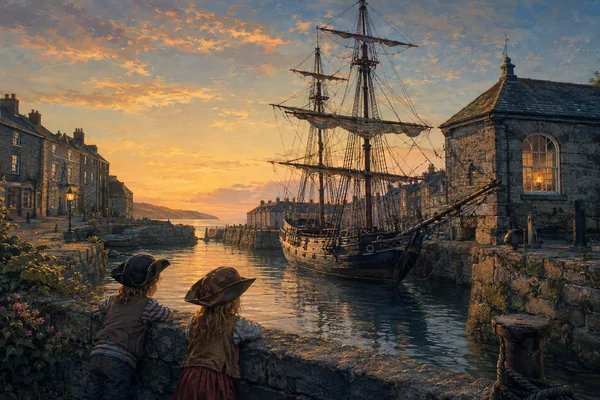
- Charlestown — the Georgian harbour and its tall ships, built in the 1790s and used for filming everything from Poldark to pirate epics; the Shipwreck Treasure Museum sits at its head.
- The caves and the barred tunnels — Perranporth and Droskyn Point — every north-coast beach has caves that a child (and, frankly, an adult) decides were smugglers’ dens, and here they were right. The barred openings in the cliffs at Perranporth are mine adits — drainage tunnels from the workings above — but the smugglers of the 1700s used exactly this ready-made maze. At Droskyn Point, on the western end of Perranporth beach, two sea caverns big enough to take several rowing boats sat beneath eighty feet of cliff, and a shaft was cut from the cavern roof to the top so contraband could be hauled up by rope and pulley to waiting mules. In 1780 the leading men of the parish — the vicar included — formed a smuggling syndicate, bought a fast ship called the Cherbourg, and traded direct with France. Look at the mineral-stained cliffs on the coast path from Perranporth to St Agnes and you’ll see the dark square adit mouths still; never go in — they collapse, and the tide cuts them off. Our tin mining guide tells the miners’ half of the same cliffs.
Pirates for families today
- Charlestown — the Georgian harbour near St Austell with tall ships at the quay and a shipwreck and treasure museum: the most convincingly piratical place in Cornwall, and a film set for good reason.
- Pirate’s Quest, Newquay — an immersive walk-through pirate adventure with actors, built for children and tolerated well by adults.
- Fowey — walk to the blockhouses at the harbour mouth, look at the chain’s ghost, and tell the children about the Gallants; then take the ferry to Polruan.
- Falmouth — Pendennis Castle, built by Henry VIII partly because of the pirates and raiders in these waters, and the National Maritime Museum on the harbour.
- Penzance — the promenade, the pirate festivities when they’re on, and a Cornish Pirates match at the Mennaye if the season’s right.
- Prussia Cove and Polperro — smugglers rather than pirates, but the coves and lanes are exactly what a child imagines a pirate haunt to be.
Personal insights and experiences
Pirates are the great gift to anyone with children in Cornwall: every cove is a hideout, every harbour wall a plank, and the coast plays along. Ours have grown up on the Fowey ferry, the harbour at Charlestown and the lanes of Polperro, and the word “pirate” has done a lot of the work of getting them to walk further than they wanted to. Only yesterday, crabbing and rock pooling at Perranporth, we found a cave in the cliff with an opening blocked by iron bars — and every one of us, me included, decided instantly that it was a smugglers’ den. My first thought was that it was almost certainly a mine adit and nothing more romantic — and then I looked it up. It is a mine adit. And the smugglers of Perranporth used those very adits and caverns, with an eighty-foot shaft at Droskyn Point and the vicar in on the syndicate. The children were right, and I have told them so.
But the history is what stays with me. I’d always thought of Cornish pirates as swagger — the Gallants, the Killigrews getting away with it — until I read about the Barbary raids and Mount’s Bay in 1625: a village losing sixty of its people to a slave market. It changed how I look at the little churches along that coast, which raised money to buy their neighbours back. Cornwall’s pirates were sometimes us and sometimes the ones who came for us. Both are worth telling the children, when they’re old enough — and the Penzance version, with a straight face, until then.
FAQ
Q: Were there real pirates in Cornwall?
A: Yes — the medieval Fowey Gallants, the Elizabethan Killigrews of Falmouth who profited from piracy, privateers in every war, and Barbary corsairs from North Africa who raided Cornish villages for slaves in the 1600s.
Q: Were the Pirates of Penzance real?
A: No — they’re the invention of Gilbert and Sullivan’s 1879 comic opera, which chose Penzance as a joke because it was so respectable. The town has embraced them ever since.
Q: Who were the Fowey Gallants?
A: Fowey’s seamen of the 14th and 15th centuries, who raided the French coast — with and without royal permission — until Edward IV confiscated the town’s ships and harbour chain in 1479.
Q: What were the Barbary raids on Cornwall?
A: Attacks by North African corsairs in the early 17th century that seized ships and carried off Cornish people into slavery — including around sixty from Mount’s Bay in 1625.
Q: Where can children do pirate things in Cornwall?
A: Charlestown’s tall ships and shipwreck museum, Pirate’s Quest in Newquay, Fowey’s harbour blockhouses, Pendennis Castle at Falmouth, and Penzance’s pirate festivities.
References and resources
- National Maritime Museum Cornwall: nmmc.co.uk
- Charlestown Shipwreck Treasure Museum: www.shipwreckcharlestown.co.uk
- Pirate’s Quest, Newquay: www.piratesquest.co.uk
- English Heritage — Pendennis Castle: www.english-heritage.org.uk