Quick answer: cold water shock starts below 15°C, and the sea around Britain averages 12°C — in a Cornish winter it is colder still. The single most useful fact: the initial effects pass in less than a minute, so if the cold hits you, do not try to swim. Float first. The second most useful: Cornwall’s beaches are not lifeguarded in winter — Perranporth, one of the busiest, is patrolled 3 April to 1 November only. And the rule you have heard about staying in one minute per degree is not true, according to the people who research it.
Winter sea swimming in Cornwall has gone from eccentric to crowded in about five years, and most of what gets repeated about it in car parks is wrong. This is the safety information from the RNLI and the Outdoor Swimming Society, the bit about lifeguards that people genuinely do not know, and an honest account of what the cold actually does. Our sea saunas guide covers the other half of the ritual and the wild swimming guide covers the warmer months.
Table of Contents
- Cold water shock, which is the thing that kills people
- Float to Live, in the RNLI’s own five steps
- Nobody is watching: the winter lifeguard gap
- The “one minute per degree” rule is a myth
- Getting out, which is the part people get wrong
- Where, and when, and with whom
- Should you, honestly?
- FAQ
- References and resources
Cold water shock, which is the thing that kills people
Not hypothermia. Hypothermia takes a long time; cold water shock takes seconds, and it is what drowns people who could otherwise swim perfectly well.
The RNLI puts the threshold at anything below 15°C, and notes that the average sea temperature around the UK and Ireland is 12°C. A Cornish sea in February is below that. So every winter swim here is, by definition, a cold water shock risk.
What it actually does
You lose control of your breathing and your movement. Heart rate and blood pressure rise sharply, which the RNLI says can lead to cardiac arrest. The gasp reflex is the dangerous part: if your face is underwater when it fires, you inhale water.
The one-minute rule that matters
The initial effects of cold water pass in less than a minute. That is the RNLI’s own figure, and it changes what you should do:
- Take a minute. Do not try to swim straight away.
- Relax and float.
- Then call for help or swim to safety, once your breathing is back.
The instinct is to thrash and strike out for shore. That instinct is the thing that kills. Everything the RNLI teaches is designed to get you through the first sixty seconds without inhaling water.
Float to Live, in the RNLI’s own five steps
Worth learning properly, because you will not be able to look it up at the time.
- Tilt your head back, submerging your ears.
- Relax and control your breathing.
- Move your hands and legs to help you stay afloat.
- Your legs may sink — that is fine. Everyone floats differently.
- Find your float by practising somewhere supervised, like a pool.
Spreading your arms and legs improves stability. The RNLI says this advice has helped save more than fifty lives, in situations from rip currents to people falling into canals.
And if you are caught in a rip
- Do not swim against it — you will exhaust yourself.
- If you can stand, wade. Do not swim.
- If it is too deep, swim parallel to the beach until you are out of it, then head in.
- In difficulty: raise one hand, shout, and float.
Nobody is watching: the winter lifeguard gap
This is the fact that surprises people most, and it is checkable in thirty seconds on the RNLI’s own site.
Perranporth — one of the busiest beaches in Cornwall — is lifeguarded daily from 3 April to 1 November, 10am to 6pm. That is it. For five months of the year, including every day of the winter swimming season, there is nobody on that beach whose job it is to come and get you.
Season dates vary by beach, so check the specific one you are going to. But the shape is the same across the county: cover runs roughly from spring to the end of October, and winter is unpatrolled.
“No flags = no lifeguards” is the RNLI’s own phrasing, and in December it means exactly what it says.
The practical consequence: swim with other people, tell someone on land, stay within your depth and close to shore, and accept that in winter the rescue is you and whoever you came with. If something goes wrong, 999 and ask for the coastguard. Our storm watching guide covers the days when you should not be near the water at all.
The “one minute per degree” rule is a myth
You will hear this in every car park: stay in one minute for each degree of water temperature. Eight degrees, eight minutes. It is tidy, it is memorable, and the Outdoor Swimming Society says plainly that it is “not actually true”.
Their article on it draws on the research of Mike Tipton and Heather Massey at the Extreme Environments Laboratory, University of Portsmouth, and gives six reasons why no single formula works:
- Body mass
- Surface area to volume ratio
- Body fat
- Whether you are a “fast cooler” or a “slow cooler”
- Lifestyle
- Day-to-day health
Two people can go into the same water on the same morning and cool at completely different rates. A rule that ignores that is not a safety rule; it is a number that makes people stay in longer than they should because they have not “done their minutes”.
What the OSS says instead
No schedule and no numbers. Their line on how winter swimmers used to talk about it is the useful one: counting strokes, not minutes
. And their closing advice is to go gently, have fun
and do it for yourself.
Which is a better rule than the arithmetic: get in, stay a short time, get out while you still want more. Build from there, over weeks, not in one go.
Getting out, which is the part people get wrong
You do not feel the worst of it in the water. You feel it ten minutes later, in the car park, when your core temperature is still falling — so the warm-up matters as much as the swim.
- Get dressed immediately, in order, starting with the top half. Have everything laid out before you get in, in the order you will need it.
- A hot drink in a flask, made before you went in rather than after.
- Do not have a hot shower straight away. Warm from the inside and from layers.
- Do not drive until you have stopped shivering properly and your hands work. Cold hands and a gear stick are a genuinely bad combination.
- Gloves and boots make more difference than anything else you can buy. Extremities go first and hurt most.
- Bring more than you think — a second hat, a dry towel you have not sat on.
And consider a sauna. The wood-fired sea saunas that have appeared all round the Cornish coast exist precisely for this, and the sauna-and-plunge combination is what most regular winter swimmers here have actually settled into. Our sea saunas guide covers where they are and what they cost. Failing that, our cosy pubs guide covers the other traditional method.
Where, and when, and with whom
Choosing a spot in winter
- Somewhere you know in summer. Winter is not the time to learn a new beach, because the sandbanks and the rips will have moved.
- Somewhere sheltered. A big swell makes entry and exit the dangerous part, not the swim.
- Somewhere with a short walk from the car. You will be grateful afterwards, and the walk back is where the cold really arrives.
- Somewhere with other people. Harbours, town beaches and the places where the local groups meet.
- Not somewhere cliff-backed that cuts off on the tide. Our family beaches guide and the dog-friendly beaches guide cover access and the beaches worth knowing.
When
The sea is at its coldest in February and March, not December — it lags the air by about two months, which is why a January swim is colder than a Christmas one despite the air being similar. Our weather guide covers what the Cornish winter actually does, and the December guide and January guide cover the months.
With whom
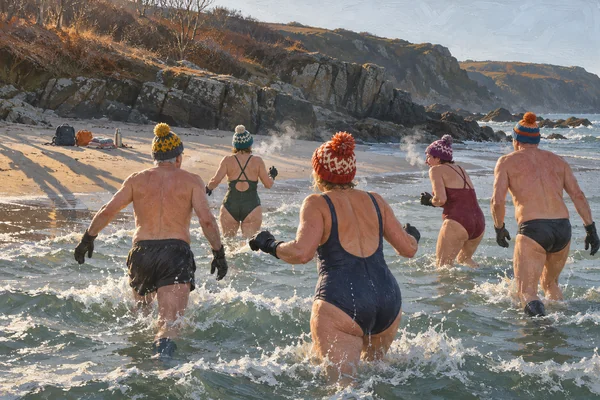
Find a group. Almost every Cornish town has one now, and they meet at the same time every week in all weathers. It is safer, it is the entire social point, and it is the thing that gets you into the water on the mornings you would otherwise talk yourself out of. Our surf therapy guide covers the formal version of the same idea, and the wellbeing retreats guide covers the organised end.
Christmas Day swims happen all round the coast — Bude, Porthtowan, Perranporth and Looe among them. They are usually organised locally and announced late, often only on a Facebook page, so check locally rather than trusting a listings site. Our Christmas in Cornwall guide covers the rest of the day, the off-season guide covers what else is open and the coastal towns in winter guide covers which towns are alive enough to have a group at all.
Should you, honestly?
Yes, if you go about it properly, and no, if you are going to treat it as a dare.
The people who get into trouble are rarely the regulars. They are the ones who do it once, on a whim, after a few drinks or on a dare, without knowing about cold water shock and without anyone watching. Every element of that is avoidable.
The people who do it twice a week through a Cornish winter mostly report the same thing: it is the best ninety seconds of their week, and the hour afterwards is better still. That is not nothing. But it is earned by doing it in small doses, with other people, at a place you know, on a day the sea allows.
And if you have a heart condition, or are not sure, ask a doctor first. Cold water shock raises heart rate and blood pressure sharply. That is a real cardiac event in a cold sea, not a figure of speech.
FAQ
Q: What temperature is the sea in Cornwall in winter?
A: The RNLI gives the average sea temperature around the UK and Ireland as 12°C, and a Cornish sea in winter is below that. Cold water shock begins below 15°C, so every winter sea swim in Cornwall is in cold water shock territory. The sea is coldest in February and March rather than December, because it lags the air temperature by roughly two months.
Q: What is cold water shock?
A: The body’s reaction to sudden immersion below 15°C. You lose control of your breathing and movement, and your heart rate and blood pressure rise sharply, which the RNLI says can lead to cardiac arrest. It is not hypothermia, which takes much longer. Cold water shock is what drowns people who can otherwise swim well.
Q: How long does cold water shock last?
A: The RNLI says the initial effects pass in less than a minute. That is why the advice is to take a minute rather than trying to swim straight away: float first, get your breathing under control, and then call for help or swim to safety.
Q: What is Float to Live?
A: The RNLI’s five steps if you get into difficulty: tilt your head back with your ears submerged, relax and control your breathing, move your hands and legs to stay afloat, accept that your legs may sink because everyone floats differently, and practise floating somewhere supervised beforehand. Spreading your arms and legs improves stability. The RNLI says the advice has helped save more than fifty lives.
Q: Are Cornwall’s beaches lifeguarded in winter?
A: No. RNLI lifeguard season dates vary by beach, but cover runs roughly from spring to the start of November. Perranporth, one of the busiest beaches in Cornwall, is patrolled daily from 3 April to 1 November, 10am to 6pm, and not at all outside those dates. The RNLI’s own phrasing is ‘No flags = no lifeguards’. Check the dates for the specific beach you are visiting.
Q: Is the one minute per degree rule true?
A: No. The Outdoor Swimming Society says plainly that it is ‘not actually true’, drawing on research by Mike Tipton and Heather Massey at the Extreme Environments Laboratory, University of Portsmouth. Six things change how fast you cool: body mass, surface area to volume, body fat, whether you are a fast or slow cooler, lifestyle and day-to-day health. Two people in the same water cool at different rates, so no single formula works.
Q: How long should you stay in cold water?
A: There is no published number, and the Outdoor Swimming Society deliberately does not give one. Their framing is that winter swimmers used to count strokes rather than minutes, and their advice is to go gently. In practice: a short time, out while you still want more, and build up over weeks rather than in a single session.
Q: What should you do after a winter sea swim?
A: Get dressed immediately, top half first, with everything laid out in order beforehand. Have a hot drink made in advance. Avoid a hot shower straight away and warm from the inside instead. Do not drive until you have stopped shivering and your hands work properly. Gloves and boots make more difference than any other kit, because extremities go first.
Q: Where can you swim in the sea in Cornwall in winter?
A: Somewhere you already know in summer, sheltered from the swell, with a short walk from the car and other people around. Avoid cliff-backed coves that cut off on the tide, and avoid learning a new beach in winter, because sandbanks and rips move. Most Cornish towns now have a swimming group that meets weekly, which is both safer and the point.
Q: Are there Christmas Day swims in Cornwall?
A: Yes, all round the coast, including Bude, Porthtowan, Perranporth and Looe. They are organised locally and often announced late, frequently only on a local Facebook page, so check with the town rather than relying on a listings site.
References and resources
- RNLI — Float to Live: rnli.org
- RNLI — find a lifeguarded beach and its season dates: rnli.org
- Outdoor Swimming Society — the 1 minute per degree myth: www.outdoorswimmingsociety.com
- Outdoor Swimming Society: www.outdoorswimmingsociety.com