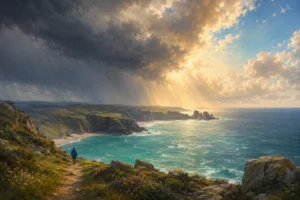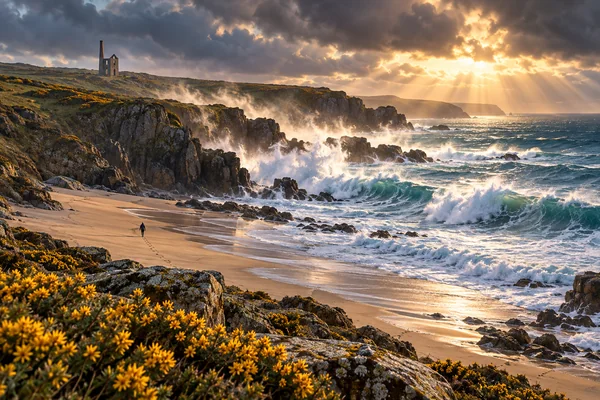
Quick answer: January is Cornwall’s quietest month and one of its wildest. Expect daytime highs around 9°C, about 17 wet days, only 60-odd hours of sunshine in the whole month, and frost on just two or three nights near the coast. What defines it isn’t cold, it’s wind: the Atlantic depressions run hardest from November to March. In return you get empty beaches, huge seas, the cheapest prices of the year, days that lengthen by more than an hour through the month, and snowdrops by the end of it. Weather figures, what’s open, what to do and what to pack, below.
January in Cornwall divides people. The coast is at its most dramatic, the roads are empty, and you can walk a mile of sand without meeting anyone. It is also dark by half past four at the start of the month, wet more days than not, and some of what you came to see is shut. This guide is the honest version, with the Met Office figures behind it. It follows on from Cornwall in December, and the year-round picture is in our Cornwall weather guide.
Table of Contents
- January weather at a glance
- Temperature, sea and light
- Wind, storms and snow
- The sea in January
- What’s open in January
- What to do in January
- What to pack
- FAQ
- References and resources
January weather at a glance
| Camborne (west) | St Mawgan (north coast) | |
|---|---|---|
| Average daily high | 9.2°C | 9.0°C |
| Average nightly low | 4.9°C | 4.3°C |
| Rainfall | 121mm | 109mm |
| Days with 1mm+ of rain | about 17 | about 16 |
| Sunshine | 61 hours | 68 hours |
| Nights with air frost | 2 | 3 |
Two numbers tell you most of what you need. Sixty hours of sunshine across the whole month is about two hours a day, so plan for grey and treat the bright days as a bonus. And two or three frosts a month is remarkably few: the Isles of Scilly average fewer than two air frosts in a whole year. The Met Office calls this the mildest region of the British Isles, but mild doesn’t mean frost-free, and inland on the moors it’s a different story.
Temperature, sea and light
The sea is why. The water around the south-west has the highest annual mean temperature of any sea area near the UK, close to 11–12°C, and it holds the peninsula’s temperature up all winter. West Cornwall’s annual temperature range is about 9°C, similar to western Ireland, against roughly 14°C in the Midlands. Cornwall doesn’t get properly cold; it gets wet and windy instead.
The light comes back fast. At Penzance, 1 January gives roughly eight hours between sunrise around 08:21 and sunset around 16:30. By 31 January it’s about nine and a quarter hours, sunrise near 07:58 and sunset near 17:13. That’s a gain of about an hour and six minutes across the month, and almost all of it at the evening end, which is exactly where you want it. (Times are calculated for Penzance and are approximate; check a local table for your dates.)
Wind, storms and snow
This is the real character of a Cornish January. The Met Office notes that the frequency and strength of depressions peaks in winter, with the highest mean wind speeds from November to March, and that over the past thirty years both December and January have produced gusts of more than 80 knots. Exposed Cornish coasts and the Isles of Scilly average around 24 days of gale a year, most of them in these months. The record gusts are remarkable: 103 knots at Gwennap Head in December 1979.
Snow is rare, but not impossible. In January 1987 convective showers dumped 35cm on Falmouth, 39cm on Penzance and 23cm on Scilly, which is worth remembering before you assume a Cornish winter can’t strand you.
Storm watching, done safely
A big swell on the north coast is one of the great sights in Britain, and it kills people most winters. The RNLI’s advice during big-swell warnings is blunt: stay well back from the water’s edge, avoid walking on harbour walls, piers and exposed promenades, and keep off wet rocks and the base of cliffs where waves rebound with extra force. On flat beaches, surges can run 200–300 metres inland. HM Coastguard puts it best: if you can feel the spray, you’re too close. Watch from high ground, well back, and if you see someone in trouble call 999 for the Coastguard rather than going in.
The sea in January
There are no lifeguards. Cover on Cornish beaches typically ends in early November and doesn’t restart until the spring, so every winter swim is unpatrolled. The RNLI defines anything below 15°C as cold water, and at this time of year the sea around the UK and Ireland is about 6–10°C: cold enough for cold-water shock, which raises heart rate and blood pressure and can cause heart attacks in people who are otherwise young and healthy.
Plenty of people still swim, and January dips are a Cornish institution, starting with New Year’s Day. Do it properly: acclimatise slowly rather than jumping in, never swim alone, wear a bright cap and use a tow float, and know Float to Live — lean back, spread your arms and legs, and let the shock pass rather than thrashing. Our guides to cold-water swimming and Cornwall’s beach saunas cover the warming-up half, which in January matters as much as the swim.
What’s open in January
More than you’d think, but check before you drive anywhere. Winter maintenance closures are common and they’re published late.
- Eden Project has already published its 2027 maintenance closures: 4–8, 11–15 and 19–21 January. Check the dates before booking, because they cover three working weeks of the month.
- National Maritime Museum Cornwall, Falmouth: open daily, and the best wet-day day out in the county.
- Tate St Ives: open daily, though gallery displays are being changed through the winter with rolling closures into early 2027, so check what’s actually hanging.
- Minack Theatre: open to visit, but closed Mondays and Tuesdays from November to February. Book a timed slot.
- Geevor Tin Mine: open Sunday to Friday, closed Saturdays.
- Bodmin Jail: open all year, with some early-January dates closed for maintenance.
- Trebah Garden, the Cornish Seal Sanctuary at Gweek and the Blue Reef Aquarium at Newquay are all open daily through winter.
- St Michael’s Mount: the castle isn’t open in January. The island is still reachable on foot at low tide, and the walk out is worth it in winter light.
- National Trust: gardens and parkland generally beat houses in January, and 2027 opening times weren’t published when we wrote this. Check each property’s page before travelling.
What to do in January
- Walk the empty beaches. This is the month when you get Perranporth or Watergate to yourself, and the light after a front clears is extraordinary.
- Watch a storm, safely. From high ground, well back, at a safe distance. Never from a harbour wall.
- The Bodmin Wassail, 6 January. A door-to-door visiting wassail first recorded in 1624, thought to be the only one of its kind left in the country, raising money for local causes as it goes. Several community orchards also hold wassails through January, with dates announced locally.
- New Year’s Day swims at beaches around the county, most of them organised locally and announced late. Check with the organisers, and see the safety notes above.
- Look for snowdrops from late January, when the first appear at Cotehele and Lanhydrock and spread through February. Caerhays, the famous camellia and magnolia garden, stays shut until mid-February.
- Seals. January isn’t pupping season, which runs from about August to December, but weaned pups and hauled-out adults are around the coast, and winter storms strand some. Watch from a distance and never approach: our seals guide has the code.
- Book the year’s cheapest stays. January is the quietest month in Cornwall’s calendar, which is the whole argument for coming. See where to stay and romantic winter breaks.
What to pack
The packing list follows the data: 16 or 17 wet days, two hours of sun a day, gales rather than frost.
- A properly waterproof coat with a hood that stays up in wind. An umbrella is useless here.
- Windproof layers rather than heavy insulation. It’s rarely cold enough for a serious winter coat, but the wind cuts through anything loose.
- Waterproof boots with grip. Coast paths in January are mud, and the granite is slick.
- A head torch if you’re walking late: it’s dark by about half past four at the start of the month.
- Swimming kit if you’re brave, plus a changing robe, a hat and a flask for afterwards.
- Layers you can dry. Nothing dries fast in a Cornish January, so take more than you think.
FAQ
Q: What is the weather like in Cornwall in January?
A: Mild, wet and windy. Average highs are around 9°C with lows near 4–5°C, about 120mm of rain over 16–17 days, and only about 60 hours of sunshine in the whole month. Frost is rare on the coast, at two or three nights a month.
Q: Is Cornwall worth visiting in January?
A: Yes, if you want empty beaches, dramatic seas and the cheapest prices of the year, and you don’t mind rain. It’s the quietest month in the calendar. Check opening times before you travel, because winter maintenance closures are common.
Q: Can you swim in the sea in Cornwall in January?
A: People do, but there are no lifeguards on any Cornish beach in winter and the sea is around 6–10°C, cold enough for cold-water shock. Acclimatise slowly, never swim alone, use a bright cap and a tow float, and learn Float to Live.
Q: Does it snow in Cornwall in January?
A: Rarely. The sea keeps the peninsula mild and frost averages two or three nights a month near the coast. It does happen, though: in January 1987 Penzance had 39cm.
Q: How long are the days in Cornwall in January?
A: About eight hours at the start of the month, from roughly 08:20 to 16:30 in the far west, rising to about nine and a quarter hours by the 31st. The month gains over an hour of daylight, nearly all of it in the evening.
Q: What is open in Cornwall in January?
A: The Maritime Museum in Falmouth, Tate St Ives, Geevor, Bodmin Jail, Trebah, the Seal Sanctuary and the Blue Reef Aquarium all open through winter. The Eden Project closes for maintenance on several January weekdays in 2027, Minack shuts Mondays and Tuesdays, and St Michael’s Mount castle is closed.
References and resources
- Met Office — Camborne long-term averages: www.metoffice.gov.uk
- Met Office — St Mawgan long-term averages: www.metoffice.gov.uk
- Met Office — the climate of South West England: www.metoffice.gov.uk
- RNLI — cold water and winter dipping: rnli.org
- RNLI — large swell warnings for the South West: rnli.org
- HM Coastguard — storms and coastal safety: hmcoastguard.uk
- Eden Project — opening times: www.edenproject.com
- Minack Theatre — theatre and garden visits: minack.com
- National Trust — where to see snowdrops: www.nationaltrust.org.uk
- Bodmin Wassail: bodminwassail.uk
- Caerhays — garden opening: www.caerhays.co.uk