Quick answer: February is Cornwall’s coldest month, and also the point where winter starts losing. The nights are the coldest of the year because the sea bottoms out at around 8°C, but the days are no colder than January’s, and it is markedly drier and brighter: about 26mm less rain, three fewer wet days and 23 more hours of sunshine, which is three hours a day instead of two. Daylight grows by an hour and a half, and the sun sets after six for the first time since October. The gardens begin, half term falls 15–19 February 2027, and two Cornish towns hurl silver balls through their streets on consecutive days. The figures, what’s open and what’s on, below.
If you only read the temperature chart, February looks like the month to avoid. The reality is better than that: it is the brightest month of the Cornish winter, the first flowers arrive, and the light comes back fast enough to notice week by week. This follows on from Cornwall in January, and the year-round picture is in our Cornwall weather guide.
Table of Contents
- February weather at a glance
- The coldest month, but not how you’d think
- The light comes back
- The sea: the coldest water of the year
- Storms, and the month it actually snows
- What’s open in February 2027
- What’s on
- Nature: the first month of the year that feels like spring
- Practical notes
- FAQ
- References and resources
February weather at a glance
| Camborne (west) | St Mawgan (north coast) | |
|---|---|---|
| Average daily high | 9.2°C | 9.0°C |
| Average nightly low | 4.6°C | 4.1°C |
| Rainfall | 95mm | 83mm |
| Days with 1mm+ of rain | about 14 | about 13 |
| Sunshine | 85 hours | 91 hours |
| Nights with air frost | 2 | 3 |
The comparison with January is the useful part. February gets about 26mm less rain, three fewer wet days, and 23 more hours of sunshine. That takes you from roughly two hours of sun a day to three. The temperature barely moves: days are identical, nights about two tenths of a degree colder. Same warmth, better weather.
The coldest month, but not how you’d think
The Met Office is explicit about this: because the sea reaches its lowest temperature in February or early March, February is the coldest month in Cornwall and Devon, while further inland in Somerset it’s January. The sea runs the thermostat here, and the sea is always a month behind.
Read it carefully, though. February owns the coldest nights in Cornwall; the days are a dead heat with January. And it’s a Cornish fact rather than a national one: across the UK as a whole, January is the colder month.
The light comes back
| Date | Sunrise | Sunset | Day length |
|---|---|---|---|
| 1 February | 07:57 | 17:14 | 9h 17m |
| 14 February | 07:36 | 17:37 | 10h 01m |
| 28 February | 07:09 | 18:01 | 10h 52m |
That’s a gain of an hour and thirty-four minutes across the month, against January’s hour and six, and this time it’s balanced at both ends: sunrise comes 48 minutes earlier, sunset 46 minutes later. The day passes ten hours around the 14th, and on the 28th the sun sets after six o’clock for the first time since October. In a Cornish winter, that evening is the one everybody notices.
The sea: the coldest water of the year
The sea around Cornwall bottoms out this month. Cefas’s long-running coastal records put February at about 8.3°C at Newlyn and 8.0°C at Plymouth, the coldest of all twelve months at both, and the most variable.
There is no lifeguard cover. The 2026 season on the longest-patrolled Cornish beaches, Perranporth and Sennen, ran to 1 November, and cover doesn’t resume until spring. The RNLI counts anything below 15°C as cold water, which can seriously affect breathing and movement, and cold-water shock pushes up heart rate and blood pressure. If you go in, go in slowly, never alone, and learn Float to Live: tilt your head back with your ears submerged, relax, control your breathing and let your legs sink if they want to. Our guides to cold-water swimming and beach saunas cover doing it properly.
Storms, and the month it actually snows
February sits inside the stormy half of the year without being its worst month: the Met Office puts the strongest gusts in December and January. February still produces the memorable ones. Storm Eunice on 18 February 2022 was the most damaging storm to hit England and Wales since February 2014, with gusts of 83mph recorded at Chivenor just over the border and a landmark tree lost at Bude. The storm of 4–5 February 2014, the one that destroyed the railway at Dawlish, brought 92mph to St Mary’s and enormous waves at Porthleven.
Here’s the surprise, though. At St Mawgan, February averages three days a year with snow or sleet falling, more than any other month, but only 0.4 days with snow lying. It falls more often than in midwinter and almost never settles, which is Cornwall in one statistic.
What’s open in February 2027
One timetable is published and most are not, so treat the rest as a season rather than a schedule and check before you drive.
- Eden Project is the exception, with 2027 dates out: closed 2–4 and 9–11 February for maintenance, then its longest hours of the period across 13–21 February, which is the half-term block. The half-term programme itself hadn’t been announced when we wrote this.
- Minack Theatre is closed every Monday and Tuesday from November to February. Worth noting what that collides with: Feast Monday on the 8th, Shrove Tuesday on the 9th, and the first two days of half term.
- Trebah is open daily all year, and its February flower list is the best guide to what’s actually out.
- Trelissick, Lanhydrock and Cotehele are year-round National Trust properties, with gardens open through the winter and estates from dawn to dusk.
- Caerhays, the great magnolia and camellia garden, reopens during February, though it had published only the month and not the date.
- Trengwainton and Glendurgan are seasonal and typically open around the end of February, and St Michael’s Mount castle had no 2027 dates published. The National Trust generally publishes about a season ahead, so February dates should appear in January.
What’s on
Half term and the shape of the month
Cornwall’s spring half term is Monday 15 to Friday 19 February 2027, with the spring term running 4 January to 25 March. Academies and voluntary-aided schools set their own dates and INSET days, so some children get longer. The practical shape: 1–12 February and 22–28 February are quiet, with the busy block in the middle.
Two silver balls in two days
The best thing about a Cornish February. On Feast Monday, 8 February 2027, St Ives holds its Feast Day: a procession from the parish church, a blessing at St Ia’s Well, and the hurling of the silver ball at 10.30am, with the ball returned to the Mayor on the War Memorial steps at midday and roads closed through the morning. The feast marks the church’s consecration in 1434. The Sunday before brings the Mayor’s parade and service.
Then on Shrove Tuesday, 9 February 2027, St Columb Major plays its own hurling match, the silver ball thrown up in the Market Square at 4:30pm, with a second match ten days later. The town’s parish describes the rule rather than publishing dates, so check locally before travelling. Two ancient ball games on consecutive days is a thing no other English county offers, and it’s covered further in our festivals guide.
Valentine’s and what’s on stage
Valentine’s Day falls on Sunday 14 February 2027, which makes the 13th and 14th the last quiet weekend before half term begins the next morning. Stay on and you hit half-term prices from the Monday, so book the weekend and leave, or book the whole week knowingly. Our romantic winter breaks guide covers where to go.
Hall for Cornwall in Truro is the one venue with a full February 2027 line-up on sale, including The Magic of Motown on the 5th, wildlife cameraman Hamza Yassin on the 7th, Dirty Dancing across half term from the 16th to the 20th, Giovanni Pernice on the 24th and Queenz on the 25th.
Nature: the first month of the year that feels like spring
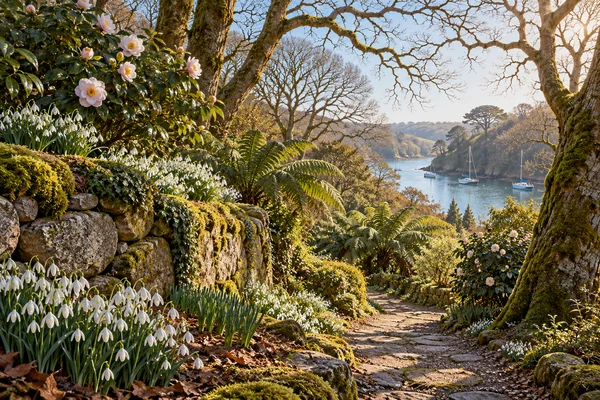
Trebah’s own flowering list makes the point: snowdrops, witch hazel and hellebores all appear in February and none of them is on its January list, alongside the first camellias, magnolias, daffodils and mimosa. Snowdrops are a January-to-early-March flower across the country; Godolphin is the National Trust’s Cornish suggestion for them. Caerhays’ famous Asiatic magnolias are only beginning: their prime is March and April.
Cornwall Wildlife Trust’s February list is the one to take out with you:
- Great crested grebes start their breeding season, growing head plumes and orange ruffs, and performing the weed dance.
- Rooks begin nesting, stealing the best twigs from each other at the top of the trees.
- Grey herons return to their heronries to repair last year’s nests before laying in March.
- Common toads wake and mass-migrate to their breeding ponds on the first warm, damp evenings, often around Valentine’s Day.
- Primroses, which can flower in Cornwall as early as December, arrive in real abundance, feeding the first pollinators.
- Scarlet elfcup, a bright red cup fungus, starts fruiting on fallen hazel and willow.
On the Isles of Scilly, February is the tail of the scented narcissi season, which runs from late October; on the mainland the daffodils are still building. Grey seals are past pupping now and into their moult, when they spend longer ashore and are at their most easily disturbed: watch from well back, and never put yourself between a seal and the sea. Our seals guide has the full code.
Practical notes
- Pack for wet and bright. Thirteen or fourteen wet days out of 28, but 85–91 hours of sunshine: waterproofs and a windproof layer, boots for mud, and sunglasses for the low glare late in the month.
- The quietest fortnight has a catch. 1–12 February is beautifully empty, but Eden shuts for six of those weekdays, so check before building a day around it.
- Prices are low except in the middle. February is low season apart from the half-term block, so the weeks either side are the value.
- Stargazing is at its best. Long dark evenings and the clearest skies of the winter make this a good month for the dark skies over Bodmin Moor.
- Somewhere warm to end up. A spa day or a pub with a fire is the right end to a February afternoon on the coast.
FAQ
Q: What is the weather like in Cornwall in February?
A: Highs around 9°C and lows around 4°C, with about 83–95mm of rain over 13 or 14 days and 85–91 hours of sunshine. It is drier and brighter than January, with roughly three hours of sun a day instead of two, and frost on only two or three nights.
Q: Is February the coldest month in Cornwall?
A: Yes, and the Met Office says so: the sea reaches its lowest temperature in February or early March, which makes February the coldest month in Cornwall and Devon. It owns the coldest nights, though; the days are no colder than January’s. Across the UK as a whole, January is colder.
Q: How cold is the sea in Cornwall in February?
A: About 8°C, the coldest of the year. Long-running records put February at around 8.3°C at Newlyn and 8.0°C at Plymouth. There are no lifeguards on any Cornish beach until the season restarts in spring.
Q: When is half term in Cornwall in February 2027?
A: Monday 15 to Friday 19 February 2027 for Cornwall Council schools, within a spring term running from 4 January to 25 March. Academies and voluntary-aided schools set their own dates, so check your school.
Q: Does it snow in Cornwall in February?
A: It falls more often than in any other month — St Mawgan averages three days a year of snow or sleet falling in February — but it almost never settles, with only 0.4 days of lying snow on average.
Q: What’s on in Cornwall in February?
A: St Ives Feast on 8 February 2027, with the hurling of the silver ball at 10.30am, and St Columb Major’s own hurling on Shrove Tuesday the next day. Valentine’s falls on Sunday 14 February, half term runs 15–19 February, and Hall for Cornwall in Truro has a full programme including Dirty Dancing across half term.
References and resources
- Met Office — Camborne long-term averages: www.metoffice.gov.uk
- Met Office — St Mawgan long-term averages: www.metoffice.gov.uk
- Met Office — the climate of South West England: www.metoffice.gov.uk
- Cefas — sea temperature records, Newlyn: www.cefas.co.uk
- RNLI — cold water shock: rnli.org
- RNLI — Float to Live: rnli.org
- Cornwall Council — school term dates: www.cornwall.gov.uk
- St Ives Town Council — Feast Day celebrations: stivestowncouncil-cornwall.gov.uk
- Eden Project — opening times: www.edenproject.com
- Trebah Garden — the year in flower, February: www.trebahgarden.co.uk
- Cornwall Wildlife Trust — February spotter’s guide: www.cornwallwildlifetrust.org.uk
- Hall for Cornwall — what’s on: hallforcornwall.co.uk