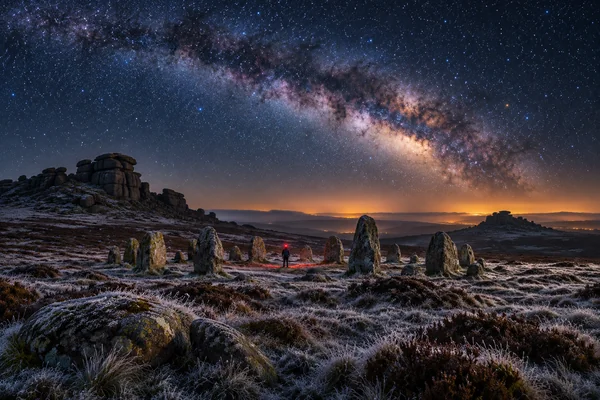
Quick answer: Cornwall has two internationally accredited dark-sky areas — Bodmin Moor, accredited in 2017 and the first National Landscape in the UK to earn the status, and West Penwith, accredited in 2021. The easiest place to start is Minions on Bodmin Moor, where two free car parks sit beside the Hurlers stone circles. Winter is the season: long nights, Orion overhead and the Geminid meteors in December. You need no equipment at all, just warm clothes, a red torch and a moonless night. Where to go, what to look for and how to stay safe on a dark moor, below.
Cornwall is a narrow peninsula with the sea on both sides and no large cities, which makes it one of the better places in England to look up. Two parts of it have the certificates to prove it. This guide covers where to go, what you can realistically see through a Cornish winter, and the safety that matters on a moor full of old mine shafts. The landscape itself is the subject of our Green Desert piece, and Cornwall in January covers the weather you’ll be standing in.
Table of Contents
- Cornwall’s two dark-sky areas
- Where to go
- What you can see, and when
- Events, observatories and groups
- Staying safe on a dark moor
- The Cornish catch: cloud
- FAQ
- References and resources
Cornwall’s two dark-sky areas
Being clear about what the designations are, because they’re often described loosely:
- Bodmin Moor was accredited by the International Dark-Sky Association in July 2017 and is branded locally as the Bodmin Moor International Dark Sky Landscape. It was the first Area of Outstanding Natural Beauty, now National Landscape, in the UK to achieve an International Dark Sky Place. The accredited area covers the part of the moor inside Section 12 of Cornwall National Landscape plus a two-mile buffer, not the whole moor.
- West Penwith was announced as an International Dark Sky Park in December 2021: the coast from the edge of St Ives through St Just and Sennen, round Land’s End to Mousehole, with inland parts around Trethewey, Sancreed and New Mill.
- The Isles of Scilly are often called the darkest skies in Britain, and the night sky out there is genuinely exceptional, but they hold no formal dark-sky accreditation. They do run a Dark Skies Week in early October, based at the community observatory on St Martin’s.
Accreditation doesn’t mean the lights go out or that access changes. It means the authorities have committed to controlling light pollution and the night sky has been measured and found good. Everything else is down to the weather.
Where to go
Bodmin Moor
- Minions — the Hurlers and Cheesewring car parks. The best starting point: two free council car parks at the highest village in Cornwall, with a level walk to the Hurlers stone circles. Wide horizons in every direction.
- Rough Tor, near Camelford. A high, unlit car park with big skies. Stay at or near the car park: walking out to Brown Willy in the dark is not a visitor activity.
- Colliford Lake. Cornwall’s largest lake, easy to reach from the A30, with parking and picnic areas, and water to double the sky.
- Siblyback Lake, near Liskeard. A car park with toilets and a café, and the occasional venue for organised stargazing evenings run with Caradon Observatory.
- Crowdy Reservoir on the north-west of the moor, and Cardinham Woods near Bodmin, which is a gentler, surfaced alternative to open moorland.
- Golitha Falls. Park at Draynes Bridge and stay in the car park area. The woods hold open shafts and adits from old copper workings, and a fast river: it’s no place to wander after dark.
- Jamaica Inn, Bolventor. The soft option, and a good one with children: the inn has been the indoor base for telescope evenings on the moor.
West Penwith
Inside the second accredited area, the ancient sites are the obvious draw: Lanyon Quoit beside the road, Chun Quoit on the moor above Morvah, and Tregeseal stone circle near St Just, which Cornwall National Landscape itself highlights for midwinter skies. The far west also gives you something Bodmin can’t: the sea as your horizon on three sides.
One to avoid
Gold Diggings Quarry near Minions is popular by day and a bad idea at night: a flooded quarry on private land with serious hazards, and police have stepped up patrols there for that reason.
A caveat worth taking seriously: we could find no official confirmation that any of these car parks are open or permit parking overnight. Read the signs on arrival, never block a gate or a passing place, and don’t sleep in your vehicle where it’s prohibited.
What you can see, and when
Honest expectation-setting first: the bright core of the Milky Way is a late-spring to early-autumn sight here, setting around midnight in October and gone by November. Through the winter, the stars of the show are the constellations and the meteors.
| What | When | Notes |
|---|---|---|
| Orionid meteors | Active 2 Oct – 7 Nov, peak night 21 October 2026 | Around 15 an hour from midnight to dawn, with a broad peak lasting about a week |
| Geminid meteors | Peak 14 December 2026 | The best shower of the year, up to 120 an hour. The crescent moon sets around 9.20pm, so the rest of the night is dark |
| Quadrantid meteors | Early January | A very narrow peak: check the exact timing nearer the date |
| Saturn | At opposition 4 October 2026 | Visible all night, rising at sunset and setting at sunrise |
| Orion and the Orion Nebula | Winter evenings | The easiest deep-sky target in the sky for ordinary binoculars |
Plan around the moon as much as the forecast. A bright moon washes out faint meteors, so aim for the week either side of new moon, which this autumn falls around 10 October, 9 November and 9 December.
You need no equipment. Meteor watching is a naked-eye activity, and the standard advice from Royal Museums Greenwich is not to stare straight at the point the meteors come from: you see more of them looking slightly away from it. Give your eyes twenty to thirty minutes to adapt, and don’t ruin it by checking your phone.
Events, observatories and groups
- Caradon Observatory, Upton Cross, on the eastern edge of the moor. Primarily a research and education site rather than a walk-in attraction, it runs public evenings elsewhere, including at Siblyback Lake and Jamaica Inn, and supplies the telescopes for dark-sky walks.
- Roseland Observatory, on the Truro High School campus, which runs open days, telescope clinics and monthly night-sky sessions timed to meteor showers and eclipses. Visits are by prior arrangement.
- Cornwall Astronomy Society holds regular observing sessions near Helston and welcomes the public without booking.
- Kernow Astronomers meet monthly at Summercourt for talks, with practical observing sessions from October to March near Mawgan Porth.
- Cornwall National Landscape runs occasional dark-sky walks on the moor, often combining archaeology with telescopes. They book out fast; the National Landscape team keeps a waiting list.
- Scilly Dark Skies Week, run by the community observatory on St Martin’s, pairs daytime workshops with evening viewing.
Cornwall has no single branded dark-skies festival of the kind Exmoor runs. What it has instead is a scattering of events across the year, so it’s worth following the societies directly.
Staying safe on a dark moor
- Mine shafts are the real hazard. Cornwall is riddled with disused shafts and adits, some hidden by vegetation, some fenced, some neither. Stay on obvious paths, keep away from hollows and fenced ground, and don’t explore in the dark.
- Bog and broken ground. Moorland is wet, uneven and surprisingly easy to turn an ankle on. Walk a short, known distance from the car and no further.
- Mist arrives fast on Bodmin Moor and can swallow landmarks in minutes. Take a map and a compass, not just a phone, and keep the car park in mind.
- Red light only. White light destroys your night vision and everyone else’s. A head torch with a red mode costs very little.
- Dress for standing still. An hour motionless at 300 metres in December is colder than any walk. Layers, hat, gloves, a flask, and something to sit on.
- At ancient sites, don’t climb on the stones, don’t light fires or candles, take everything home, and keep voices and lights low: other people may be out there observing in the dark.
The Cornish catch: cloud
The thing nobody tells you about stargazing in Cornwall is how often the sky is shut. The coast gets over 1,600 hours of sunshine a year and inland parts 1,400 to 1,600, but December is the dullest month of all, and clear nights in winter are the ones with the hardest frost and the sharpest wind. Treat a clear, moonless night as the thing you drop everything for rather than the thing you book in advance. If you’re making a trip of it, camp or stay on or near the moor and give yourself several nights.
FAQ
Q: Where are the dark sky areas in Cornwall?
A: Two places hold international accreditation: Bodmin Moor, accredited in 2017 as the first National Landscape in the UK to achieve the status, and West Penwith, accredited in 2021. The Isles of Scilly have famously dark skies but no formal designation.
Q: Where is the best stargazing on Bodmin Moor?
A: Minions is the easiest start, with two free car parks and a short walk to the Hurlers stone circles. Rough Tor, Colliford Lake and Siblyback Lake are also good, and Cardinham Woods is a gentler option than open moorland.
Q: When is the best time to stargaze in Cornwall?
A: Winter, for the long dark nights, and in the week either side of a new moon. The Geminid meteors around 14 December are the best annual display, and the bright Milky Way is a late-spring to early-autumn sight rather than a winter one.
Q: Do I need a telescope?
A: No. Meteor showers are a naked-eye event, and ordinary binoculars will show you the Orion Nebula and the Pleiades. Warm clothes and a red torch matter more than optics.
Q: Is it safe to go on Bodmin Moor at night?
A: With care. Stay near the car park, keep to obvious paths, and remember Cornwall’s disused mine shafts, some of which are hidden or poorly fenced. Take a map and compass, dress for standing still in the cold, and don’t attempt Brown Willy or open crossings in the dark.
Q: Are there stargazing events in Cornwall?
A: Yes, though scattered rather than one big festival. Caradon Observatory runs evenings at Siblyback and Jamaica Inn, Roseland Observatory opens by arrangement, Cornwall Astronomy Society and Kernow Astronomers hold regular sessions, and Cornwall National Landscape runs dark-sky walks that book out quickly.
References and resources
- Cornwall National Landscape — dark skies: cornwall-landscape.org
- DarkSky International — Bodmin Moor: darksky.org
- DarkSky International — West Penwith: darksky.org
- Cornwall Council — West Penwith dark sky park designation: www.cornwall.gov.uk
- Royal Museums Greenwich — Orionid meteor shower: www.rmg.co.uk
- Royal Museums Greenwich — Geminid meteor shower: www.rmg.co.uk
- Royal Museums Greenwich — astronomy highlights: www.rmg.co.uk
- COSMOS Community Observatory — Scilly Dark Skies Week: cosmosscilly.co.uk
- English Heritage — the Hurlers stone circles: www.english-heritage.org.uk
- Golitha Falls National Nature Reserve: www.gov.uk