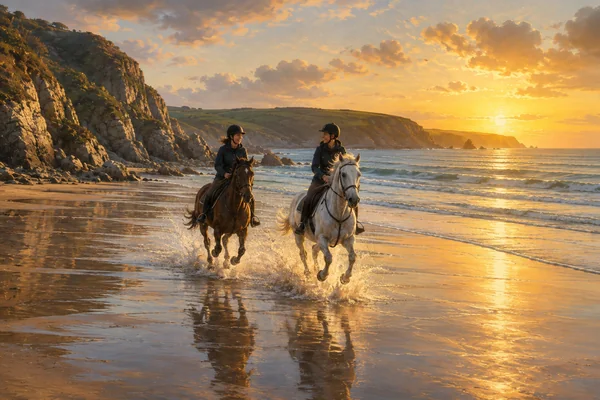
Quick answer: you book a beach ride through a riding stables, not on your own. Rides run one to two hours, almost always around low tide on the firm sand, and most stables take complete beginners at a walk as well as experienced riders who want a canter along the tideline. Perranporth and Gwithian are the classic beaches. Expect to telephone: Cornish stables generally do not publish prices or take online bookings, and summer slots go weeks ahead. Autumn to spring is quieter, cheaper and arguably better.
Riding a horse along a Cornish beach at low tide is one of those things that looks like a brochure photograph and turns out to be entirely real. This is how it actually works, which beaches to aim for, what it costs and what nobody tells you about the tide.
Table of Contents
- How beach riding works in Cornwall
- The tide is the whole thing
- The best beaches for riding
- Who to ride with
- The one nobody mentions: swimming with horses
- What it costs, and why you have to phone
- What to wear and when to go
- The other option: riding on Bodmin Moor
- Watching, not riding
- Why our friend’s husband learned to ride
- FAQ
- References and resources
How beach riding works in Cornwall
- Through a stables, mostly. Unless you are bringing your own horse, you book an escorted ride with a riding school or trekking centre near the beach. Rides typically run one to two hours, with a hack through lanes or dunes to reach the sand.
- Tide and time matter. Beach rides happen around low tide, on the firm sand, and many beaches only permit horses early in the morning or in the evening in summer, or outside the main season altogether. The stables plan around this, which is another reason to go through them.
- All levels. Most stables take complete beginners on quiet horses at a walk; experienced riders can usually book faster rides with a canter along the tideline. Say honestly what you can do — they are matching you to a horse, not judging you.
- Book ahead. Beach rides are the most popular thing every stables offers, and summer slots go weeks in advance.
The tide is the whole thing
This is the part most guides skip, and it is the difference between a good ride and a cancelled one.
Horses need firm, flat sand, which only exists for a few hours either side of low water. At high tide most Cornish beaches have no usable sand at all — the sea is against the cliffs or the dunes. So a beach ride is not scheduled around your diary; it is scheduled around the moon.
- Spring tides, around the new and full moon, go out furthest and expose the most sand. These are the big, cinematic low tides.
- Neap tides, at the half moons, move least. The beach is narrower and some stables will not run.
- Low water moves by roughly 50 minutes a day, so a ride that was at 9am on Monday is nearer 10am by Tuesday. This is why stables offer you a time rather than letting you pick one.
The practical version: ask for the available times first and build the day around them, rather than asking for a time that suits you. And if you are offered an early morning slot, take it — the light is better and the beach is empty.
The best beaches for riding
| Beach | What it gives you | Suits |
|---|---|---|
| Perranporth | Three miles of flat, firm sand backed by dunes — the classic Cornish beach ride | Everyone, including first-timers |
| Gwithian and Hayle Towans | Three miles from Hayle to Godrevy, lighthouse at one end, dunes behind | Confident riders; it can be windy |
| Watergate Bay | Two miles of sand beneath cliffs, near Newquay | All levels, tide depending |
| Holywell Bay | Dune-backed bay with the twin rocks offshore, quieter | All levels |
| Long Rock, Marazion | St Michael’s Mount as the backdrop | Experienced riders |
Others worth asking about
Polzeath and Rock on the Camel estuary, Par Sands and Pentewan on the south coast all see riders, particularly out of season. Access rules vary by beach and by month, so ask a local stables what is currently permitted rather than assuming. Keep an eye out for seals off Godrevy at the Gwithian end — our seals guide covers watching them responsibly.
Who to ride with
Cornish stables are small businesses with minimal web presence, and several listed in older guides have closed or changed hands. These are ones we could verify directly on their own sites at the time of writing — check before you travel, and treat any price you read elsewhere with suspicion.
Reen Manor Riding Stables, near Perranporth
Runs what it calls its most popular ride, starting along the dunes above the beach and using safe bridleways. Horses are suited to riders from beginners to advanced, and there are designated children’s rides. Durations and prices are not published — telephone.
Cornwall Swimming Horses, Long Rock near Penzance
The unusual one. Beach rides here are for experienced riders only, at low tide, with St Michael’s Mount behind you. Groups are one-to-one, pairs or a maximum of four. Prices are not published on the main page.
Other stables operate around Newquay, Hayle and Bodmin Moor. Rather than list names that may be out of date, the reliable method is to search for riding stables near the beach you want and telephone two or three — they will tell you the tide times before they tell you anything else.
The one nobody mentions: swimming with horses
At Long Rock the same yard takes horses into the sea at high tide — the opposite of a beach ride — and this is open to riders and non-riders alike. Their own framing is that young and old, fit and unfit, can all benefit from it.
It is a genuinely different experience from a hack along the sand, and it is the answer for anyone who wants to be around horses on a Cornish beach without needing to ride competently. It also neatly solves the tide problem: if the low tide falls badly for a ride, the high tide may suit a swim.
What it costs, and why you have to phone
Cornish riding stables generally do not publish prices. Neither of the operators above lists a price for a beach ride on its main pages, and most of the figures circulating in magazine listings and directories are of uncertain age. Treat a price you find online as a rumour.
As an indication only, an escorted beach ride of one to two hours has commonly been quoted in the region of £40–£80, with private and specialist rides higher — but confirm when you call, because that is the only number that counts.
Two things worth asking on the same call: whether they have weight and age limits, which every stables has for the horses’ welfare, and whether hats and boots are provided or lent.
What to wear and when to go
- Long trousers, always. Jeans are fine; shorts are not.
- Boots or shoes with a small heel. Trainers with thick grippy soles can jam in a stirrup, which is the one thing you genuinely do not want.
- Layers and a waterproof. The beach is considerably windier than the car park, and you are sitting still on a horse rather than walking.
- Hats are provided by every reputable stables, and some lend boots.
- Autumn to spring is quietest and often the most beautiful — see our off-season guide for what else is running. Summer rides go early or late and book out fastest; our September and August guides cover the season.
The other option: riding on Bodmin Moor
Cornwall’s other great riding is on Bodmin Moor: open granite country, tors, ponies running semi-wild, and trekking centres around St Breward and the moor’s edges that will take you out for an hour or a whole day.
It is the counterpoint to the beach — bigger, wilder, and available whatever the tide is doing, which makes it the sensible backup when the low water falls at the wrong end of the day. Plenty of riders do both on one trip. Do not underestimate the weather up there: see our weather guide and dress for the moor, not the beach. Our Bodmin Moor piece covers what the moor actually is, ecologically.
Watching, not riding
Worth saying, because it is free and most people never think of it. Low tide at Perranporth or Gwithian, early on a summer morning, with riders strung out along the tideline, is one of the finest sights in Cornwall and costs nothing. Combine it with a rock pooling guide session on the way back, or see our family beaches guide for where else to spend the morning.
Why our friend’s husband learned to ride
I rode on a beach exactly once, about thirty-five years ago, and I remember two things: how much bigger the sea looks from a horse, and how sore I was the next day. I have been a happy spectator since — beach riders at low tide are one of the sights I will always stop for.
The real rider in our circle is a friend who is out on the moors and beaches most weeks, and she has the best reason I have heard for taking it up seriously. She dreamed of a Lord of the Rings themed holiday to New Zealand and wanted to ride through parts of it, so her husband, who had never ridden, learned to ride purely so he could go with her. He caught the bug. They rode New Zealand, and now they ride Cornwall together, regularly, moor and beach.
If you needed a reason to book that first beginners’ beach ride, borrow theirs.
FAQ
Q: Can beginners do a beach ride in Cornwall?
A: Yes. Most stables take complete beginners on quiet horses at a walk, and several run designated children’s rides. Say honestly what you can do when you book — they are matching you to a horse, not testing you.
Q: How much does horse riding on a Cornish beach cost?
A: Most Cornish stables do not publish prices, so you will need to telephone. As an indication only, a one- to two-hour escorted beach ride has commonly been quoted around £40–£80, with private rides higher, but confirm on the call.
Q: Which Cornish beaches can you ride horses on?
A: Perranporth and Gwithian are the classics, with Watergate Bay and Holywell Bay near Newquay and Long Rock at Marazion under St Michael’s Mount. Access rules vary by beach and by month, so ask a local stables what is currently permitted.
Q: Do beach rides depend on the tide?
A: Entirely. Horses need firm flat sand, which only exists for a few hours either side of low water, and low tide shifts by roughly 50 minutes a day. That is why stables offer you a time rather than letting you choose one.
Q: When is the best time of year for beach riding in Cornwall?
A: Autumn to spring is quietest and often the most beautiful, with more beaches open to horses outside the main season. Summer rides run early morning or evening and book out weeks ahead.
Q: Can you swim with horses in Cornwall?
A: Yes. A yard at Long Rock near Penzance takes horses into the sea at high tide, and it is open to riders and non-riders alike. It is the opposite of a beach ride, which happens at low tide.
Q: What should I wear for a beach ride?
A: Long trousers, boots or shoes with a small heel rather than grippy trainers, layers and a waterproof — the beach is much windier than the car park. Hats are provided by every reputable stables and some lend boots.
References and resources
- Reen Manor Riding Stables: www.reenmanorstables.com
- Cornwall Swimming Horses: www.cornwallswimminghorses.co.uk
- Tide times, UK Hydrographic Office: easytide.admiralty.co.uk
- British Horse Society — approved centres: www.bhs.org.uk