Quick answer: yes, if you use it properly. The thing almost nobody realises is that an Eden Project general ticket is an annual pass — £35.50 online for an adult buys unlimited entry for a whole year, because Eden is a charity and treats the fee as a donation. As a single day out at that price it is top of the market for Cornwall and you could argue it’s two large greenhouses and a garden. As a pass you come back in four seasons, it’s one of the best-value attractions in the county, and the Rainforest Biome in January is worth the money on its own.
Eden is the attraction visitors ask about most and the one locals are most divided on. It drew 679,076 people in 2025, which makes it one of the fifty or sixty busiest paid attractions in Britain. This is an honest guide to the price, the closures, the walk back up the hill and when to go. All prices and dates here were read from Eden’s own pages in October 2026, and both move — check before you book.
Table of Contents
- The thing to understand first: your ticket is an annual pass
- What it costs
- Five legitimate ways to pay less
- What’s actually there
- The honest criticisms
- When to go, and when it’s shut
- Getting there, and eating there
- Accessibility
- How it compares nearby
- FAQ
- References and resources
The thing to understand first: your ticket is an annual pass
This is the single most useful fact about visiting Eden and it is buried on the ticket page. Eden’s general tickets are also annual passes giving unlimited entry for a whole year, because, in their words, offering passes this way allows them to treat the ticket fee as a donation. Eden is a registered educational charity, not a theme park.
It changes the maths completely. £35.50 for a day out is expensive. £35.50 for a year of a 13-hectare botanical garden forty minutes from most of mid-Cornwall is not, and the site is genuinely different in each season: the outdoor gardens in June, the Mediterranean Biome’s citrus in late winter, ice skating and Christmas lights in December, bare bones and empty paths in February.
So the honest verdict splits in two. If you live within an hour and will go back twice, it’s good value and you should buy it. If you are here for one week of the summer and will see it once, you are paying a premium price for a single visit, and the rest of this piece is about making that one visit count.
What it costs
| Ticket | Online | On the door |
|---|---|---|
| Adult (16+) | £35.50 | £39.50 |
| Student (with ID) | £32.00 | £35.50 |
| Child 5–15 | £12.50 | £15.00 |
| Under 5 | Free | Free |
Booking online saves 10%, so the door price is effectively the penalty for turning up unplanned. There is no family ticket published, which catches people out: a family of four with two children aged 5–15 is £96 online. Gift Aid at the checkout is a tick-box that adds 25% to Eden’s donation at no cost to you, not a more expensive tier.
Booking is not compulsory, but Eden says entry is not guaranteed without an advance booking and strongly encourages everyone to reserve a time slot, pass holders included. In half term, book.
Five legitimate ways to pay less
- The Locals’ Pass. If you live in Cornwall or Devon (TR, PL, TQ and EX postcodes, proof required) it’s from £26.80 adult, £16.50 student and £10.80 child for the same year’s unlimited entry, with another 10% off if you pay by Direct Debit. This is the answer for anyone reading this from inside the county.
- Universal Credit or Pension Credit. A day ticket at £15 adult and £7.50 child, limited numbers, maximum two adults and two children per household per day. Note this is a day ticket, not a pass. (Be careful with search results here — a £5/£1 rate circulating online is the Lost Gardens of Heligan’s, not Eden’s.)
- Arriving by train? Use the Days Out Guide. National Rail’s 2FOR1 offer applies to day entry, which for two adults is the biggest single saving available. Eden’s own green-transport incentive is a free guide book worth £6, not money off the ticket — worth having, but don’t plan around it as a discount.
- Membership, from £56.50 for a student or 17–25, £72.50 at 60+, £77.50 for an adult 26–59 and up to £120.50 joint family. It adds a free guest on every visit, 10% off the shops and cafés, reserved parking and no need to pre-book. If you’d otherwise bring a friend twice, it pays for itself.
- Other routes: Blue Peter badge holders go free with a paying adult, Tesco Clubcard vouchers convert to day entry (not a pass), and group rates start at 15 people by coach.
Parking is free, with a park-and-ride bus from the car parks at peak times, and there’s 22kW EV charging in the Banana car park.
What’s actually there
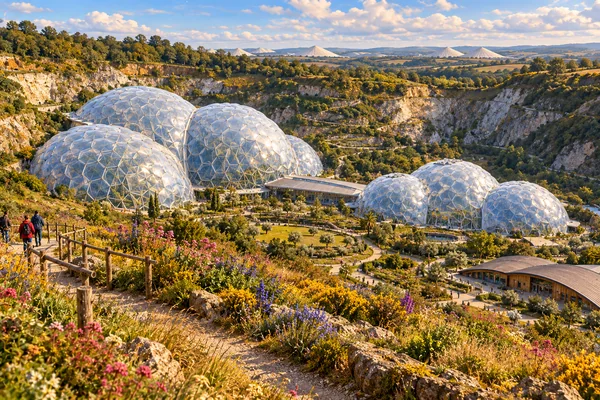
Eden was built in an exhausted china clay pit with, as Eden puts it, no soil and no plants, and opened in 2001. The pit is still the best thing about the approach: you come over the rim and the biomes are below you, which no photograph quite conveys.
- The Rainforest Biome is the reason to come. About 16,000m² and 50 metres high — you could fit the Tower of London inside it — holding over a thousand plant varieties at 18–35°C, and billed as the world’s largest indoor rainforest. The Canopy Walkway and the Lookout above the treetops are the standout, though Eden is clear that Lookout access isn’t guaranteed every day and depends on the temperature inside.
- The Mediterranean Biome, about 6,540m² and 30 metres high at 9–25°C: olives, citrus, a perfume garden, South African and Western Australian planting. In February it’s the warmest, best-smelling room in Cornwall.
- The outdoor gardens, over 20 acres and 3,000-plus plant varieties, with the Wild Edge, crop beds, a climate garden and play areas. Easy to skip and the part most people underrate.
- The Core, Eden’s education building, its geometry taken from the Fibonacci spirals of a sunflower head. It houses Invisible Worlds with the breathing Infinity Blue sculpture, plus a gallery — currently Extinction: Renewal, 36 artists, running to September 2027 and included in admission.
The biomes themselves are worth a look up. Grimshaw’s hex-tri-hex frames descend from Buckminster Fuller’s geodesic domes; the windows are three-layer ETFE pillows two metres deep, under 1% the weight of the equivalent glass but strong enough to take the weight of a car, and the whole structure is anchored down because it is more likely to blow away than fall down. The build used 230 miles of scaffolding, a Guinness record. The biomes are now heated by the UK’s first new operational deep geothermal plant since 1986, from a well five kilometres down.
If the rainforest idea appeals, Cornwall has the real thing too: see our piece on Cornwall’s temperate rainforest.
The honest criticisms
All of these are fair, and three of them are solvable.
- “It’s just greenhouses.” Eden’s own FAQ calls the biomes greenhouses, so this isn’t unfair. The honest answer is that the Rainforest Biome is a genuinely unrepeatable space and the Mediterranean one is a very good glasshouse. If you have been to Kew, you have seen a version of the second; you have not seen the first.
- The walk back up is the real complaint. From the Apple car parks it’s just over 400 metres downhill at about 1:18 with a short 1:10 section, which is a pleasant stroll at 10am and a long haul at 4pm with tired children. The park-and-ride bus only runs at peak times. Plan for it, or park as close as you can.
- The heat. Eden warns that the Rainforest Biome gets very hot in warm weather and to take extra care with babies and anyone vulnerable. Do that biome first thing in the morning, when it is coolest and emptiest, and wear layers you can strip.
- Crowding. Eden cites limited visitor capacity and pushes pre-booking for a reason. Half term and the Halloween week are the busiest.
- Time. Eden’s own suggested timings are 1.5 hours for the Rainforest, an hour for the Mediterranean and two hours for the gardens: about four and a half hours before you eat, see the Core or do anything seasonal. It is a full day, not a stop on the way somewhere.
One thing that is not a criticism: it works in the rain. Most of the garden displays are outdoors, but the biomes, the Core and the cafés are all under cover, which makes it one of the few big Cornish days out that doesn’t collapse in bad weather. You can, oddly, get sunburnt through the ETFE.
When to go, and when it’s shut
Eden closes the whole site for maintenance in blocks through the winter, and people turn up to locked gates every year. As published in October 2026, the full-site closures are 25 December, then blocks in January (4–8, 11–15, 19–21 and 26–28), February (2–4 and 9–11) and 10–12 March. Individual biomes also close early on scattered dates and Eden warns more can be added at short notice.
A caveat worth knowing: Eden’s own timetable is headed as the 2025/26 season while tickets are on sale to 31 March 2027, so check the specific dates for your month on the day you book rather than trusting any summary, this one included.
On a normal day the gates open at 9.45am, last entry is 2.30pm or 3.30pm and the site closes at 4pm or 5pm, with the biomes opening half an hour after the desks and closing half an hour before the site. Christmas Lights evenings run much later, to 8.30pm.
The seasonal programme
- Ice skating, 17 October 2026 to 21 February 2027. Forty-minute sessions, adult from £11.50 and child from £9.50 on top of admission, with parent-and-toddler ice play at £6.
- Halloweden, 24 October to 1 November 2026, included in admission — and the busiest week of the autumn.
- Christmas, selected dates 20 November 2026 to 2 January 2027. The evening Lights Pass is £12.50 with under-16s free and allows unlimited return evenings until 2 January; Father Christmas is £16 on set dates; Christmas lunch in the Mediterranean Biome is £46 on Thursdays from late November. On Lights dates the site closes to general visitors at 3.15pm and reopens at 4pm for pass holders.
- Candlelight concerts on 7 November 2026, 9 January and 20 February 2027.
- February half-term, 13–21 February 2027, with the programme still being finalised.
- Eden Sessions 2027: nothing announced yet beyond the Inside Track Passes selling out. A Sessions ticket includes free site entry on the show day and the day after.
For the quietest visit: a winter weekday outside the closure blocks, arriving at 9.45am. Our off-season opening guide covers what else is running then, and the Christmas events guide and autumn half-term piece put Eden’s dates alongside everything else.
Getting there, and eating there
Eden is at Bodelva, PL24 2SG, just outside St Austell. One satnav warning: some routes send you via St Blazey and Cornhill Road, which you do not want. Stay on the A391.
Without a car it is one of the easier big attractions to reach. St Austell is on the Paddington main line with a direct bus, and buses 28 and 31 serve the site. The Clay Trails give 4–5 mile off-road walking and cycling routes in, it’s 2.5 miles from Luxulyan on the Saints’ Way, and National Cycle Route 3 passes the entrance; there are bike racks and £1 returnable lockers. Our guide to reaching Cornwall covers the long-distance part.
For food there’s the Biome Kitchen, the Mediterranean Terrace Restaurant (lunch daily without booking, pre-booked evenings), the Biome Café and an all-day Coffee House, with the Bakehouse, Core and Stage cafés open on limited days. Bring your own cup for 30p off hot drinks, or borrow one for a refundable £2.50. Cash is accepted again. Dogs are allowed in the outdoor gardens only.
Accessibility
This is genuinely one of Eden’s strengths and worth spelling out, because the terrain sounds forbidding.
- Personal assistants enter free.
- Around 25 free manual wheelchairs on a first-come basis in the Apple car parks and Visitor Centre, plus a bookable self-propelled chair.
- Six electric scooters at £20 a day; pushchairs at £10 and £14.
- Changing Places and accessible toilets, hearing loops, and an external lift to the Core.
- The whole Canopy Walkway takes wheelchairs and buggies, apart from the Canopy Rope Bridge, which can be bypassed.
How it compares nearby
| Adult | Child | Notes | |
|---|---|---|---|
| Eden Project | £35.50 online | £12.50 | Ticket is a year’s unlimited entry |
| Lost Gardens of Heligan | £28.20 | £10 (5–17) | Student £15.70; Universal Credit £5 adult, £1 child |
| Trebah Garden | £17.50 | £8.75 | Priced to 28 February 2027; Eden Members free here in November and January |
| Wheal Martyn | £17.00 | £7.50 | Family saver £43; free returns for a year |
Heligan is the obvious pairing and the honest advice is not to pair them: both are full half-days and squeezing them into one is how you enjoy neither. Wheal Martyn, on the other side of St Austell, explains the china clay industry that dug the pit Eden sits in, which makes it the better companion visit and a fraction of the price. Our mining heritage guide covers the wider industrial story.
FAQ
Q: Is the Eden Project worth it?
A: Yes if you treat it as what it is: a general ticket is also an annual pass giving unlimited entry for a year, so £35.50 online for an adult is good value if you return even once. For a single visit it is top of the market for Cornwall, and the Rainforest Biome is the part that justifies the price.
Q: Is an Eden Project ticket really an annual pass?
A: Yes. Eden says its general tickets are also annual passes allowing unlimited entry for a whole year, because as a charity it treats the ticket fee as a donation. Keep your ticket and the booking confirmation.
Q: How much does the Eden Project cost?
A: As published in October 2026: £35.50 adult online or £39.50 on the door, £32/£35.50 student, £12.50/£15 for a child aged 5–15, and free for under-5s, up to four per paying adult. There is no family ticket.
Q: Is there a discount for Cornwall residents?
A: Yes, the Locals’ Pass for Cornwall and Devon residents with proof of address, from £26.80 adult, £16.50 student and £10.80 child for a year’s unlimited entry, with a further 10% off by Direct Debit.
Q: When is the Eden Project closed?
A: As published in October 2026, the whole site closes on 25 December and for maintenance blocks in January (4–8, 11–15, 19–21 and 26–28), February (2–4 and 9–11) and on 10–12 March. Individual biomes also close early on some dates, and Eden adds dates at short notice, so check before travelling.
Q: How long do you need at the Eden Project?
A: Eden’s own guidance is 1.5 hours for the Rainforest Biome, an hour for the Mediterranean and two hours for the outdoor gardens: about four and a half hours before food, the Core or seasonal events. Treat it as a full day.
Q: Can you get to the Eden Project without a car?
A: Yes. St Austell is on the London Paddington main line with a direct bus to the site, buses 28 and 31 serve it, the Clay Trails provide off-road walking and cycling routes in, and National Cycle Route 3 passes the entrance. Rail arrivals should check National Rail’s Days Out Guide 2FOR1 offer.
References and resources
- Eden Project — buy tickets: www.edenproject.com
- Eden Project — opening times and closures: www.edenproject.com
- Eden Project — Locals’ Pass: www.edenproject.com
- Eden Project — accessibility guide: www.edenproject.com
- Eden Project — directions: www.edenproject.com
- Eden Project — what’s on: www.edenproject.com
- Eden Project — the architecture: www.edenproject.com
- ALVA — 2025 visitor figures: www.alva.org.uk
- Lost Gardens of Heligan — ticket prices: www.heligan.com
- Trebah Garden — admission prices: www.trebahgarden.co.uk
- Wheal Martyn — prices: www.wheal-martyn.com
- National Rail — Days Out Guide: www.daysoutguide.co.uk