Quick answer: Cornwall has rainforest — real, ancient, internationally important temperate rainforest, the Atlantic kind that once cloaked a fifth of Britain and now survives on around one per cent of it. You can walk into it: Dizzard Wood, a 6,000-year-old dwarf oak forest clinging to the cliffs of the north coast, and the valley woodlands of Bodmin Moor, where Cabilla’s 3,500-year-old oaks are about to host Europe’s first temperate rainforest research station. What it is, where to find it, why it matters, and how to visit without harming it — below.
Say “rainforest” and nobody pictures Cornwall. But the Atlantic edge of Britain — mild, drenched, frost-shy — is exactly what a temperate rainforest needs, and fragments of a forest that has stood since before the pyramids still survive here, hiding in plain sight above beaches the county’s visitors walk every summer. I know, because I’ve been one of them: our family has camped for years on the clifftops near Boscastle, a few headlands from a rainforest older than Stonehenge, and until recently I had no idea it was there. This article is what I found when I looked properly — and why Cornwall’s rainforest story is quietly becoming one of the most hopeful in Britain.
Table of Contents
- What is temperate rainforest?
- Dizzard Wood: the dwarf forest on the cliff
- Cabilla and the Thousand Year Trust
- Golitha Falls and the valley woods
- Why it matters
- Visiting Cornwall’s rainforest
- Personal insights and experiences
- FAQ
- References and resources
What is temperate rainforest?
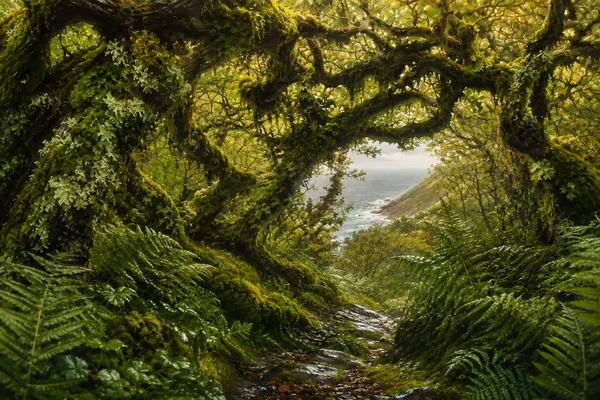
Temperate rainforest is what happens when woodland grows somewhere so consistently wet, mild and humid that life stops needing soil: mosses, liverworts, ferns and lichens grow on every rock, trunk and branch, wrapping the trees in a living green tapestry. It needs high rainfall, high humidity and stable temperatures — which is a fair description of Cornwall’s climate (our weather guide makes the same point less romantically). This habitat once covered perhaps a fifth of Britain, sweeping up the wet western fringe from Cornwall to the Highlands. Centuries of clearance for timber, fuel and farming reduced it to something like one per cent, in scattered fragments — a loss proportionally far worse than anything the tropical rainforests have yet suffered. Some of the finest surviving fragments are Cornish, and that’s where this gets exciting.
Dizzard Wood: the dwarf forest on the cliff
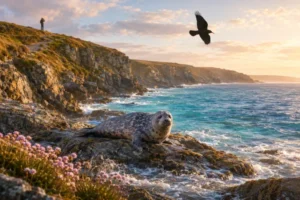
Between Crackington Haven and Millook on the north coast, the South West Coast Path passes above a forest out of a fairy tale. Dizzard Wood — the name is from the Cornish for “very steep”, and it is — is a wood of sessile oaks that are centuries old yet barely head-high in places, their growth stunted by thin cliff soils and a lifetime of salt-laden Atlantic gales; even the tallest parts of the canopy reach only around eight metres. Pollen preserved in its soils shows woodland has grown, died back and regrown on this slope since roughly 6,500–4,000 BC — today’s trees are direct descendants of Cornwall’s first post-glacial oaks. It sits within the Boscastle to Widemouth Site of Special Scientific Interest, and its lichen community is rated internationally important, with over 130 species recorded — including tree lungwort, a leafy, lung-shaped lichen that grows millimetres a year and tolerates only genuinely clean air. Its abundance at Dizzard is effectively a certificate for the purity of the coast’s atmosphere. Among the oaks grow rowan and the rare wild service tree — a species so tied to ancient woodland that finding one tells you the ground you’re standing on has been wooded for a very, very long time.
Cabilla and the Thousand Year Trust
Inland, on the southern edge of Bodmin Moor, the Cabilla valley holds an ancient oak woodland carbon-dated at more than 3,500 years old, protected as an SSSI for its exceptional mosses and liverworts. It’s home to the Thousand Year Trust — the only UK charity dedicated entirely to restoring temperate rainforest — whose ambition matches its name: not just protecting the fragment, but expanding it, reconnecting valleys, and thinking in centuries. Their headline project has planning approval and is under way: Europe’s first dedicated temperate rainforest research station, a timber building of laboratories, accommodation and community space in the woods at Cabilla Manor Farm, intended to serve rainforest science across the whole Atlantic fringe from Norway to Portugal. It’s a remarkable thing for Cornwall to host: the habitat’s best remaining fragments and, soon, the place where the world comes to study them. Founder Merlin Hanbury-Tenison’s book Our Oaken Bones tells the personal story behind it.
Golitha Falls and the valley woods
The most walkable taste of Cornwall’s rainforest character is Golitha Falls, a National Nature Reserve where the young River Fowey tumbles through Draynes Wood off Bodmin Moor: ancient sessile oaks, boulders upholstered in moss, ferns at every level and that unmistakable green light. The same character runs through many of Cornwall’s steep valley woodlands — the wooded coombs our woodland walks guide covers carry rainforest species wherever the humidity holds. And these damp, mossy, legend-soaked places are plausibly where Cornwall’s piskies, giants and enchanted groves were first imagined — the storytelling tradition and the rainforest grew up together.
Why it matters
- Rarity — globally, temperate rainforest is scarcer than tropical; Britain holds a meaningful share of what’s left, and Cornwall holds some of Britain’s best.
- Biodiversity — the lichens, mosses and liverworts here include internationally rare species with nowhere else to go; the fungal networks under ancient, never-ploughed soils are irreplaceable on any human timescale.
- Water — rainforest valleys hold moisture, feed rivers steadily and slow storm water; restoring them is flood defence that grows on its own (our rewilding guide covers the wider case, beavers included).
- Hope at scale — the western fringe has millions of hectares with the right climate. The fragments are seed sources; expansion is a choice, and Cornwall — with Dizzard, Cabilla and the research station — is where that choice is being made first. (Why the moors around these fragments look the way they do is the subject of our green desert essay.)
Visiting Cornwall’s rainforest
- Dizzard: seen best from the South West Coast Path between Crackington Haven and Millook — a properly steep, wild stretch. Admire the wood from the path; the interior is fragile, the slope unstable, and the lichens grow slower than reputations.
- Golitha Falls: NNR with a car park and an easy riverside trail — the family-friendly option, glorious after rain.
- Cabilla: a working retreat and project site rather than an open attraction — visit via the Thousand Year Trust’s events and retreats.
- The code everywhere: stay on paths, tread softly, take nothing, touch the moss with your eyes. In a habitat where a lichen takes a decade to cover a thumbnail, a careless boot is a century’s damage.
- When to go: honestly? In or just after rain — the forest switches on: colours deepen, the air turns green, and you’ll likely have it to yourself. Every month works; see our wildlife calendar for what’s stirring when.
Personal insights and experiences
Here’s what got me about Dizzard: it’s ours. Our family’s Cornish camping heartland is the clifftop between Boscastle and Bude — Pennycrocker’s fields, the gales, the view we’d trade nothing for — and for all those years, a few headlands north, a forest that has stood since the Stone Age was quietly getting on with being one of the rarest habitats on Earth. I’ve stared at that coastline in summer glory and October fury and never once knew. That discovery has done to me exactly what the barred cave at Perranporth did: it has gone on the list, and the list gets acted on — the next camping trip up that coast now includes a walk along the Dizzard stretch, ideally in soft rain, which for once I’ll be glad of. I’ve spent years following the rewilding movement and building small wild things of my own — ponds, a resurrected garden — and what draws me to the rainforest story is that it’s the same idea at the grandest scale: stop the damage, help the recovery start, then let time do what time does. Cornwall has kept the seeds for six thousand years. The least we can do is give them room.
FAQ
Q: Does Cornwall really have rainforest?
A: Yes — temperate (Atlantic) rainforest: ancient, wet, mild-climate oak woodland smothered in mosses, ferns and internationally rare lichens. Dizzard Wood on the north coast and the Cabilla valley on Bodmin Moor are outstanding examples.
Q: Where can I see temperate rainforest in Cornwall?
A: Golitha Falls NNR is the easiest visit; the coast path between Crackington Haven and Millook overlooks Dizzard’s dwarf oaks; Cabilla is reachable via the Thousand Year Trust’s retreats and events.
Q: Why are the trees at Dizzard so small?
A: Thin cliff soils and constant salt-laden Atlantic wind keep centuries-old sessile oaks stunted — parts of the canopy are barely head-high, and even the tallest reaches only around eight metres.
Q: How much of Britain’s rainforest is left?
A: It’s estimated the habitat once covered around a fifth of Britain; roughly one per cent survives, in scattered fragments — which is what makes Cornwall’s pieces internationally significant.
Q: What is the rainforest research station in Cornwall?
A: The Thousand Year Trust is building Europe’s first dedicated temperate rainforest research station at Cabilla on Bodmin Moor — laboratories and accommodation for scientists studying the Atlantic rainforest zone from Norway to Portugal.
References and resources
- Thousand Year Trust — research and the Cabilla project: thousandyeartrust.org
- Woodland Trust — rainforest recovery programme: www.rainforestrecovery.org.uk
- Natural England — Golitha Falls National Nature Reserve: www.gov.uk
- South West Coast Path — Dizzard Point walk: www.southwestcoastpath.org.uk
- Guy Shrubsole, The Lost Rainforests of Britain; Merlin Hanbury-Tenison, Our Oaken Bones — the two books to read next.
- Leave Curious — the rewilding storytelling channel that first led us to Dizzard: youtube.com/@LeaveCurious
- Planet Wild — community-funded rewilding projects worldwide: planetwild.com