Quick answer: it depends entirely on which village, and the difference is measurable. Some Cornish parishes are more than a third second homes — St Minver Lowlands, which takes in Rock and Polzeath, stands at 35.9% — and those places genuinely do go quiet. But the working towns do not. Penzance, Falmouth, Newlyn, Porthleven, Marazion, Looe and Fowey have year-round populations, which means pubs, cafés, galleries and shops stay open because local people use them. What you lose in winter is choice, not life. The practical rule: assume fewer options and midweek closures, and phone ahead before building a day around one place.
A reader emailed to ask whether Cornwall’s coastal towns are worth visiting in November if the weather turns, or whether they are deserted. It is the best question we have been asked, because the honest answer is not the one the tourist board gives — and it is not the same answer for every village. This is which places stay alive out of season, which genuinely empty, and how to tell before you drive anywhere. Our off-season guide covers attractions and opening times; this is about the villages themselves.
Table of Contents
- The divide is second homes, and there are numbers
- The towns that do not close
- What actually closes, and what does not
- Bad weather is not the problem you think
- How to check before you go
- Why winter is the better trip
- FAQ
- References and resources
The divide is second homes, and there are numbers
Cornwall has just under 289,000 dwellings, of which around 10,740 are second homes on Cornwall Council’s figures — with several thousand more holiday lets on top, which those council-tax counts largely miss. The county average is not the point. The distribution is.
| Parish | Second homes |
|---|---|
| St Minver Lowlands (Rock, Polzeath) | 35.9% |
| St Minver Highlands | 29.2% |
| St Endellion (Port Isaac area) | 27.4% |
| Padstow | 23.2% |
| Maker with Rame | 22.8% |
The pattern is geographic. The highest concentrations sit in a band on the north coast around the Camel estuary — Rock, Polzeath, Trebetherick, Port Isaac, Padstow. The 2021 census found Cornwall had the most holiday homes in England and Wales, with the sharpest hotspots in exactly that area.
That is where “deserted” is a fair description on a wet Tuesday in January. It is not a criticism of those places — several are lovely and Padstow in particular has a genuine year-round core — but if you want a village with its lights on, the data tells you where to look.
The towns that do not close
These have populations that live there all year, work there all year, and need a pub in February.
- Penzance — a working town with a main-line station, galleries, independent shops and a proper high street. The far west’s practical base and busy in any month.
- Falmouth — a university town as well as a port, which means it is arguably livelier in term time than in August. The strongest bet in the county for a winter evening.
- Newlyn — one of the UK’s major fishing ports. The boats do not stop for the season and neither does the town.
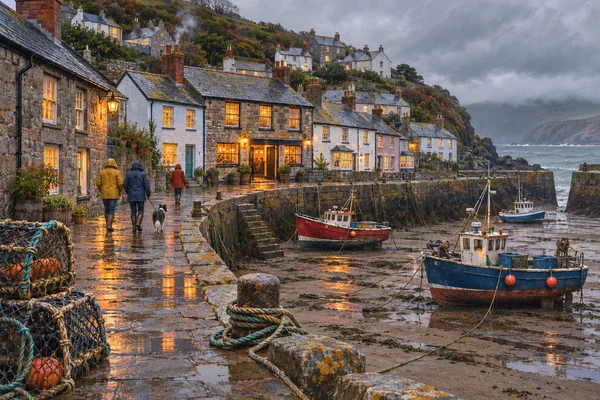
- Porthleven — a working harbour, and the one place on this list that is arguably better in bad weather. More on that below.
- Marazion — small, but a real town rather than a resort, with the Mount across the water.
- Looe and Fowey — both working harbours on the south coast with year-round life, though Fowey is quieter in deep winter.
- Truro — not coastal, but the county town, and the fallback when the weather makes the coast unpleasant.
Mousehole sits between the two categories. It is small and it is pretty enough to have attracted its share of second homes, but it keeps a genuine community and its December harbour lights are a village event, not a municipal one. Our Christmas in Cornwall guide covers them — they come on in mid-December, so an earlier winter visit will miss them.
What actually closes, and what does not
The useful distinction is between a village closing and a village thinning. Almost nowhere closes. Nearly everywhere thins.
| In winter | |
|---|---|
| Pubs | Mostly open. Some cut midweek lunch, a few shut one or two days |
| Cafés | Fewer, shorter hours, and seasonal ones shut entirely |
| Restaurants | The main casualty — many close Mondays and Tuesdays, some for weeks |
| Shops and galleries | Independents mostly open; seasonal gift shops closed |
| Beach kiosks and surf hire | Closed |
| Boat trips and seasonal ferries | Largely stopped |
| Attractions | Split, and worth checking individually |
The failure mode is not an empty village, it is a closed restaurant. You arrive, everything looks fine, and the one place you wanted to eat is shut until Wednesday. Our dinner for two guide covers booking, and the cosy pubs guide covers the places most likely to be open and warm.
Seasonal ferries stop too, which can cut a short crossing into a long drive — our ferries guide has which run year-round and which do not.
Bad weather is not the problem you think
The assumption behind the question is that rain ruins a coastal village. In Cornwall it mostly does not, and in one case it is the entire point.
- Porthleven in a swell is one of the best things in Cornwall. When the Atlantic is up, waves break over the harbour wall and against the clock tower, and people drive across the county to watch. Our storm watching guide covers doing that safely, which means well back and never on the wall.
- Wind matters more than rain. A still, wet day on a harbour is atmospheric. A dry gale is unpleasant and occasionally dangerous. Our weather guide covers the difference.
- The light is better. Low winter sun on wet granite and slate is why painters came to Newlyn and St Ives in the first place.
- You will have it to yourself, which in a village built for a few hundred people and visited by thousands is not a small thing.
The honest exception: a succession of grey, windless, drizzling days with low cloud is genuinely flat, and Cornwall gets those. Our November guide, December guide, January guide and February guide guides cover what each month actually does.
How to check before you go
Five minutes of this prevents the only real disappointment.
- Check the specific places, not the village. Three or four pubs, cafés and restaurants you would actually use, on their own pages or by phone.
- Phone rather than trust a listing. Winter hours change at short notice and aggregator sites lag by months. This is the single most useful thing you can do.
- Check the day of the week. Monday and Tuesday are the common closures, and some attractions have their own rules — St Michael’s Mount, for instance, is closed every Saturday of the year.
- Have a second town in reach. Penzance, Falmouth and Truro all absorb a wet afternoon. Our parking guide and branch lines guide cover getting between them.
- Book accommodation somewhere with life around it rather than an isolated cottage, if being able to walk to dinner matters. Our where to stay guide and B&B guide cover that choice.
Why winter is the better trip
Having given the honest caveats, the recommendation is still straightforward: the working towns in winter are the best version of coastal Cornwall, and it is not close.
You get the same harbours, the same light, the same sea, without the queue for a parking space or a table. Prices fall sharply. The people serving you are not exhausted. And you see the places as they actually are rather than as they perform in August — which, if you came to Cornwall for somewhere real, is the entire point.
Our St Michael’s Mount guide covers the one near Marazion in detail, the romantic winter breaks guide covers making a proper break of it, and the off-season guide covers everything else that stays open.
FAQ
Q: Are Cornwall’s coastal towns deserted in winter?
A: It depends which one. Parishes with very high second-home shares do go quiet — St Minver Lowlands, covering Rock and Polzeath, is 35.9% second homes. But working towns such as Penzance, Falmouth, Newlyn, Porthleven, Marazion, Looe and Fowey have year-round populations and stay open because local people use them.
Q: Which Cornish coastal towns stay open all year?
A: Penzance, Falmouth, Newlyn, Porthleven, Marazion, Looe, Fowey and Truro all have year-round life. Falmouth is arguably liveliest in term time because of the university. Newlyn is a major working fishing port, so it never stops.
Q: Is it worth visiting Cornwall’s coast in bad weather?
A: Usually yes. Wind matters far more than rain, and a wet harbour is atmospheric rather than ruined. Porthleven in a big swell, when waves break over the harbour wall by the clock tower, is one of the best sights in the county — watched from well back.
Q: What closes in Cornish villages in winter?
A: Restaurants are the main casualty, with many shutting Mondays and Tuesdays or for weeks at a time. Beach kiosks, surf hire and seasonal boat trips stop. Pubs, independent shops and galleries mostly stay open. The village does not close; the choice narrows.
Q: Which part of Cornwall has the most second homes?
A: The band around the Camel estuary on the north coast. On Cornwall Council figures, St Minver Lowlands is 35.9%, St Minver Highlands 29.2%, St Endellion 27.4% and Padstow 23.2%. The 2021 census found Cornwall had the most holiday homes in England and Wales, concentrated in the same area.
Q: How do I check whether somewhere will be open?
A: Phone the specific pubs, cafes and restaurants you intend to use rather than trusting a listing site, because winter hours change at short notice and aggregators lag badly. Check the day of the week too, as Monday and Tuesday are the common closures.
Q: Is Cornwall better in winter?
A: For the working coastal towns, yes. Same harbours, same light, same sea, without the crowds or the parking, at much lower prices. The trade is fewer options and shorter hours, which planning solves.
References and resources
- Cornwall Council — housing evidence and second homes: www.cornwall.gov.uk
- ONS — holiday homes in England and Wales, Census 2021: www.ons.gov.uk
- Visit Cornwall: www.visitcornwall.com
- Transport for Cornwall: www.transportforcornwall.co.uk