Quick answer: Cornwall’s story runs for more than five thousand years. Its Stone Age people built hilltop enclosures and granite tombs, and its tin was reaching the Mediterranean by around 1300 BC. It had its own Celtic saints and a high-status stronghold at Tintagel. It rose against the Crown twice, in 1497 and 1549, and it came close to losing its own language. In the 19th century it led the world in copper, then watched a quarter of a million people emigrate when mining collapsed. Today it is a recognised national minority, its language has official protection, and tin and lithium are coming back. Here is the whole story in order, with links to our deeper guides along the way.
Cornwall is a peninsula almost surrounded by sea, joined to the rest of Britain only across the River Tamar. That geography shaped everything that follows: a Celtic people who kept their own language long after the rest of southern Britain became English, a Stone Age landscape that was never ploughed away, and a mineral wealth that made the county rich and then broke it. This is the story, from the first stone monuments to the lithium mines.
Table of Contents
- Stones and tin: prehistoric Cornwall
- Rome’s light touch
- Saints, Tintagel and the Tamar
- The Duchy and the stannaries
- Rebellion: 1497 and 1549
- Royalist Cornwall
- The language that refused to die
- Boom and bust: the mining century
- The sea, the railway and the Riviera
- Cornwall today
- Myths and facts
- FAQ
- References and resources
Stones and tin: prehistoric Cornwall
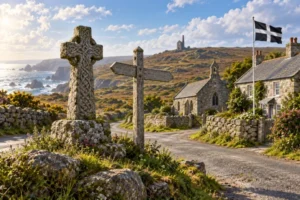
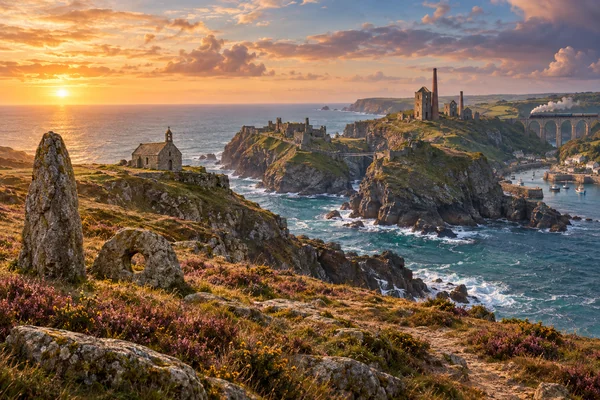
Cornwall’s granite uplands are full of the Stone Age. On Carn Brea, above Redruth, a hilltop enclosure was in use between roughly 3900 and 3350 BC. Excavations there found more than 700 flint arrowheads clustered at an entrance, and they are often read as evidence of an attack. Lanyon Quoit in West Penwith, a Neolithic tomb, fell in a storm in 1815 and was rebuilt, though not quite as it had stood. Nearby, the holed stone of Men-an-Tol dates to somewhere between the late Neolithic and the middle Bronze Age, and nobody knows what it was for. On Bodmin Moor, the three stone circles of the Hurlers were already the stuff of legend by 1650, when a writer likened them to men playing the old Cornish game of hurling.
Cornwall’s wealth was always under the ground. For two centuries historians argued about whether Cornish tin really reached the ancient Mediterranean, and in 2025 the question was settled. Tin ingots from shipwrecks off Israel, dating to around 1300 BC, were chemically traced to south-west Britain. The Greek historian Diodorus Siculus, writing in the 1st century BC, describes Britons carrying tin to a tidal island called Ictis to trade. St Michael’s Mount is the favourite candidate, but it has never been proved, and archaeologists are still digging there.
By Roman times people were living in villages like Chysauster near Penzance, where stone courtyard houses sheltered perhaps fifty to seventy people between the 1st and 3rd centuries AD. You can still walk its lanes today.
Rome’s light touch
The Romans reached Cornwall but never made it their own. A turf-and-timber fort at Nanstallon near Bodmin was occupied for only a few years, around AD 65 to 79, and a second fort was found at Restormel near Lostwithiel in 2008. Five Roman milestones are known in the county, but there’s no sign of a network of paved roads. Tin was probably what brought the Romans this far west. The people they found here were the Dumnonii, who most likely spoke an early form of Cornish.
Saints, Tintagel and the Tamar
After Rome, Cornwall became part of the Celtic world of the western seas. Saints arrived from Wales and Ireland and gave their names to many of its parishes. St Piran, who by legend discovered tin when his hearthstone smelted in the fire, became the patron saint of tinners. His story, and dozens like it, are part of our guide to Cornish storytelling.
On the headland at Tintagel, between about AD 450 and 650, stood a high-status stronghold, probably a seat of Cornwall’s rulers. More imported Mediterranean pottery has been found there than anywhere else in Britain. The link with King Arthur came much later: Geoffrey of Monmouth placed Arthur’s conception at Tintagel around 1138, and Earl Richard built the castle whose ruins stand today after buying the island in 1233. Our guide to the myths of Tintagel separates the legend from the digging.
Meanwhile Wessex was pushing west. In 838 the Cornish and their Danish allies were beaten at Hingston Down, and the last recorded Cornish king, Dungarth, drowned in 875. By tradition, it was King Athelstan who fixed Cornwall’s boundary at the east bank of the Tamar in 936, though the account comes from a chronicler writing two hundred years later. The river has marked where Cornwall begins ever since.
The Duchy and the stannaries
Medieval Cornwall ran on tin, and tin had its own law. In 1201 King John granted the tinners a charter, and Cornwall’s four stannaries (Foweymore, Blackmoor, Tywarnhayle, and Penwith and Kerrier) became a kind of state within the state, with their own courts and, later, their own Stannary Parliament. The Crown taxed every block of tin at twice the Devon rate, a charge that lasted until 1838. In 1337 Edward III made his son, the Black Prince, the first Duke of Cornwall, the first duchy in England, and the title has passed to the monarch’s eldest son ever since. Our tin mining heritage guide follows the industry from these beginnings.
Rebellion: 1497 and 1549
Twice in fifty years, Cornwall marched against the Crown. In 1497 a blacksmith from St Keverne, Michael Joseph, known as An Gof (“the smith”), and a Bodmin lawyer, Thomas Flamank, led thousands of Cornishmen towards London in protest at taxes raised for Henry VII’s war with Scotland. They were defeated at Blackheath on 17 June and both men were executed ten days later. That September the pretender Perkin Warbeck landed at Whitesand Bay and led a second Cornish rising as far as Exeter and Taunton before it collapsed. Eleven years later Cornwall bought its rights back: the 1508 Charter of Pardon, which cost £1,000, restored the stannary charters and gave the Stannary Parliament a veto over laws that harmed the tinners.
The second rising was deadlier. In 1549 the government replaced the Latin church service with the English Book of Common Prayer. Cornwall rose with Devon in the Prayer Book Rebellion, and the rebels’ own demands complained that some of them understood no English. The rising was crushed that August at Sampford Courtenay. Historians estimate that around 4,000 people died, possibly more. It’s remembered as a turning point in the decline of the Cornish language.
Royalist Cornwall
In the Civil War Cornwall came out for the King and fought hard. Royalist Cornish armies under Sir Ralph Hopton and Sir Bevil Grenville won at Braddock Down in January 1643 and at Stratton in May, where 300 Parliamentarians died and 1,700 were taken prisoner. In 1644 the Parliamentarian Earl of Essex was trapped around Lostwithiel. He escaped by boat, but his infantry surrendered on 2 September, one of the King’s greatest victories, though it did little to change the course of the war.
The language that refused to die
Cornish is a Celtic language, a close cousin of Welsh and Breton. It retreated west for centuries as English advanced, until by the 1700s it survived only among fishing communities in the far west. Dolly Pentreath of Mousehole, who died in 1777, is famous as its last native speaker, but she wasn’t. A Mousehole fisherman, William Bodinar, wrote a letter partly in Cornish in 1776, and recent research suggests there were still between ten and ninety-nine speakers in the late 18th century. Fragments lasted much longer, with John Davey of Zennor, who died in 1891, still remembering parts of the language.
The revival began in 1904, when Henry Jenner published A Handbook of the Cornish Language. In 1928 Jenner and Robert Morton Nance held the first Gorsedh at the stone circle of Boscawen-Un. In 2010 UNESCO changed its listing of Cornish from “extinct” to “critically endangered”, and in January 2026 Cornish was given the highest level of protection under the European Charter for Regional or Minority Languages, the same level as Welsh and Scottish Gaelic. Children are being raised in it again. The full story, with the Cornish you’ll meet on the map, is in our guide to the Cornish language.
Boom and bust: the mining century
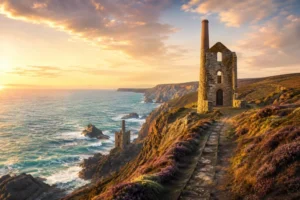
In the early 19th century Cornwall was one of the most industrialised places on earth. By the 1830s it dominated world copper production, and output peaked in the mid-1850s. It was also a county of inventors. On Christmas Eve 1801 Richard Trevithick drove his steam road locomotive, the Puffing Devil, up Camborne Hill, and Penzance-born Humphry Davy invented the miners’ safety lamp in 1815. Engine houses went up on every cliff and moor, and the pasty became the miner’s lunch. Our guide to the Cornish pasty tells that story.
Then it fell apart. Copper crashed in 1866, and tin began to decline from 1874 as cheaper tin came in from Malaya and Australia. Around a quarter of a million people left Cornwall between 1841 and 1901, the “Cousin Jacks” who took Cornish mining skills around the world. They went to Real del Monte in Mexico from 1825, to Wisconsin and California, and to South Africa. In South Australia Cornish people made up a huge share of the immigrants, and a Gwennap miner, John Verran, became the state’s Premier in 1910. The last working mines held on through the 20th century: Geevor closed in 1990, Wheal Jane in 1991 and South Crofty in 1998. In 2006 Cornwall and West Devon’s mining landscape became a UNESCO World Heritage Site. The same years saw the darker side of Victorian Cornwall, told in our guide to Bodmin Jail.
The sea, the railway and the Riviera
The sea fed Cornwall as surely as the mines did. Pilchards were the great fishery: in 1847 Cornwall exported 40,883 hogsheads of them, about 122 million fish, and a single seine net at St Ives landed a record 5,600 hogsheads in 1868. By the 1960s the shoals had all but gone. The coast had its outlaws too, and our guides to the pirates of Cornwall and Cornwall’s maritime heritage cover the smugglers, wreckers and lifeboat crews.
Then the railway came. Brunel’s Royal Albert Bridge carried the line over the Tamar at Saltash in 1859. Prince Albert opened it on 2 May, and Brunel died that September. In 1904 the Great Western Railway launched the Cornish Riviera Express and sold Cornwall as a sunny, exotic escape. Tourism took over from mining as the county’s great industry. Our guide to reaching Cornwall covers the journey today.
Cornwall today
Modern Cornwall is two things at once: one of Britain’s favourite holiday destinations and one of its poorer regions. Its economy was weak enough to qualify for the European Union’s top level of regional aid, Objective One, from 2000. In 2014 the UK government recognised the Cornish as a national minority, the same status as the Welsh, Scots and Irish. In the 2021 census, 117,350 people in Cornwall identified as Cornish. St Piran’s Day on 5 March, once the tinners’ feast, has become a national day, with black-and-white flags everywhere; see our festivals guide. The pressures are real too: second homes, house prices and a seasonal economy, which our guide to moving to Cornwall covers honestly.
The story may be coming full circle. The world needs tin and lithium for electronics and batteries, and Cornwall has both. South Crofty, the last tin mine to close, raised major new funding in 2026 and is being pumped dry ahead of a decision to reopen. At St Dennis, Cornish Lithium plans to extract lithium from the old china-clay pits, with its planning application due in late 2026. After a century and a half, Cornwall could be a mining county again.
Myths and facts
- “King Arthur was born at Tintagel.” That’s legend, first written down around 1138. What is true is that Tintagel was a genuinely important royal site centuries earlier.
- “St Michael’s Mount was the ancient tin port of Ictis.” It’s possible, but it has never been proved.
- “Dolly Pentreath was the last speaker of Cornish.” She wasn’t. Other speakers outlived her, and the language never quite disappeared.
- “Athelstan fixed the Tamar border in 936.” That’s the traditional story, told by a writer two centuries later. The Tamar as the border is real; the details are uncertain.
- “St Piran discovered tin.” A much-loved legend. Tin was being traded from Cornwall more than 1,500 years before St Piran lived.
FAQ
Q: What is the history of Cornwall in brief?
A: Stone Age monuments and a prehistoric tin trade reaching the Mediterranean; a light Roman presence; Celtic saints and the stronghold at Tintagel; medieval tin law and the Duchy of Cornwall (1337); the 1497 and 1549 risings; a Royalist Civil War; the near-loss and revival of the Cornish language; world-leading copper and tin mining, then collapse and mass emigration; and a modern Cornwall of tourism, national minority status and a mining revival.
Q: Is Cornwall a country?
A: Cornwall is part of England, governed as a county and unitary authority, and it is also a royal duchy. Many Cornish people regard it as a Celtic nation, and in 2014 the UK government recognised the Cornish as a national minority.
Q: Is the Cornish language dead?
A: No. The last communities of traditional speakers faded in the late 18th and 19th centuries, but a revival began in 1904. Cornish now has official protection, the highest level under the European Charter for Regional or Minority Languages since 2026, and is spoken and taught again.
Q: Was King Arthur from Cornwall?
A: Arthur is a legend. Geoffrey of Monmouth linked him to Tintagel around 1138. Archaeology shows Tintagel really was a high-status site between about AD 450 and 650, but there is no evidence that Arthur existed.
Q: Why did so many Cornish people emigrate?
A: When copper crashed in 1866 and tin declined from the 1870s, mining jobs vanished. Around a quarter of a million people left between 1841 and 1901, taking Cornish mining skills to the Americas, South Africa and Australia.
Q: Is mining coming back to Cornwall?
A: It looks likely. South Crofty tin mine raised new funding in 2026 and is being prepared to reopen, subject to a final investment decision, and Cornish Lithium is planning to extract lithium near St Dennis.
References and resources
- English Heritage — Tintagel Castle history: www.english-heritage.org.uk
- English Heritage — Chysauster Ancient Village: www.english-heritage.org.uk
- English Heritage — the Hurlers: www.english-heritage.org.uk
- The Conversation — Bronze Age Britain traded tin with the Mediterranean: theconversation.com
- Cornwall Heritage Trust — timeline of Cornish history: www.cornwallheritagetrust.org
- Cornish Mining World Heritage Site — history: www.cornishmining.org.uk
- History of Parliament — Perkin Warbeck and 1497: historyofparliament.com
- University of Exeter — Cornish after Dolly Pentreath: news.exeter.ac.uk
- Gorsedh Kernow — history: gorsedhkernow.org.uk
- Cornwall Council — Cornish granted Part III status: www.cornwall.gov.uk
- Cornwall Council — the Cornish national minority: www.cornwall.gov.uk
- Trevithick Society — the Puffing Devil: trevithicksociety.info
- University of Exeter — the Cornish diaspora: www.exeter.ac.uk
- National Wealth Fund — South Crofty funding: www.nationalwealthfund.org.uk