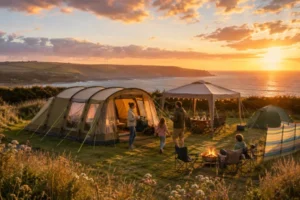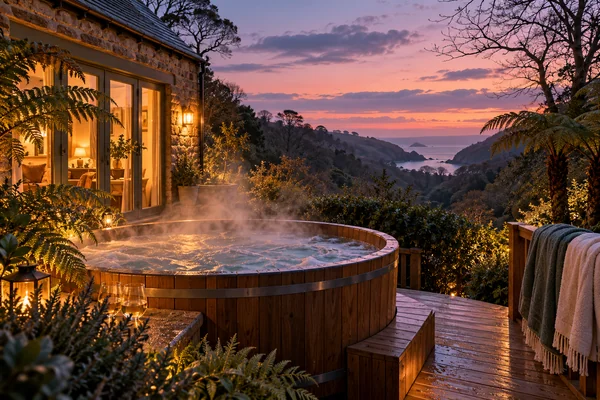
Quick answer: hundreds of Cornish cottages advertise a hot tub, and the listing rarely tells you the things that matter. Is it private or shared? Is the water changed between guests? Is it heated in winter, and does it cost extra? Health and Safety Executive guidance for holiday lets says a domestic-type tub should be emptied and refilled after each rental or weekly, whichever comes first — yet almost no Cornish operator publishes its policy. This is the buyer’s guide: where to search, what to ask before you pay, and where a hot tub is actually worth having in a Cornish winter.
A hot tub is the single most requested extra in self-catering, and in Cornwall it’s a genuinely good one: the climate is mild enough to sit outside in February, and the view is usually the point. But “with hot tub” is a filter, not a specification, and two cottages at the same price can offer completely different things. This guide is about the questions, not the pretty photographs. For the hotel version of the same idea, see our guide to Cornish spa breaks.
Table of Contents
- Where to look
- Private or shared? The question that matters most
- The question nobody answers: the water
- Ten questions to ask before you book
- Where a hot tub actually works in Cornwall
- What it costs
- Places worth knowing
- FAQ
- References and resources
Where to look
Three kinds of place sell them, and they behave differently:
| Agency | Cornish hot-tub properties | Worth knowing |
|---|---|---|
| Classic Cottages | 71 stated | Cornwall-based, dedicated hot-tub pages, booking fees shown in the price |
| Unique Homestays | 46 stated | The luxury end; short breaks typically 15–30% below the weekly rate |
| Cornish Gems | 37 stated | The only agency we found that publishes a hot-tub FAQ |
| Sykes Cottages | Filter available | The biggest national list; its page count covers all Cornwall, not just hot tubs |
| Cornish Horizons | Filter available | Town-level hot-tub pages for Newquay and St Ives |
| Airbnb | Amenity filter | The tub is described by the owner, with no agency checking it |
The resort model is the other one to understand. At places like Retallack near St Columb Major, the lodges are individually owned and let through several agencies at once, so the same lodge can appear in three places with different descriptions. Book the lodge, not the resort, and read that specific listing.
Private or shared? The question that matters most
“Hot tub” can mean a tub on your own deck, or a tub in a shared garden you book a slot in, or a tub in a leisure club that other people use too. All three are legitimate; they’re just not the same holiday.
- Private, on your own terrace. What most people are imagining. Cornish Gems is the only operator we found that states in writing that its tubs are exclusively for guests at the property.
- Shared with timed private sessions. Tredethick Farm near Lostwithiel runs a hot-tub garden where guests book a private hour. It’s a sensible model, and completely different from having one outside your door.
- Part of a leisure club. At some resorts the pool and spa are open to members and local residents as well as guests, so the facilities are busier than the brochure suggests.
This isn’t only about privacy. The HSE’s own guidance says that where several units share a tub it should be a commercial-specification spa pool, not the domestic sort you’d have at home: shared use is a different risk, and should come with different equipment.
The question nobody answers: the water
Here is the fact worth knowing before you book anything. The Health and Safety Executive’s guidance on spa pools covers holiday lets explicitly. For a domestic-type tub rented to one family or group at a time, it says the water should be changed after each rental or each week, whichever is shorter, with disinfectant fed in continuously rather than tipped in by hand.
- Typical operating temperature is 30–40°C.
- At pH 7, free chlorine should be 3–5 mg/l, or bromine 4–6 mg/l.
- A tub should be closed and corrected if chlorine falls below 1 or exceeds 10 mg/l, or bromine below 2 or above 12.
Now the awkward part: of every Cornish agency page we checked, not one published its water-change policy. That absence isn’t evidence of bad practice, but it does mean the only way to know is to ask. A good operator will answer immediately and specifically, because the ones who do it properly are proud of it.
Ten questions to ask before you book
- Is the hot tub private to our cottage, or shared?
- Is the water emptied and refilled between guests, or treated and topped up?
- Is it heated and available all year, or seasonally?
- Is there an extra charge, and is it per stay or per use?
- If it’s turned off between lets, how long does it take to reach temperature after we arrive?
- What time can we use it until, and are there quiet hours?
- Are children allowed in it, and at what age?
- Is there a no-glass rule, and is there somewhere to put drinks?
- Is it screened from neighbours and the lane, or is it overlooked?
- Are towels or robes provided for it, or should we bring our own?
None of these were published by the operators we looked at, which makes them worth an email. The replies also tell you a lot about how the place is run.
Where a hot tub actually works in Cornwall
This is our opinion rather than a measurement, but it holds up: shelter beats a view. A tub in a wooded valley, a walled garden or a farm courtyard is usable in a February gale. An exposed clifftop deck photographs beautifully and can be miserable in a wind that comes off the Atlantic with nothing in its way for three thousand miles.
If you want the sea view as well, look for a tub set below the skyline, with a hedge, a wall or a bank behind it. And remember that the best of the Cornish winter is often horizontal rain: the tub is a place to sit in weather, not to escape it. Our January guide is an honest account of what you’re sitting out in.
What it costs
Expect to pay a premium. Letting agencies rate a hot tub as the single biggest revenue-raising feature a Cornish cottage can have: an industry report put the uplift at around 49% of annual revenue for owners who add one. That premium comes out of your booking.
Two ways to soften it: book midweek or a short break, where some agencies discount 15–30% against the weekly rate, and book early for next season, where deposits can be as low as £40. Winter is when hot-tub cottages are at their best value and their most enjoyable, which is the whole argument of our romantic winter breaks guide.
Places worth knowing
- Bosinver Farm, near St Austell — 20 cottages in 30 acres with an indoor pool, sauna and animals for children. Only a couple of the cottages have their own tub, so book the specific one.
- Tredethick Farm Cottages, near Lostwithiel — a 700-year-old farmstead with a shared hot-tub garden and bookable private sessions, plus an indoor pool.
- Retallack Resort, St Columb Major — individually owned lodges, many with private tubs, alongside a shared pool, sauna and steam room. Check the individual listing.
- Cornish Gems’ hot-tub collection — the clearest written statement that the tubs are for the property’s guests alone.
- Classic Cottages and Unique Homestays — the broadest Cornwall-based choice at either end of the price range.
Two cautions from our research: ownership changes fast in this market, and at least two well-known Cornish parks have changed hands or dropped their hot tubs in the past couple of years. Check the operator’s own website, not an aggregator’s cached description, before you book.
FAQ
Q: How often should hot tub water be changed in a holiday cottage?
A: HSE guidance for holiday lets says a domestic-type hot tub used by one family or group at a time should have its water changed after each rental or weekly, whichever is shorter, with disinfectant fed in continuously. Few Cornish operators publish their policy, so ask.
Q: How many Cornwall cottages have hot tubs?
A: Hundreds across the agencies. Classic Cottages lists 71 in Cornwall, Unique Homestays 46 and Cornish Gems 37, and the national agencies such as Sykes and Airbnb add many more through their filters.
Q: Is the hot tub private or shared?
A: It varies, and listings often don’t say. Some are private to the cottage, some are in a shared garden with bookable private sessions, and some are part of a leisure club open to members and local residents too. Ask before booking.
Q: Are hot tubs available in winter in Cornwall?
A: Usually, and winter is when they’re best: Cornwall’s mild coastal climate makes sitting outside in January genuinely pleasant. Check with the owner, as some tubs are turned off between lets and take hours to heat.
Q: Do hot tub cottages cost more?
A: Yes. A hot tub is the biggest revenue-raising feature a holiday cottage can add, with an industry estimate of around 49% more annual revenue, and that premium is in the price. Midweek and short-break rates can be 15–30% lower than weekly ones.
Q: Where in Cornwall is best for a hot tub cottage?
A: Sheltered inland and wooded settings, where you can use it in a gale. Exposed clifftop decks look better in photographs than they feel in February. If you want a sea view, look for a tub below the skyline with a wall or hedge behind it.
References and resources
- HSE — control of legionella in spa-pool systems (HSG282): www.hse.gov.uk
- Classic Cottages — Cornwall cottages with hot tubs: www.classic.co.uk
- Cornish Gems — hot tub holidays: www.cornishgems.com
- Unique Homestays — Cornwall cottages with hot tubs: www.uniquehomestays.com
- Sykes Cottages — Cornwall cottages with hot tubs: www.sykescottages.co.uk