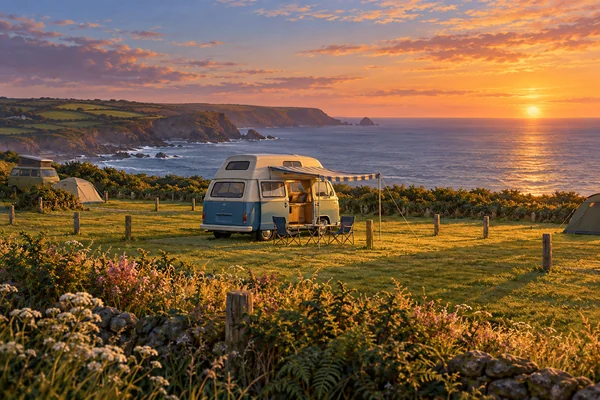
Quick answer: Cornwall is one of the best places in Britain to take a van and one of the worst to assume you can sleep anywhere in it. Overnight sleeping in council car parks is not permitted as a general rule — but following a trial at Bude, Cornwall Council has opened overnight motorhome parking at an additional ten car parks, for fully self-contained vehicles only, meaning your own toilet and sealed waste. Those ten include Padstow, Watergate Bay, St Ives, Perranporth and Fowey. Everywhere else, book a campsite. And the real constraint is not the rules at all — it is the lanes.
A campervan looks like the perfect way to do Cornwall: park at the beach, cook outside, move on. The reality is a county with single-track lanes bounded by stone, villages that cannot physically take a large vehicle, and a council that has spent two years rewriting the rules on where you may sleep. None of that makes it a bad idea — it makes it a trip you have to plan. This is what the rules actually say, where you can legitimately stay, and which roads to keep a long vehicle off. Our parking guide covers parking generally, and the camping guide covers campsites and the wild camping position.
Table of Contents
- The overnight rules, and what actually changed
- Where you can legitimately stay
- The real constraint is the lanes
- Practical van things specific to Cornwall
- Why do it anyway
- FAQ
- References and resources
The overnight rules, and what actually changed
Start here, because this is the part that has moved and most published advice is out of date.
The default position is unchanged: you may not sleep overnight in a Cornwall Council car park. Paying for a parking session is not the same as buying the right to stay in the vehicle, and people have been fined for assuming otherwise in car parks they had paid for.
What changed is that there are now exceptions. After what the council called a successful trial at Bude, it consulted in January 2026 on allowing fully self-contained motorhomes to park overnight at an additional ten car parks. The consultation closed on 4 February 2026, and the new Off Street Parking Order — made on 26 March 2026 — brought in motorhome charges at ten named sites.
The ten sites
- Link Road, Padstow
- Watergate Bay
- Trenwith, St Ives
- Wheal Leisure, Perranporth
- Main car park, Fowey
- Marazion Station
- Gyllyngvase coach park, Falmouth
- Seaton Bridge
- Cattle Market, Launceston
- Victoria Square, Bodmin
That is a genuinely useful spread: north coast, south coast, the far west, and two inland towns.
What ‘fully self-contained’ means
It is the condition everything else hangs on. The council’s proposal required vehicles to carry their own toilet and sealed waste containers. A van with a bed and no toilet does not qualify, however tidy you are about it.
One honest caveat. The overnight window and the nightly price have been widely reported — commonly as roughly 6pm to 9am, and somewhere between £10 and £20 a night in summer with less in winter — but we could not confirm those figures from the council’s own published material, and reports of height barriers and blanket enforcement come only from low-quality sources. Treat the ten locations as solid and every number as something to check against the sign and the council’s current parking pages before you rely on it.
Where you can legitimately stay
Four options, in descending order of certainty.
A campsite, which is still the answer most nights
Cornwall has a dense network of sites, from large commercial parks with hook-ups to farm fields with a tap. For a van this is the only option that guarantees you a pitch, a shower, power and somewhere legal to empty a toilet. Our camping guide covers choosing between them and the rules that apply.
Book ahead between May and September. The idea that you will roll up somewhere in August is how people end up driving at eleven at night looking for anywhere at all.
One of the ten designated car parks
Self-contained motorhomes only, charged, and almost certainly limited in number. Useful for a night in a specific town rather than as a touring strategy.
A pub or farm with hardstanding
Cornwall has a long informal tradition of pubs letting a van stay for the price of dinner, and a number of farms offer a handful of pitches. Both are arrangements you ask for in advance, not assume on arrival.
Not a layby, not a beach car park, not a clifftop
This is where goodwill has been lost. Overnight stopping at the coastal beauty spots is what prompted the restrictions in the first place, and in the honeypot villages residents report it. Our off-season guide notes that the pressure eases enormously outside the school holidays, which is also when the county is at its best in a van.
The real constraint is the lanes
Rules aside, the thing that decides whether a van trip in Cornwall is a pleasure or an ordeal is the road network, and this is where size matters more than anything on your booking.
- Cornish lanes are bounded by stone, not hedge. What looks like a green hedgerow is a stone-faced earth bank — our Cornish hedges piece explains what they are — and brushing one does not give the way a hedge does. It takes the side off a van.
- Passing places are the system. On single-track lanes, reversing is expected, and in a long vehicle you should assume you will be the one doing it. Know your reversing camera before you come.
- Height and width catch people at the bottom, not the top: the last few hundred metres down to a cove is routinely the narrowest, steepest part of the route.
- Satnav is actively dangerous here for a large vehicle. It will route you down lanes that are legal and impassable. Set it to avoid unpaved and narrow roads, and sanity-check on a map.
- The A30 is the spine and the A38 the alternative. Stay on them as long as you can and come down to the coast once. Our road trip itinerary and guide to reaching Cornwall cover the approach.
And use the ferries. Several of them take vehicles and cut out long detours — King Harry saves 27 miles round the Fal — though check the deck length limits for anything large. Our ferries guide has every crossing.
Practical van things specific to Cornwall
- Water and waste. Plan emptying around campsites; the ten designated car parks require you to be self-contained precisely because they are not service points.
- Gas and supplies are easy in the towns, thin on the peninsulas. Fill up before heading for the Lizard or Land’s End.
- Wind is the weather that matters in a van, not rain. A high-sided vehicle on an exposed clifftop car park in a gale is unpleasant and occasionally unsafe — our weather guide covers how often that happens, and the storm watching guide covers the days to sit out.
- Phone signal is poor in the coves, which matters when parking payment is app-based. Download what you need before you drop down the hill.
- Fuel is dearer the further west you go, and sparse beyond Penzance.
- Dogs, boards and bikes all work better from a van than from a hotel, which is much of the point.
Why do it anyway
Having spent five sections on constraints, the case for a van in Cornwall is still strong, and it is strongest in the half of the year nobody comes.
Out of season the whole calculation inverts. Campsites have space, lanes are empty, car parks are half full, and the county is at its most dramatic. A van puts you on a clifftop for sunrise and at a pub fire by evening without booking either. Our sunset spots guide covers where to finish the day, the stargazing guide covers Bodmin Moor’s dark skies, and the coast path guide covers walking a stretch and coming back for the van.
The trade is simple: in a van you give up certainty about where you will sleep and gain everything else. In Cornwall, in August, that trade is a bad one. In October it is an excellent one.
FAQ
Q: Can you sleep overnight in a campervan in Cornwall?
A: Not as a general rule in Cornwall Council car parks, where overnight sleeping is not permitted and people have been fined for it. Following a trial at Bude, the council has opened overnight motorhome parking at an additional ten car parks for fully self-contained vehicles. Otherwise, use a campsite.
Q: Which Cornwall car parks allow motorhomes overnight?
A: The ten sites named in the 2026 parking order are Link Road in Padstow, Watergate Bay, Trenwith in St Ives, Wheal Leisure in Perranporth, the main car park in Fowey, Marazion Station, the Gyllyngvase coach park in Falmouth, Seaton Bridge, Cattle Market in Launceston and Victoria Square in Bodmin. Check current conditions with the council before relying on any of them.
Q: What counts as a fully self-contained motorhome?
A: For Cornwall’s overnight parking, a vehicle carrying its own toilet and sealed waste containers. A converted van with a bed but no toilet does not qualify, regardless of how carefully it is used.
Q: How much does overnight motorhome parking cost in Cornwall?
A: Figures of roughly £10 to £20 a night in summer, with less in winter, have been widely reported, but we could not confirm them from the council’s own published material. Check the sign and the council’s parking pages rather than relying on a published figure.
Q: Is wild camping allowed in Cornwall in a van?
A: No. Overnight stopping in laybys, beach car parks and clifftop pull-ins is what prompted the current restrictions, and it is reported by residents in the busier villages. Use a campsite, one of the ten designated car parks if you are self-contained, or a pub or farm that has agreed in advance.
Q: Are Cornish roads suitable for a large motorhome?
A: The main roads are fine; the lanes are the problem. They are bounded by stone-faced earth banks rather than soft hedges, passing places require reversing, and the narrowest, steepest section is usually the last stretch down to a cove. Set satnav to avoid narrow roads and check routes on a map.
Q: When is the best time to take a campervan to Cornwall?
A: Outside the school holidays, and ideally in autumn or spring. Campsites have space, the lanes are empty, car parks are not full by mid-morning and the coast is at its most dramatic. August is the hardest month for a van in every respect.
References and resources
- Cornwall Council — overnight motorhome parking consultation: www.cornwall.gov.uk
- Cornwall Council — Off Street Parking Order 2026: letstalk.cornwall.gov.uk
- Cornwall Council — parking: www.cornwall.gov.uk
- Cornwall Council — temporary campsite planning guidance: www.cornwall.gov.uk