Quick answer: to find a secluded spot in Cornwall, walk. Almost every famous beach has an empty cove a mile along the coast path; the tide, the time of day and the season empty the rest. Go early or late, go in September, choose the beach with the long walk from the car park, learn to read an OS map for the coves with no road, and treat the coast path as a corridor of private places rather than a route. The method — and a few starting points — below.
Every couple in Cornwall wants the same thing: the beach with nobody on it, the headland with one bench, the harbour before the day-trippers arrive. The good news is that Cornwall still has hundreds of such places; the trick is that they don’t have signposts, and if this guide gave you a list of them they’d stop being secluded by next summer. So instead of a list, here’s the method — the handful of habits that reliably find quiet corners of Cornwall for two — with a few honest starting points that can take the company.
Table of Contents
- The method: six habits that find quiet places
- Reading the map for coves
- Starting points that can take the company
- Secluded, but safe
- Personal insights and experiences
- FAQ
- References and resources
The method: six habits that find quiet places
- Walk twenty minutes. Crowds are lazy. From any busy beach, follow the coast path for twenty minutes and you’ll pass the last of them; the next cove is usually yours.
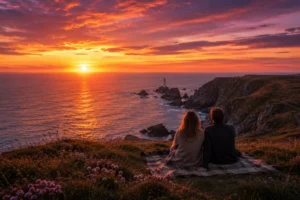
- Own the edges of the day. Before 9am and after 5pm the most famous beaches in Cornwall are quiet, golden and mostly empty. Sunrise swims are a couples’ cheat code.
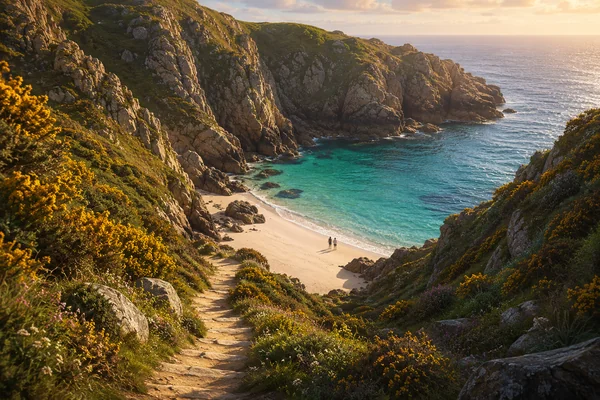
- Use the tide. Many coves only exist at low water; check tide times, arrive as it drops, and you’ll have a beach that wasn’t there an hour ago — and leave before it isn’t again.
- Choose the long car park. Beaches with a mile’s walk from parking are quieter than beaches with a mile of parking. National Trust car parks on the coast are a good sign.
- Come in the shoulder season. The whole county empties in September; by October you can have famous beaches to yourselves.
- Look inland too. The creek-side woods of the Helford, Fowey and Fal, the moorland tors, the river valleys — the crowds go to the coast; the quiet is often just behind it.
Reading the map for coves
An Ordnance Survey Explorer map is the best romantic accessory in Cornwall. Look for the pattern: a cove name on the coast, a footpath reaching it, and no road — no car park symbol, no lane ending at the beach. Those are the ones. Then check the contour lines for how steep the descent is (steep keeps the crowds out and tests the knees), and the tide tables for whether the sand exists at high water. The coast path will get you there; the map tells you where “there” is.
Starting points that can take the company
- The coves between Fowey and Polkerris — a coast-path stretch of small beaches, most reached only on foot.
- The Roseland — Towan and Porthcurnick beaches, and the whole quiet peninsula behind them.
- The Helford’s creeks — Frenchman’s Creek and its neighbours; wooded, tidal, hushed.
- The Penwith coast between Zennor and Pendeen — wild, mostly roadless, and gloriously underused.
- The Rame peninsula — Cornwall’s forgotten corner across the water from Plymouth, with beaches most of the county has never heard of.
- Anywhere on the map that fits the pattern above. That’s the point.
Secluded, but safe
- Tides cut people off every year — know the time of high water and the way back up before you settle in.
- No lifeguards means no swimming in surf or near rocks; sheltered coves only, and never alone.
- Tell someone where you’re heading; mobile signal on the coast path is patchy.
- Leave it as you found it — the seclusion is the gift; the litter is the tax nobody wants to pay.
Personal insights and experiences
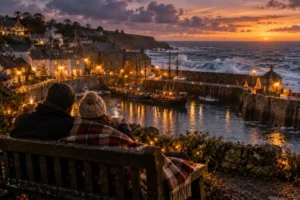
Our own version of this is less about undiscovered coves and more about timing. My wife and I go to Looe when it’s just us — hardly a secret — but Looe at eight on a September morning, walking the empty harbour with the boats going out and the tide making, is as private as any hidden beach. The lesson generalises: you don’t always need a place nobody knows; you need the hour nobody uses.
Everything else on this page comes from years of family days out and the coast path — the beach that emptied when we walked twenty minutes, the cove that only appeared as the tide went out, the map on the kitchen table the night before. Cornwall doesn’t hide its quiet places; it just doesn’t advertise them. Go and look.
FAQ
Q: Where are the most secluded beaches in Cornwall?
A: The coves without road access — between Fowey and Polkerris, on the Roseland, along the Penwith coast and the Rame peninsula. Find them on an OS map by looking for a footpath and no car park.
Q: How do I avoid crowds in Cornwall?
A: Go early or late in the day, walk twenty minutes from any car park, use the tide, choose beaches with long walks in, and travel in September or October rather than August.
Q: Are secluded coves safe for swimming?
A: Only sheltered ones, never alone, and never near surf or rocks; unlifeguarded water needs more caution, not less. Always know the tide.
Q: What is the quietest part of Cornwall?
A: The Rame peninsula in the far south-east, the Roseland, and the Penwith coast between Zennor and Pendeen are among the least crowded, even in summer.
References and resources
- Ordnance Survey maps: shop.ordnancesurvey.co.uk
- Tide times: www.tidetimes.org.uk
- South West Coast Path Association: www.southwestcoastpath.org.uk