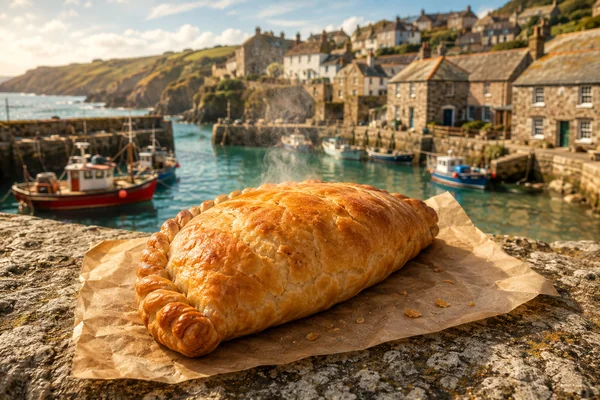
Quick answer: a genuine Cornish pasty is a D-shaped pastry case, crimped along one side (never on top), filled raw with roughly chopped beef, potato, swede and onion, seasoned with salt and pepper and nothing else, then baked slowly until golden. Since 2011 the name has been legally protected: only pasties made in Cornwall to that recipe can be called Cornish. Everything else — history, the family recipe, where to eat one — is below.
The Cornish pasty is the county’s greatest edible export and, in our family, something close to a religion. My father has made them all my life without measuring a thing; my uncle once ran a pasty shop in Looe; I bake them myself to the Cornish Pasty Association’s own recipe; and I have eaten them in more Cornish towns than I can count without ever finding one I didn’t like. This guide covers the pasty’s history and its myths, exactly what makes one genuinely Cornish, how our family makes them, the modern twists, and where to eat them — written by someone who has spent a lifetime doing the research the hard way.
Table of Contents
- The history of the Cornish pasty
- What makes a pasty genuinely Cornish
- How our family makes Cornish pasties
- Modern twists on the classic pasty
- Where to eat Cornish pasties in Cornwall
- Personal insights and experiences
- FAQ
- References and resources
The history of the Cornish pasty
From medieval pie to miner’s lunch
Pasties of one sort or another have been eaten in Britain since the Middle Ages — the word turns up in the 13th century, wrapped around all manner of fillings for all manner of people, including royalty. What made the pasty Cornish was the mining boom of the 18th and 19th centuries. Cornwall’s tin and copper miners — the “tinners” — needed a meal that was filling, portable, held its heat underground for hours, and could be eaten with dirty hands. The pasty was perfect: a whole dinner in a robust pastry case, and the origin of the “tinner’s pasty” you’ll still see on bakery boards today. When Cornish miners emigrated in their thousands to Mexico, Australia, South Africa and the copper mines of Michigan, the pasty went with them, which is why you can find surprisingly good ones in some surprising places.
Myths and traditions
- The crimp as a handle. The famous story is that miners held the pasty by its thick crimp with arsenic-dusted fingers, then threw the crust away. It’s a lovely tale and it may sometimes have been true — but historians point out that hungry miners weren’t in the habit of throwing food away, and many carried their pasties in muslin bags. Enjoy the story; hold it lightly.
- The two-ended pasty. Traditionally, some pasties were made savoury at one end and sweet at the other — meat and potato, then apple or jam — a full dinner and pudding in one crust. Yes, sweet-and-savoury Cornish pasties really were a thing, and my dad still makes them.
- Initials in the corner. Miners’ wives would mark a pasty with the man’s initials in the pastry at one end, so a half-eaten pasty could be claimed later.
- Devon versus Cornwall. Devon points to the oldest surviving written record — Plymouth accounts from the early 1500s — and claims the pasty as its own. Cornwall replies that it made the pasty famous, and that a real one is crimped on the side, not on top. Both are true; only one has the protected name.
What makes a pasty genuinely Cornish
Since 2011 the “Cornish pasty” has held Protected Geographical Indication (PGI) status — the same protection as Champagne or Melton Mowbray pork pies. To carry the name, a pasty must be:
- Made in Cornwall — prepared and assembled here (it can be baked elsewhere, but it must be Cornish-made).
- D-shaped and crimped along one side — never across the top.
- Filled with beef, potato, swede and onion — roughly diced or minced beef (at least 12.5%), sliced or diced potato, swede and onion (at least 25% vegetables), seasoned with salt and pepper. No other meat, no other vegetables, no additives — and, famously, no carrots.
- Filled raw and baked slowly, so the meat and vegetables cook together inside the pastry and make their own gravy.
- Glazed with egg or milk, and robust enough to hold its shape without cracking — because it was designed to survive a shift down a mine.
Anything else — cheese and onion, chicken, lamb and mint, the vegan one — can be a very good pasty from Cornwall, but legally it isn’t a Cornish pasty. Locals will happily eat both.
How our family makes Cornish pasties
My dad’s method is entirely traditional and entirely unmeasured — lard and butter in the shortcrust, beef skirt, potato, swede, onion, a lot of pepper, and forty years of feel. When I made a proper batch myself last year I wanted numbers, so I followed the Cornish Pasty Association’s official genuine Cornish pasty recipe, which turns out to be exactly what my dad does by instinct. They were amazing. Rather than reprint the Association’s recipe, here’s the shape of it and the things I learned making it.
The essentials (makes about six)
- Pastry: strong bread flour, roughly equal parts lard (or white shortening) and butter, a teaspoon of salt, cold water. Knead it more than you would ordinary shortcrust — it needs to be strong — then rest it, covered, in the fridge for a good three hours. Don’t skip the rest.
- Filling: beef skirt cut into small cubes, waxy potato, yellow-fleshed swede (what the Cornish call turnip), and onion, all raw, seasoned generously with salt and pepper between layers — about two parts salt to one part pepper, but be brave with the pepper.
- Assembly: roll to about the thickness of a pound coin, cut 20cm rounds, layer the vegetables then the meat on one half, bring the pastry over, and crimp along the side. Glaze with beaten egg or milk.
- Bake: low and slow — around 165°C fan for 50–55 minutes until deep golden. Then let them stand a few minutes; the inside is molten and the gravy needs to settle.
What I learned
- Beef skirt is not optional. It’s the traditional cut for a reason: no gristle, little fat, and it cooks to tenderness in exactly the time the pastry takes, releasing the juices that become the gravy. Diced braising steak just doesn’t do the same thing.
- Raw filling is the whole point. Nothing is pre-cooked. Everything steams together inside the case, which is why the potato should be sliced thin enough to cook through.
- The crimp is a skill. Mine looked agricultural on the first two and respectable by the sixth. Fold and pinch, working along the edge, and seal it properly — a leaking pasty is a sad pasty.
- Overfilled is better than underfilled, right up until the moment the pastry won’t close.
- They freeze beautifully — glazed but unbaked — and bake from frozen with extra time. Make twelve, not six.
Modern twists on the classic pasty
Every Cornish family has its variations, and ours are my dad’s. Alongside the traditional he makes lamb and mint, the old sweet-and-savoury pasty with pudding at one end, and — because my wife won’t eat a steak pasty under any circumstances (the single exception being when she was pregnant, when my dad’s were the only thing she’d touch) — a cheese and onion made specially for her. Beyond the family kitchen, Cornwall’s bakeries now offer:
- Vegetarian and vegan: cheese and onion is the classic; mushroom and spinach, curried vegetables, spiced chickpea and lentil fillings are everywhere now.
- Seafood: fish, leek and potato pasties, and luxurious crab or lobster versions near the harbours — fitting for a county with Cornwall’s fishing heritage.
- Sweet: apple and cinnamon, cherry and almond — the descendants of the two-ended pasty’s pudding end.
Where to eat Cornish pasties in Cornwall
Honest disclosure first: I’ve eaten pasties across a large part of Cornwall and I have never found one I didn’t like — which makes me a poor judge for a ranking and a good one for reassurance. Some of the most-praised shops in the online lists and YouTube taste-offs I’ve still never got to. So here’s a two-part answer.
The famous names
- Philps Bakery (Hayle and Marazion) — a west Cornwall institution, regularly named among the best in the county.
- Ann’s Pasties (Helston and The Lizard) — founded by Ann Muller; a cult following and a permanent place in the “best pasty” debate.
- Pengenna Pasties (Bude, Tintagel and St Ives) — famous for generous fillings and a proud crimp.
- The Chough Bakery (Padstow) — award-winning, and on my own eaten-and-approved list.
- Sarah’s Pasty Shop (Looe) — the town’s well-known pasty shop today, though not, as you’ll read below, the Looe pasty shop that matters most to me.
- St Agnes Bakery, Hampsons of Hayle, Lavenders of Penzance — local favourites worth a detour.
Our own patch
Where I’ve actually eaten them, and would again: Looe, Polperro, Liskeard, Saltash and Par in our south-east corner (a pasty on the wall at Par Sands after a morning on the beach is a family fixture); Padstow, Harlyn and Perranporth on the north coast; and Boscastle and Tintagel up on the legend-heavy stretch — a pasty makes an excellent reward after a day at Tintagel. If you’re building a Cornwall road trip, a pasty stop in each town is not the worst organising principle I’ve heard.
Personal insights and experiences
My first proper Cornish pasty was in Looe, and it came from my uncle. He had a small pasty shop there — one of two or three little units tucked inside what I’d now describe as a tiny arcade, with tables and chairs outside on the pavement. I was about ten. We’d come over from Plymouth on the bus, my parents, my sisters and me — a long journey in those days, and always a double-decker; it was summer, we had the top deck to ourselves, and I remember watching the hedgerows go by from up there like it was a private tour.
He gave me one of his small pasties. When I got into it, some of the filling had caught and stuck to the bottom of the pastry, slightly overdone — so my uncle went and got me a second one. I have never forgotten it: two pasties, aged ten, at a table outside a shop that belonged to family. Whatever the rankings say, that is the best pasty shop in Cornwall, and it isn’t there any more.
Since then it’s been my dad’s kitchen — his unmeasured, perfect pasties, my children rolling and crimping alongside him — and now my own bakes to the Association’s recipe. Three generations of the same crimp. That’s not really a food story; that’s what this whole site is about.
FAQ
Q: What is a Cornish pasty?
A: A D-shaped, side-crimped pastry case filled raw with beef, potato, swede and onion, seasoned with salt and pepper, and baked slowly. Since 2011 the name is legally protected for pasties made in Cornwall to this recipe.
Q: What’s the difference between a Cornish pasty and a Devon pasty?
A: Tradition says a Cornish pasty is crimped along the side and a Devon pasty across the top. Devon has the older written record; Cornwall has the protected name and the mining history that made it famous.
Q: Did miners really throw the crimp away?
A: It’s the popular story — the crimp as a handle for arsenic-dusted fingers — but historians doubt hungry miners wasted food, and many carried pasties in muslin bags. Treat it as folklore.
Q: Were there sweet-and-savoury Cornish pasties?
A: Yes — the traditional two-ended pasty had meat and vegetables at one end and apple or jam at the other, dinner and pudding in one crust. Some families still make them.
Q: Do Cornish pasties contain carrots?
A: No. Under the protected recipe the only vegetables are potato, swede and onion. Carrots are the surest sign of an imposter.
Q: What is a tinner’s pasty?
A: Another name for the traditional beef pasty, after the Cornish tin miners (“tinners”) whose underground lunch it was.
Q: Can I freeze Cornish pasties?
A: Yes — best frozen glazed but unbaked, then baked from frozen with extra time. Baked pasties freeze well too; reheat until piping hot throughout.
References and resources
- Cornish Pasty Association — the genuine recipe and PGI information: cornishpastyassociation.co.uk
- Philps Bakery: www.philpspasties.co.uk
- Ann’s Pasties: www.annspasties.co.uk
- Pengenna Pasties: www.pengennapasties.co.uk