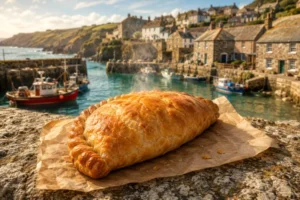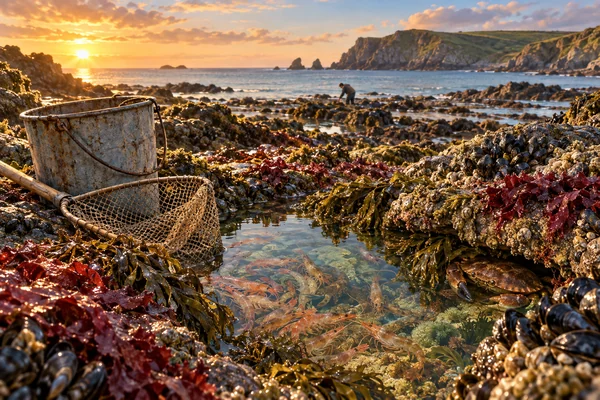
Quick answer: Cornwall is one enormous larder with a tide timetable. Its 400 miles of coast serve crabs, prawns, mussels, cockles and razor clams; its clean Atlantic water grows dulse, sea lettuce and samphire; its cliff-top hedges add sea beet, wild garlic and blackberries — and all of it is free to those who learn the tides, the rules and the restraint. This guide covers what to gather, how, when, and the code that keeps it sustainable — from a family that has been feeding itself from these shores for three generations. The full larder — below.
Coastal foraging is the oldest Cornish skill there is — older than mining, older than the pasty it eventually filled — and it never went away: watch any harbour or rocky shore on a big low tide and you’ll see people doing what people have always done here. Our family is among them. Foraging and catch-and-cook are how we’ve fed ourselves at the coast since I was a boy gathering supper with my dad, and this guide is the working knowledge: species by species, with the safety and the law built in, because the sea feeds the careful and punishes the casual.
Table of Contents
- The code first: law, sizes and safety
- Crabs, lobsters and prawns
- Shellfish of the shore
- Fish in the pools
- Seaweeds: the underrated harvest
- Coastal plants and the hedgerow behind the beach
- When to forage: a rough calendar
- Personal insights and experiences
- FAQ
- References and resources
The code first: law, sizes and safety
- Minimum sizes are law, not etiquette: Cornwall’s Inshore Fisheries and Conservation Authority (IFCA) publishes minimum landing sizes for crabs, lobsters and shellfish — carry a gauge or a rule, measure everything, and anything undersized goes straight back.
- Berried females always go back — a crab or lobster carrying eggs is next year’s foraging; returning her is not optional, legally or morally. V-notched lobsters go back too.
- Eels go back, and estuaries stay trap-free — conger eels that muscle into a prawn trap on the rocky shore are released on the spot, and we never set traps in the estuaries at all: that’s where the critically endangered European eel lives, and where young bass nurse — the prawns there are their food, not ours.
- Water quality decides shellfish safety: filter feeders (mussels, cockles) concentrate whatever’s in the water. Gather from clean, open coast away from outfalls and estuary discharges, avoid the days after heavy rain, check Surfers Against Sewage’s live map, and cook shellfish thoroughly.
- Plant identification must be certain — one warning above all in the South West: hemlock water dropwort, Britain’s most poisonous plant, grows near coastal streams and ditches and can pass for wild celery or parsley. If you are not one hundred per cent sure, it stays in the ground. No exceptions, no “probably”.
- Take a little, from plenty: a meal, not a haul; cut seaweed above the holdfast so it regrows; leave every spot looking ungathered. Some areas (no-take zones, SSSI foreshores, private or commercially managed shellfish beds) are off-limits — check locally.
Crabs, lobsters and prawns
The crustaceans are the glory of Cornish foraging. Brown crabs — the heavy, pie-crust-edged classic — hide under weed-fringed ledges and in the deep cracks of the low-shore rocks; spider crabs arrive inshore in warm months in extraordinary numbers, spiky, alien-looking and, with patience, some of the sweetest meat the coast offers. Work the biggest spring tides, lift and replace every rock as you found it, and mind your fingers — a big brown crab means it. Lobsters are the crevice-hunter’s jackpot: nobody finds them often, but the ones you do find are found by reading the rock — look for a dark nook with fresh debris pushed out of the entrance, the housekeeping of something armoured living inside. Measure, check for eggs and notches, and know how rare a keepable one is. Prawns are the reliable feast: big low tides fill the weedy gullies and pools with them, a fine-mesh net worked under the overhangs fills a bucket, and a baited drop-trap left in a deep pool or off a wall does the work while you do something else — expect the occasional small fish or conger eel as bycatch, released on the spot. A pan of prawns cooked within an hour of the sea is one of the best things Cornwall will ever serve you, and it costs a net and a tide table.
Shellfish of the shore
- Mussels — the beginner’s harvest: rocky, wave-washed beds away from river mouths; take only well-sized shells, and stick to the colder months by tradition and to clean water always. Discard any that stay open before cooking or closed after.
- Cockles — raked or toe-felt from clean estuary sand at low water; rinse hard, purge in clean seawater, cook thoroughly.
- Winkles — everywhere, easy, and better than their reputation: boiled minutes, extracted with a pin, tossed in garlic butter.
- Limpets — the survival-food cliché redeemed by correct cooking: fast and fierce or long and slow; anything between is a rubber button. Take sparingly — limpets garden the rocks and a cleared rock stays scarred for years.
- Razor clams — the low-tide magic trick: find the keyhole siphon holes on big spring-tide sand flats, pour salt down the hole, and be ready — the razor rises like a submarine surfacing. Grip firmly, pull slowly, and take only what dinner needs.
Fish in the pools
On the biggest spring tides, the fish come to you: young bass and pollock get caught out by the falling water and stranded in the larger rock pools, and finding one is the day’s event — a wild fish in a pool the size of a bath, catchable by hand if you’re patient and faster than you look. They go back, every time: pool-trapped fish are almost always undersized, and bass are strictly protected besides. But “back” takes judgement. A big, deep, weedy pool will keep a fish comfortably until the tide returns; a small shallow one on a warm afternoon holds precious little oxygen and a long wait — so we size up the pool, and if it’s marginal we carry the fish down to the sea’s edge and see it away. Treat a stranded fish as being in your temporary custody rather than your bucket and you’ve understood the whole ethic of the shore. For fish you actually take home, that’s rod fishing from the rocks and surf — our sustainable seafood guide covers doing that responsibly, and the shortest version holds: eat what you catch, catch no more than you’ll eat.
Seaweeds: the underrated harvest
Cornwall’s clean Atlantic water grows seaweed worth real money in delicatessens, free at the tideline. Dulse — the reddish-purple fronds on mid-to-low shore rocks — fries into the sea’s answer to crispy bacon and dries for stock. Sea lettuce — the bright translucent green sheets — goes into soups, salads and around baked fish. Cut with scissors above the holdfast so the plant regrows, gather where the water runs clean and moving, rinse well, and dry or use fresh. Nothing on the British shore is a faster route to feeling like you know a secret.
Coastal plants and the hedgerow behind the beach
- Rock samphire — the succulent, aromatic spears of the splash-zone rocks and walls: pickled or steamed with butter, the taste of a Cornish summer cliff.
- Sea beet — wild spinach’s tougher, glossier, better ancestor, growing along shorelines and hedge-banks most of the year; the leaves cook exactly as spinach and outclass it.
- Wild garlic — spring’s gift in the damp valley woods behind the coast: leaves, buds and flowers, all of it good, the smell finding you before your eyes do.
- Blackberries — because the hedge behind the beach is part of the larder too, and no Cornish forager walks past September brambles with an empty bucket and a clear conscience. Where the coast path pairs them with sloes and elderberries, autumn takes care of itself.
When to forage: a rough calendar
Spring: wild garlic in the valleys, sea beet coming strong, the first big gathering tides of the year. Summer: prawns and spider crabs inshore, samphire at its best, seaweeds lush on the long evening lows. Autumn: blackberries and the hedgerow harvest, mussels coming into season, crabs still working the warm water. Winter: the shellfish months — mussels at their plumpest, quiet shores, and the year’s most dramatic spring tides for the hardy. Every one of these runs on the tide table rather than the calendar: the fortnightly spring tides — around the full and new moons — expose the shore that matters, and our rock pooling guide covers reading them (and keeping the escape route open behind you — the tide that revealed the larder will take it back on schedule).
Personal insights and experiences
I learned this larder the old way: most weekends of my childhood were spent camped above the rocks with my dad, down a cliff path with the kit, eating what we caught — and forty years later the only things that have changed are the size of the tribe and the quality of the cool box. The species list at the top of this page isn’t research; it’s our family’s actual menu. Prawns are the fixture — netted from the gullies or trapped overnight from a wall, with the traps’ occasional freeloading fish and conger eels tipped straight back, and the traps themselves kept off the estuaries where the young bass and their prey belong to each other — crabs are the sport, and a lobster is an event: I’ve learned to read the fresh-swept debris outside a crevice the way other people read a menu. The rule I hold hardest after a lifetime of this is the unglamorous one: the tide book is the real foraging guide. Everything else — the salt trick, the crevice signs, which rocks lift and which don’t — you learn by going, going again, and putting back more than feels natural. The sea has fed my family for three generations of low tides. Treat it like it needs to feed three more.
FAQ
Q: Is coastal foraging legal in Cornwall?
A: Hand-gathering shellfish and plants for personal use is generally permitted on the open foreshore, subject to minimum sizes, local IFCA bylaws, and restrictions in no-take zones, protected sites and private or managed beds. Personal use only — selling foraged shellfish is a different legal world entirely.
Q: What’s the easiest thing to start with?
A: Winkles and mussels from clean rocky shores, blackberries from the hedge behind the beach, and prawns with a net on a big low tide — high reward, low risk, minimal kit.
Q: When is the best time to forage the shore?
A: The two hours either side of low water on spring tides — the fortnightly big tides around the full and new moon. The lower the tide, the bigger the larder.
Q: Are Cornwall’s shellfish safe to eat?
A: From clean, open-coast water, gathered away from outfalls and rain run-off, and cooked properly — yes, magnificently. Filter feeders concentrate pollution, so water quality is the forager’s first check, every time.
Q: What should a beginner never do?
A: Eat a coastal plant they can’t identify with certainty (hemlock water dropwort has killed confident people), keep an undersized or egg-carrying crab or lobster, or turn their back on an incoming spring tide.
References and resources
- Cornwall IFCA — minimum sizes and local bylaws: www.cornwall-ifca.gov.uk
- Surfers Against Sewage — live water quality map: www.sas.org.uk
- GOV.UK — recreational bass fishing rules (check current): www.gov.uk
- The Wildlife Trusts — responsible seashore code: www.wildlifetrusts.org
- Tide times: www.tidetimes.org.uk