Quick answer: Bodmin Jail, historically Bodmin Gaol, was built in 1779 to a design by Sir John Call, on the reforming ideas of John Howard. The jail’s own history describes it as the first British prison to hold prisoners in individual cells. It was greatly expanded in the Victorian era, with a separate naval prison, and executions ran there until the last of them, William Hampton, in 1909. The Domesday Book was kept there for safekeeping at the end of the First World War, and the jail closed in 1927. Today it’s a visitor attraction with the immersive Dark Walk, and part of it is a hotel. The full history, the famous cases, the ghosts and how to visit, below.
Quick answer: Bodmin Jail is Cornwall’s most atmospheric visitor attraction — a vast, half-ruined Georgian prison built in 1779, closed in 1927, where more than fifty people were executed and where, since a major restoration, you can walk the cells, experience the “Dark Walk” immersive tour, stand at the last working execution pit in Britain, and even sleep in a converted cell wing turned hotel. It’s famous for ghosts, for the tragic story of Charlotte Dymond and Matthew Weeks, and for the fact that the Crown Jewels once hid here. History, hauntings and how to visit, below.
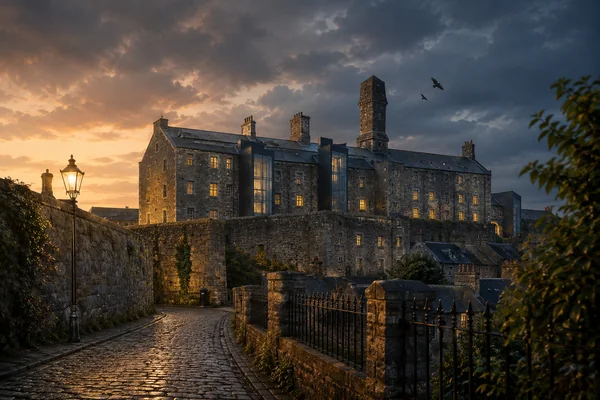
Bodmin Jail looms over the town like something out of a Gothic novel, and it has earned the reputation: a prison built on Enlightenment ideals that became a byword for misery, a place of public hangings and private despair, a ruin for most of the last century, and now — after one of the most ambitious heritage restorations in the county — an attraction that manages to be genuinely educational and genuinely unnerving at once. This guide covers its history, its ghosts, its most famous prisoner, and what to expect from a visit today.
Bodmin Jail is one dark chapter of a much longer story. For the county’s 4,000-year history, see The Story of Cornwall.
Table of Contents
- History of Bodmin Jail
- Paranormal activity at Bodmin Jail
- Famous inmates and executions
- Exploring Bodmin Jail today
- FAQ
- References and resources
History of Bodmin Jail
Construction and design
Bodmin Jail was built in 1779, designed by Sir John Call on the reforming principles of the day: individual cells, segregation of men from women and debtors from felons, light and air, and labour as rehabilitation — a deliberate break from the filthy communal lock-ups that came before. It was, on paper, one of the most progressive prisons in the country, and it was expanded through the 19th century into the huge granite complex whose shell you see today, including a separate naval prison wing.
Life inside the jail
Ideals met reality quickly. Overcrowding, disease, hard labour on the treadwheel and the crank, meagre rations and harsh discipline made Bodmin a place of suffering for much of its life — and public executions outside its walls drew crowds by the thousand until hangings moved inside in the 1860s. More than fifty people were executed here between the jail’s opening and its last hanging in 1909; the execution pit built for the later hangings still exists, the only one of its kind left in Britain.
Closure and legacy
The jail closed in 1927, and its most surprising chapter had already happened: during the First World War the Domesday Book and the Crown Jewels were quietly moved here for safekeeping, far from the risk of bombing. After closure it decayed for decades — a roofless ruin, a nightclub for a while in the 1970s and 80s — until restoration in the 2010s and 2020s turned it into the attraction and hotel it is now.
Bodmin Jail timeline
| Year | What happened |
|---|---|
| 1779 | Built to Sir John Call’s design, by prisoners of war according to the jail’s own history |
| 19th century | Rebuilt and expanded into the granite complex seen today, including a naval prison for those convicted of crimes at sea |
| 1844 | Matthew Weeks hanged for the murder of Charlotte Dymond on Bodmin Moor |
| 1878 | Selina Wadge hanged |
| 1909 | William Hampton hanged on 20 July, the last execution in Cornwall |
| 1918–19 | The Domesday Book and other national records stored here for safekeeping |
| 1927 | The jail closes |
| Today | Restored as a visitor attraction with the Dark Walk, and a hotel in the old cell wings |
Paranormal activity at Bodmin Jail
Ghostly encounters
Bodmin Jail is regularly named among the most haunted buildings in Britain, and its ghost tours are its best-known night out. Visitors and staff report cold spots, footsteps in empty wings, figures on stairways, and the sense of being watched in the condemned cell — whether that’s the dead or the architecture is for you to decide, but the building does its part magnificently.
Famous apparitions
The best-known are a woman in white seen in the corridors, said to be searching for a lost child; a figure near the site of the old gallows; and Matthew Weeks himself, hanged here in 1844, who is said to walk the wing where he waited. Selina Wadge, hanged in 1878 for the drowning of her young son, is another name the tour guides return to.
Haunted surroundings
Bodmin Moor at the jail’s back door has its own dark catalogue — Jamaica Inn, Dozmary Pool and Jan Tregeagle, the Beast of Bodmin — and the town sits between the two. If you like a ghost story, this corner of Cornwall is its capital; our storytelling guide has the folklore.
Famous inmates and executions
Between 1802 and 1909, Bodmin Jail was where Cornwall hanged the men and women its courts condemned. The jail’s own records name a dozen notable executions across that period. Totals given elsewhere vary widely — from around thirty to more than fifty — and the jail itself publishes no figure, so treat any single number with care.
The executions at a glance
| Date | Who | Crime |
|---|---|---|
| 1 September 1802 | John Vanstone and William Lee | Burglary. The first confirmed hangings at the jail |
| 6 September 1813 | Elizabeth Osborne | Setting fire to her former employer’s mow of corn |
| 12 August 1820 | Sarah Polgrean | Causing the death of her husband Henry with rat poison in his food |
| 13 April 1840 | The Lightfoot brothers | Murdering the merchant Nevill Norway in a highway robbery gone wrong |
| 12 August 1844 | Matthew Weeks | The murder of Charlotte Dymond on Bodmin Moor |
| 18 August 1862 | John Doidge | Murdering Roger Drewe. The last public execution in Cornwall |
| 15 August 1878 | Selina Wadge | The murder of her youngest child |
| 20 July 1909 | William Hampton | The murder of Emily Tredrea. The last execution in Cornwall |
The Lightfoot brothers, and the biggest crowd
The largest crowd the jail records was not for its most famous case. In 1840 the Lightfoot brothers were hanged for murdering the merchant Nevill Norway in a highway robbery that went wrong, and the jail puts the crowd at around 25,000 — an extraordinary number for a small moorland town.
From public hangings to the execution pit
Hangings took place outside the walls, in front of whoever came. The last public execution in Cornwall was John Doidge’s, on 18 August 1862, for the murder of Roger Drewe; the executioner was William Calcraft, then the country’s chief executioner, and between six and eight thousand people watched.
A change in the law in 1868 required executions to take place in private, and public hangings ceased everywhere. At Bodmin, new gallows with an execution pit were built in 1897, housed in a shed in the corner of the front yard. Valeri Giovanni, an Italian sailor convicted of murdering Victor Bayliff, was the first to be executed in it, in 1901.
The structure was later forgotten, rediscovered during renovation work in 2005 and fully restored. The jail describes it as the only working execution pit in the UK, and it is part of the visitor route today.
Selina Wadge and William Hampton
Selina Wadge was hanged on 15 August 1878 for the murder of her youngest child — the first execution at Bodmin in sixteen years. It was carried out by William Marwood using the “long drop”, the method intended to kill quickly rather than by slow strangulation.
The last hanging came on 20 July 1909, when William Hampton was executed for the murder of his girlfriend Emily Tredrea. It was the last execution at Bodmin Jail and the last in Cornwall. Nobody has been executed in the county since.
The story of Matthew Weeks
In April 1844, eighteen-year-old Charlotte Dymond, a farm servant, was found with her throat cut on Rough Tor on Bodmin Moor. Her sweetheart Matthew Weeks — a fellow servant, lame, and by all accounts gentle — was tried at Bodmin, convicted on circumstantial evidence, and hanged outside the jail before a crowd the jail itself puts at several thousand, though some retellings say twenty thousand. Doubts about his guilt began almost immediately and have never gone away; a monument to Charlotte stands on the moor, and their story is Cornwall’s most enduring true-crime tragedy.
Literary inspirations and media appearances
The Dymond case has inspired novels, plays and a famous Charles Causley ballad; the jail itself has featured in Poldark and in more ghost-hunting television than it would care to count. Daphne du Maurier’s Jamaica Inn, set a few miles across the moor, borrows the whole atmosphere.
Exploring Bodmin Jail today
Exhibits and the Dark Walk
The restored jail opens as an attraction with the “Dark Walk” — an immersive, theatrical journey through Cornwall’s criminal past, dramatised with light, sound and effects (it’s intense; check the age guidance for younger children) — followed by the museum wings, the cells with their exhibits on prisoners and punishment, and the execution pit.
Guided tours and ghost tours
Evening ghost tours and paranormal nights run through the year and are the jail’s signature — book ahead, wrap up, and don’t go alone if you scare easily. Daytime guided tours give the history without the theatrics.
Practical information for visitors
- Where: Bodmin town, minutes from the A30 and A38 — an easy stop on any Cornwall road trip.
- Book tickets online in advance, especially for the Dark Walk and evening events.
- The hotel — Bodmin Jail Hotel occupies restored cell wings; you can sleep in a (much improved) cell and eat in the old chapel. Yes, it’s haunted-adjacent; that’s the appeal.
- Make a day of it with the Bodmin & Wenford steam railway next door, Cardinham Woods ten minutes away, or a walk up to Rough Tor to see where the Dymond story began. — or across to the engine houses of the moor’s mining past; our tin mining guide has the whole story.
FAQ
Q: Is Bodmin Jail worth visiting?
A: Yes — since its restoration it’s one of Cornwall’s best heritage attractions, combining the immersive Dark Walk with the museum wings, the execution pit and evening ghost tours.
Q: Is Bodmin Jail haunted?
A: It’s regularly named among Britain’s most haunted buildings, with reported apparitions including a woman in white and Matthew Weeks; the ghost tours are its signature evening event.
Q: Can you stay overnight at Bodmin Jail?
A: Yes — Bodmin Jail Hotel occupies restored cell wings of the old prison, with a restaurant in the former chapel.
Q: Who was Matthew Weeks?
A: A farm servant hanged at Bodmin in 1844 for the murder of Charlotte Dymond on Bodmin Moor — a conviction on circumstantial evidence that has been doubted ever since.
Q: Is Bodmin Jail suitable for children?
A: The museum and daytime tours suit older children; the Dark Walk and ghost tours are intense and carry age guidance — check before booking.
Q: When was Bodmin Jail built?
A: In 1779, to a design by Sir John Call based on the reforming ideas of John Howard. Most of the building you see today is Victorian.
Q: Who was the last person executed at Bodmin Jail?
A: William Hampton, hanged on 20 July 1909. It was the last execution in Cornwall. At least 55 people were executed at the jail.
Q: When did Bodmin Jail close?
A: In 1927. Much of it fell into ruin before its restoration as a visitor attraction and hotel.
Q: Who are Bodmin Jail’s most famous inmates?
A: Matthew Weeks, hanged in 1844 for the murder of Charlotte Dymond, is the best known, partly because many still doubt his guilt. Others include the Lightfoot brothers, whose hanging in 1840 drew a crowd the jail puts at around 25,000; Selina Wadge in 1878; and William Hampton, whose execution in 1909 was the last in Cornwall.
References and resources
- Bodmin Jail — official site and tickets: www.bodminjail.org
- Bodmin Jail Hotel: www.bodminjailhotel.com
- Bodmin & Wenford Railway: www.bodminrailway.co.uk
- Historic UK — Bodmin Jail: www.historic-uk.com
- Bodmin Jail — about the jail and its history: www.bodminjail.org
- Bodmin Jail — executions: www.bodminjail.org