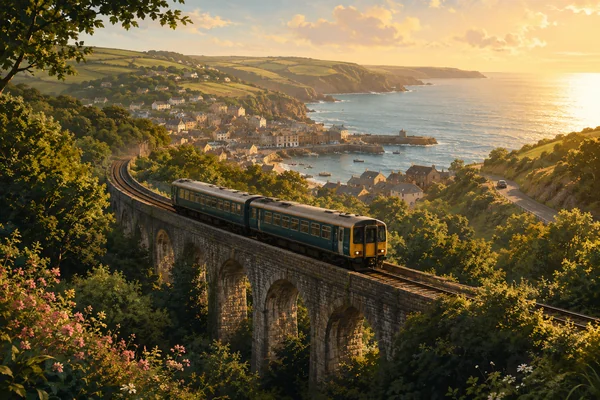
Quick answer: most visitors reach Cornwall by car (M5 to Exeter, then the A30 or A38 west) or by train on the Great Western main line from London Paddington to Penzance — about five hours, or overnight on the Night Riviera sleeper. Cornwall Airport Newquay has flights from several UK cities. Whichever way you come, avoid Saturday changeover traffic in summer if you possibly can. Full details, the A30-versus-A38 question, and getting around once you’re here, below.
Cornwall is a long way from almost everywhere — that’s rather the point of it — and the last stretch is the one people underestimate. From the Devon border it’s another eighty miles to Land’s End, on roads that range from fast dual carriageway to lanes with grass down the middle. I’ve driven in and out of Cornwall more times than I can count, and this guide is the practical version: train, plane, coach and car, honestly compared, plus what to know about getting around once you’ve arrived.
Table of Contents
- By train
- By car — and the A30 versus the A38
- By plane
- By coach
- Getting around Cornwall
- When to travel
- Personal insights and experiences
- FAQ
- References and resources
By train
The Great Western main line runs from London Paddington through Reading, Exeter and Plymouth, over Brunel’s Royal Albert Bridge at Saltash and on through Bodmin Parkway, Par, St Austell, Truro and Redruth to Penzance — roughly five hours end to end, and one of the great railway journeys in Britain once you’re past Exeter, with the sea wall at Dawlish and the Tamar crossing as highlights. Direct trains also run from the north and Midlands via Bristol. From the main line, branch lines reach St Ives (from St Erth — a stunning coastal ride), Newquay (from Par), Falmouth (from Truro), Looe (from Liskeard, down the wooded valley) and Gunnislake (from Plymouth, over Calstock viaduct).
Then there’s the Night Riviera — the sleeper from Paddington to Penzance, leaving late evening and arriving with the sun up over Mount’s Bay. Cabins are limited and book up; for a family it’s an adventure in itself and saves a hotel night. Book rail tickets as far ahead as you can — advance fares on the Cornwall route are dramatically cheaper than walk-up, and railcards apply. Trainline and the operators’ own sites both sell them.
By car — and the A30 versus the A38
Almost everyone driving to Cornwall arrives at Exeter on the M5, and there the road splits — and this is a genuine choice, not a technicality:
- The A30 runs across the top: Okehampton, Launceston, then over Bodmin Moor and on down the spine of the county to Penzance. Now dual carriageway almost all the way to beyond Truro, it’s the faster road for anywhere from Bodmin westwards and for the whole north coast — and the better drive: long open stretches, big skies, the moor and its reservoir shining beside you, trees and farmland set well back from the road.
- The A38 runs along the bottom: past Plymouth, over the Tamar Bridge, then Saltash, Liskeard and Bodmin, where it meets the A30. It’s the road for south-east Cornwall — Looe, Polperro, Fowey, the Rame peninsula — and it’s more intimate: two lanes much of the way, hedgerows close in, villages to pass through, and a slower, greener feel.
- The Tamar crossing: the Tamar Bridge is free heading into Cornwall and tolled heading out; the Torpoint chain ferry from Plymouth is the scenic alternative for the Rame peninsula and Looe side.
- Fuel and charging: fill up in Devon or at the first Cornish services — the far west is thin on both, though EV charging is improving fast.
By plane
Cornwall Airport Newquay, on the north coast, has flights from London and several other UK cities plus seasonal European routes, and it’s twenty minutes from Newquay and the north-coast beaches — by far the quickest way in from the north of Britain or Ireland. Exeter Airport is the alternative for east Cornwall, an hour or so from the border. And from Land’s End and Newquay, small planes fly to the Isles of Scilly.
By coach
National Express and Megabus run to Newquay, Truro, Penzance and other Cornish towns from London and major cities — the cheapest way to get here, and the slowest, but the overnight services get you a full first day.
Getting around Cornwall
- The branch lines are genuinely useful: St Erth to St Ives beats the town’s car parks every time in summer; Liskeard to Looe drops you at the harbour.
- Buses reach most towns and many beaches; the open-top coastal routes in summer are half sightseeing, half transport.
- Driving is how most people do it — but Cornish lanes are narrow, passing places are a skill, sat-navs will send you down farm tracks, and summer car parks fill by mid-morning. Our road trip guide covers the routes worth driving for their own sake.
- Ferries — King Harry, Fowey–Polruan, Padstow–Rock, St Mawes — are shortcuts and treats in one.
When to travel
Summer Saturdays are changeover day for the whole county’s holiday lets, and the A30 and A38 both know it. If you can, arrive and leave midweek, or travel very early or after 6pm; a Friday-evening drive west and a Sunday-morning drive home will spare you hours. Bank holidays behave like Saturdays. Outside the school holidays the roads are a different county — see our guides to September and August for what each brings.
Personal insights and experiences
I live on the border and drive in and out of Cornwall constantly, so I have opinions. The A38 is my everyday road — it’s the practical one from home — but the A30 is the one I prefer: those long open stretches, the views, the moor. When we go camping we take the A38 out because it’s easier to get onto, and I make a point of coming home the long way round on the A30, across the moor past Colliford Lake, which is one of my favourite drives anywhere.
The A38 has its moment too, and it’s a small, local one: Tideford, by the Riverside Garage, after heavy rain. The River Tiddy comes up and floods the whole green meadow beside the road — a great sweep of reeds standing in water — and for a day or two it looks like a lake has appeared out of nowhere. I look for it every time. Whichever road you take: get past Exeter, watch for the “Kernow a’gas dynergh” sign at the Tamar, and slow down. You’ve arrived; the county rewards people who stop rushing. (And if you haven’t yet decided where you’re heading, our guide to choosing your Cornish base is the next read.)
FAQ
Q: What is the quickest way to get to Cornwall?
A: Flying to Newquay from a UK city, if there’s a route; otherwise the train from London (about five hours to Penzance) or driving via the M5 and A30, which is fastest for most destinations west of Bodmin.
Q: Can you get a train to Cornwall?
A: Yes — the Great Western main line from London Paddington runs to Penzance via Plymouth, Bodmin Parkway, Truro and more, with branch lines to St Ives, Newquay, Falmouth and Looe, and the Night Riviera sleeper overnight.
Q: What is the nearest airport to Cornwall?
A: Cornwall Airport Newquay, in the county itself; Exeter Airport serves east Cornwall.
Q: A30 or A38 — which is better?
A: The A30 is faster and more scenic for anywhere from Bodmin westwards and the north coast; the A38 is the road for Looe, Polperro, Fowey and south-east Cornwall.
Q: How long does it take to drive to Cornwall from London?
A: Around four and a half to five hours to the border on a clear run, and five to six to the far west — considerably more on summer Saturdays.
References and resources
- Great Western Railway: www.gwr.com
- Trainline — tickets and times: www.thetrainline.com
- Cornwall Airport Newquay: www.cornwallairportnewquay.com
- National Rail: www.nationalrail.co.uk
- Tamar Bridge and Torpoint Ferry: www.tamarcrossings.org.uk