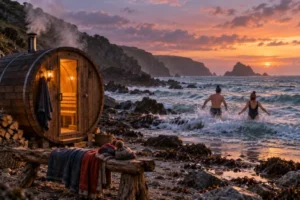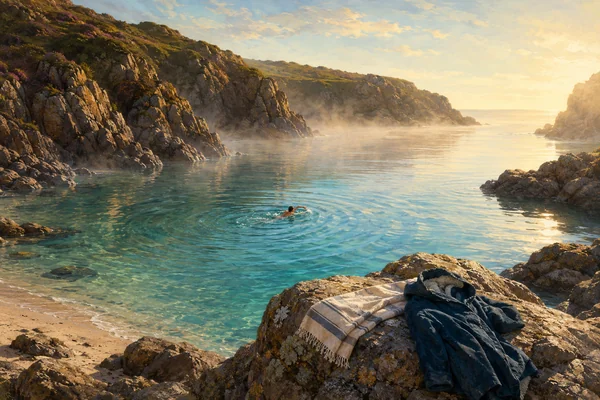
Quick answer: cold-water swimming has real, evidence-supported benefits for mood, stress and resilience — and Cornwall is one of the best places in Britain to try it, with sheltered coves, tidal pools and sea temperatures that peak at a swimmable 16–17°C in late summer. Start in September when the sea is warmest, never swim alone, get in slowly, and get out before you’re cold. Where to go and how to do it safely, below.
Something happens when you walk into cold sea. The breath goes, the mind empties of everything except the water, and about ninety seconds later — if you’ve done it right — a calm settles that lasts the rest of the day. Wild swimming has gone from eccentric to everywhere in the last decade, and Cornwall, with two coasts of coves and a long tradition of harbour-wall jumping, is where a lot of people fall for it. This guide covers what the cold water actually does for you, how to start without hurting yourself, and where in Cornwall to swim.
Table of Contents
- What cold water does for you
- How to start safely
- Where to swim in Cornwall
- Rivers — and a word about Devon
- Personal insights and experiences
- FAQ
- References and resources
What cold water does for you
- Mood. Cold immersion triggers a surge of stress hormones and endorphins that most swimmers describe as an hours-long lift; research on regular cold-water swimmers consistently reports improved mood and lower reported stress. It’s why charities including Mind now point to it as a genuine wellbeing tool — alongside, not instead of, other support.
- Resilience. Repeated exposure blunts the body’s shock response — the “cold shock” fades over a few weeks — and many swimmers find everyday stress feels smaller for it.
- Sleep and inflammation. Cold water is anti-inflammatory and many regulars sleep better; the science is younger here, but the anecdotes are unanimous.
- Company. The bit that gets underrated: swim groups on every Cornish beach, all year, all ages. The community may be doing as much as the water.
How to start safely
- Start in late summer or autumn — the sea is at its warmest (16–17°C) in September and eases you in; keep going and your body adapts as it cools.
- Never swim alone. A friend on the beach at minimum; a group is better and more fun.
- Walk in, don’t jump until you’re acclimatised — cold shock is the danger, and it’s worst in the first two minutes.
- Short and often beats long and rare. A few minutes is plenty; get out before you shiver hard, and dress fast — warm layers, hat, hot drink. “Afterdrop” chills you further ten minutes after you’re out.
- Know the beach. Lifeguarded beaches, red-and-yellow flags in season, and no swimming near rips or river mouths. Tidal pools and sheltered coves are your friends.
- Check with a doctor if you have a heart condition, and don’t do it after alcohol.
Where to swim in Cornwall
Sheltered beaches and coves
Par Sands and Looe on our south-east coast — flat, sheltered, easy in and out; Carlyon Bay next door; Readymoney Cove at Fowey; Porthminster at St Ives and Gyllyngvase at Falmouth for calm town swims; Prussia Cove and Porthcurno in the far west for drama and clarity. On the north coast, Harlyn, Polzeath and Rock (across the estuary from Padstow) are gentler than the surf beaches either side, and Perranporth at low tide has calm pools behind the sand bars.
Tidal pools
Cornwall’s secret weapon for nervous starters: Bude Sea Pool beneath the cliffs at Summerleaze, Porthtowan‘s rock pool at low tide, Treyarnon‘s natural pool near Padstow, and the tidal baths in the rocks at Perranporth — sea water, no waves, and a way out you can see.
Harbours
Cornish children learn to swim by jumping off harbour walls, and adults haven’t stopped: Boscastle, Mousehole, Porthleven and Charlestown all have their leaping spots at high water. Watch the locals, check the depth, mind the boats.
Rivers — and a word about Devon
Here’s an honest one: Cornwall’s rivers are short and quickly tidal, and the county has nowhere near the freshwater swimming of its neighbour. Devon’s moorland rivers — the Dart, the Teign, the Tavy and their pools and streams around Dartmoor — are the river-swimming country of the south-west, and we use them. In Cornwall, the sea, the tidal pools and the harbours are where the swimming is; the estuary reaches at Looe or the Fowey give a brackish middle way. If you know a genuine Cornish river pool worth the name, we’d like to hear about it — it’s on our list.
Personal insights and experiences
Our family’s swimming is mostly the unglamorous, joyful kind: the sea at Par and Looe (the beach and the river mouth both), Harlyn and Polzeath and Rock on the north coast, Carlyon Bay, and jumping off the harbour wall at Boscastle whenever we’re near Tintagel. Nobody in our house calls it wild swimming — it’s just swimming, and it’s the point of a Cornish beach day.
What I’ve noticed is that the cold-water effect works whether or not you dignify it with a name. The best-tempered afternoons we have are the ones that started with everybody shrieking their way into September sea and coming out an hour later hungry, calm and pleased with themselves. We do the same in the rivers and streams of the Devon moors, and finding the Cornish equivalents is genuinely on the list. If you’re thinking about starting: pick a warm sheltered beach, take a friend, walk in slowly, and stay in for less time than you want to. The calm turns up on the way back to the car.
FAQ
Q: Is wild swimming good for mental health?
A: Regular cold-water swimming is consistently associated with improved mood and lower stress, and mental health charities recognise it as a genuine wellbeing tool — best alongside other support where that’s needed, not instead of it.
Q: How cold is the sea in Cornwall?
A: Around 9–10°C in early spring, rising to a peak of 16–17°C in September, then falling through winter to about 9°C.
Q: Where is the best place to wild swim in Cornwall?
A: For beginners, sheltered beaches like Par, Porthminster and Gyllyngvase, or a tidal pool like Bude Sea Pool; for scenery, Porthcurno and Prussia Cove; for a laugh, any harbour wall at high tide.
Q: Do I need a wetsuit?
A: Not in late summer; from November to May most people use one, or keep swims very short. Neoprene gloves and boots make winter dips far more pleasant.
Q: Are there rivers to swim in in Cornwall?
A: Very few — Cornish rivers are short and soon tidal. The estuaries at Looe and Fowey are the nearest thing; for proper river pools, Devon’s Dartmoor rivers are the south-west’s best.
References and resources
- Outdoor Swimming Society — safety and swim spots: www.outdoorswimmingsociety.com
- Mind — nature and mental health: www.mind.org.uk
- RNLI — cold water and beach safety: rnli.org/safety
- Bude Sea Pool: www.budeseapool.org