Quick answer: this is an opinion piece, and the opinion is this — the moors on our doorstep, Dartmoor and Cornwall’s own Bodmin Moor, are not the wild places the signboards claim. They are biological deserts: treeless, overgrazed, drained, and held in that state by policy and habit rather than nature or necessity. Nothing grows beyond a shoot. But none of it is the farmers’ fault, none of it is irreversible, and the proof — from a rewilded Sussex farm to a family smallholding on Dartmoor itself to a rainforest research station rising on Bodmin Moor — says recovery starts faster than anyone expects. The argument, honestly made — below.
I drive within sight of the moors most days of my life, and for years I saw what everyone sees: wild, open, rugged Britain. Then I started looking properly — years of following the rewilding movement, reading, watching every project I could find — and now I can’t unsee the other thing: a landscape where almost nothing is allowed to grow taller than a fingernail. This is the site’s first full opinion piece, so let me be plain about that: what follows is an argument, mine, honestly held and, I hope, honestly made — including the parts that complicate it.
Table of Contents
- The green desert: what you’re actually looking at
- The forest that cannot have children
- Why it matters downstream
- It was never the farmers’ fault
- What the alternative looks like
- How far could it go?
- Bodmin: Cornwall’s own moor
- Personal insights and experiences
- FAQ
- References and resources
The green desert: what you’re actually looking at
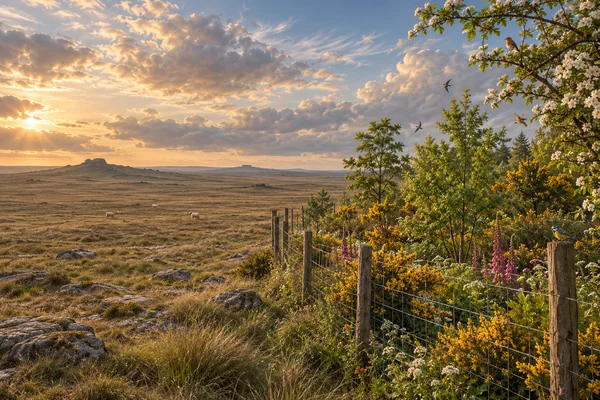
“Desert” sounds absurd for one of the wettest places in England, so let me define it: a biological desert — a landscape stripped to a handful of species and held there. The moors are not natural wilderness; they are man-made habitats kept in arrested development by continuous grazing and periodic burning. Here’s the mechanism, and once you know it you’ll see it everywhere: sheep graze selectively, taking every palatable seedling and wildflower and leaving purple moor-grass — Molinia — which is edible to them for only a few weeks a year. The Molinia spreads into a monoculture carpet; the carpet gets burned to reset it; the burning and grazing between them ensure no tree, no shrub, and almost no flower ever gets past its first season. Walk an upland and count what’s actually growing: it is astonishingly little, astonishingly uniform. That’s not wilderness. It’s a lawn the size of a county.
The forest that cannot have children
If you want the whole story in one place, Dartmoor keeps three fragments of ancient high-altitude oak rainforest — Wistman’s Wood, Black-a-Tor Copse and Piles Copse — survivors of the wildwood, centuries old, draped in mosses and rare lichens. They are protected, celebrated, signposted. Visitors are rightly told to stay out of their fragile interiors. And sheep graze freely through at least some of them, because much of this woodland stands unfenced. The result is a forest that survives but cannot reproduce: the understory browsed away, and oaks that should tower standing knee-high — ancient trees nibbled back every month of their lives, unable to get thirty centimetres off the ground. Where restorers have caged individual saplings, the trees leap away — which raises the obvious question campaigners keep asking: if a cage works for one tree, why does the whole forest not merit a fence? A wood with no next generation is not being conserved. It is being embalmed.
Why it matters downstream
This would matter less if the consequences stayed on the tops. They don’t — they arrive in the valleys, where we live. Bare, compacted, drained uplands shed water like a car park: rain that a wooded, boggy moor would hold for days instead races off in hours, and the towns below flood — Cornwall needs no reminding of what a saturated catchment did to Boscastle in 2004, and every winter’s flood warnings tell the same story in a minor key. The same thatch of dead Molinia that blocks seedlings cures into fuel, which is why our soaking-wet islands now produce wildfires. And the peat — thousands of years of stored carbon and water — erodes and washes away with the topsoil. Meanwhile the restored version pays its way: healthy bogs, woods and beaver wetlands hold storm water, feed rivers slowly through drought, and defend the towns downstream at a fraction of what concrete costs. Keeping water on the land is the whole game — the moors are simply where the game is won or lost first.
It was never the farmers’ fault
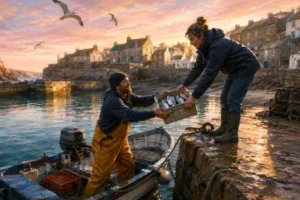
Now the part that matters most, because arguments like this one usually curdle into blame. Hill farmers did not design this system. Governments did — with subsidies that for decades paid by the head and by the cleared acre, telling farming families in the plainest language money speaks to keep the sheep on the hill. Even rewilding’s fiercest voices say so: this is a policy failure wearing a farmer’s coat, and the upland farmers working brutal hours for thin margins inside it deserve better than to be cast as villains by comfortable commentators. The economics campaigners cite are stark — George Monbiot estimates upland sheep farming occupies some four million hectares, more land than all our grain growing, while producing around one per cent of our calories — but the conclusion that follows is not “get rid of the farmers.” It’s “pay them for something better”: restoration, water, carbon, wildlife, access — real work the nation actually needs from its uplands, done by the people who know them. Nearly everyone I’ve encountered in this movement, from the Knepp estate to the wildlife trusts, says the same thing: the farmers-versus-rewilders war is mostly a media invention, and the projects that work are the ones built together.
What the alternative looks like
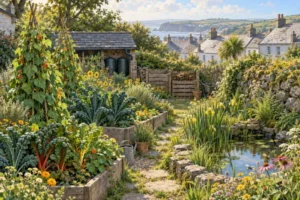
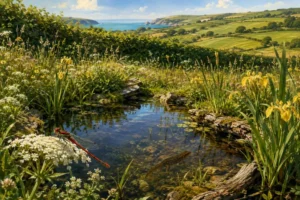
None of this is theoretical any more. The science (ecologist Frans Vera’s work reshaped it) says primeval Europe wasn’t closed forest but a shifting mosaic driven by herds of large herbivores — so the fix isn’t removing animals, it’s changing how animals behave: mixed herds, moving as herds do, trampling, dunging, breaking up the thatch, creating the mess that biodiversity actually lives in. At Knepp in Sussex, a bankrupt arable farm handed over to free-roaming herds became one of the richest wildlife sites in Britain inside twenty years. And on Dartmoor itself — this is the part that gives me real hope — a smallholding in the Walkham Valley called Leewood has spent three decades proving the model at family scale: grazing timed and moved to mimic the missing predators, meadows thick with broadleaf flowers where a rested field revealed orchids the owner first mistook for a blown-in plastic bag, pigs steered by electric fence to dig a lost stream back to a ghost pond, and a small conservation flock of sheep — yes, sheep — browsing hedges at low density and lifted off when the wildflowers come. That last detail is the whole argument in miniature: it was never “sheep bad.” It’s density, breed, and timing. The moor doesn’t need emptying. It needs its animals to move like wild ones.
How far could it go?
Honestly — further than most people think, and less far than romantics hope. Beavers are already back, quietly re-engineering West Country rivers, and their wetlands stay wet through drought. Lynx are genuinely close: reintroduction modelling points to the big forest belts of northern England and Scotland — not, note, to our moors, which lack the tree cover; the models are honest about where it works, and that honesty is why I trust them. Wolves are ecologically viable in Britain and culturally distant, and the serious voices say so plainly: the landscape is ready, the people aren’t, and pretending otherwise helps nobody. In the meantime the predator’s job — keeping herbivores moving, keeping numbers sane — falls to us, which on the moors means facing the deer question and the stocking question with the same honesty. Rewilding, I’ve learned, is not letting go of the land. It’s front-loading the repairs — the fences down here, the drains blocked there, the herds rebalanced — and then, only then, letting the land take over.
Bodmin: Cornwall’s own moor
Everything above applies one moor west. Bodmin Moor shares Dartmoor’s dynamics — the grazing, the Molinia, the vanished trees — and it also hosts Cornwall’s brightest counter-example: the ancient rainforest at Cabilla, where the Thousand Year Trust is expanding a 3,500-year-old oak wood and building Europe’s first temperate rainforest research station (the full story is in our Cornwall’s rainforest guide). Between the county’s beavers, its recovering valley woods and that research station, Cornwall is quietly becoming a place where the recovery is led, not just argued about. The moor that taught me the word “desert” could yet teach the country the word after it.
Personal insights and experiences
My conviction on this comes from years of following the movement — the books, the projects, one particular YouTube channel (Leave Curious) whose field reports first showed me sheep grazing inside an unfenced Dartmoor rainforest — and from practising the same principles at the only scale I own: a rented garden brought back from dead soil, yellow rattle sown to knock back the grass the way herds once would have, ponds dug and left for the wild things, which arrived within weeks. The principle is identical at every scale from my back fence to the high moor: stop the constant pressure, put the structure back, and life returns so fast it feels like it was waiting outside the gate. And I have stood among those knee-high oaks many times — Wistman’s Wood is one of my favourite places anywhere. Go in a very light drizzle, when the wet brings the smells of the wood to life, and the mossed boulders and lichen-furred branches make it feel like the most natural thing England has left. I mean that precisely: standing in that little biome makes me feel at home in a way almost nowhere else does — this is England, or what it should be. And that’s exactly why every visit carries its sadness, because once you know what you’re looking at, the evidence is everywhere: sheep wool snagged on the low branches, cattle eating everything at the wood’s edge, bark and saplings visibly nibbled away, and the convenient near-horizontal stretches of ancient trunk polished bare by generations of us sitting and sliding over them — a forest everyone photographs and nobody lets grow. I wish it could be fenced off and allowed to flourish. I know Black-a-Tor Copse too, its quieter sibling above the Meldon valley — which means everything this piece argues, I’ve seen with my own eyes, more than once. This, then, is my honest opinion, formed on the ground: the moors on our doorstep are the most beautiful broken thing in the South West, and we are one policy generation away from beginning to mend them.
FAQ
Q: Is Dartmoor natural?
A: No — it’s a cultural landscape: cleared over millennia and held treeless by continuous grazing and burning. Its wild look is management, not wilderness; pollen records show the wooded moor beneath.
Q: Why are there so few trees on the moors?
A: Because almost every seedling is eaten in its first seasons. Where grazing is excluded — cages, fences, rested land — trees return quickly, which is the clearest evidence of what holds them back.
Q: Does rewilding mean an end to farming?
A: No — the working examples run livestock deliberately: mixed animals at low density, moved the way predators once moved them, alongside food production. The change campaigners ask for is what public money rewards, not whether farmers exist.
Q: Can you visit Dartmoor’s rainforest fragments?
A: Yes — Wistman’s Wood and Black-a-Tor Copse are reachable on foot (Black-a-Tor from Meldon Reservoir). Admire from the edges: the interiors are fragile, and the mosses and lichens are the treasure.
Q: What can an ordinary person do?
A: Plenty: rewild any patch you control (a pond is the fastest magic), support the doers — Moor Trees, the Thousand Year Trust, your Wildlife Trust — visit the recovering places so they earn their keep, and vote for upland payment reform when the chance comes.
References and resources
- Rewilding Britain — principles and case studies: www.rewildingbritain.org.uk
- Knepp Wildland — the flagship English rewilding project: knepp.co.uk
- Moor Trees — restoring native woodland on Dartmoor: www.moortrees.org
- Thousand Year Trust — rainforest restoration on Bodmin Moor: thousandyeartrust.org
- Leave Curious — the rewilding field reports that shaped this piece: youtube.com/@LeaveCurious
- Reading: George Monbiot, Feral; Isabella Tree, Wilding; Guy Shrubsole, The Lost Rainforests of Britain.