Quick answer: permaculture is a way of designing a garden so that it works with nature rather than against it: living soil, captured water, plants and animals that do several jobs at once, and less work for you each year. Cornwall suits it well. The winters are mild, frosts are rare near the coast and there’s plenty of rain, and you only have to deal with the wind and salt. You don’t need land or a design certificate, and you don’t even need to own your home. Here are the principles that pay off in an ordinary garden, and where to see permaculture done properly in Cornwall.
Permaculture has a reputation for being complicated: design courses, zones and sectors, forest gardens with seven layers. At its heart, though, it is common sense written down. Watch your ground before you change it, feed the soil instead of the plants, keep the water that falls on you, and let living things do the jobs you would otherwise do yourself. This guide is the practical version, for a normal back garden in a Cornish town. It sits alongside our guide to rewilding Cornwall, which is the same idea at the scale of the landscape.
Table of Contents
- What permaculture actually is
- Why Cornwall suits it — and where it bites
- The principles that pay off in an ordinary garden
- You don’t need to own your garden
- Where to see and learn permaculture in Cornwall
- Personal insights and experiences
- FAQ
- References and resources
What permaculture actually is
The word is a contraction of “permanent agriculture”. The idea was developed in Tasmania in the mid-1970s by Bill Mollison and David Holmgren, who set it out in Permaculture One in 1978. It began as a response to farming that wore out its own soil. Since then it has grown into a general approach to designing gardens, smallholdings and even communities.
The Permaculture Association, the UK’s national charity for the movement, sums it up in three ethics:
- Earth care: look after the soil, water and living systems everything depends on.
- People care: meet your own needs and your community’s in ways that last.
- Fair shares: take what you need and pass on the surplus, whether that’s produce, seeds, cuttings or knowledge.
Everything else comes from those three: the design principles, the jargon and the diagrams. You don’t have to sign up to all of it to use it. Most gardeners who get good results take the principles that fit their plot and leave the rest.
Why Cornwall suits it — and where it bites
Few places in Britain are as generous to growers. Near the coast the average temperature is around 11–12°C across the year. The Isles of Scilly average fewer than two air frosts a winter, and most of coastal Cornwall only around fifteen to twenty. That means a long season, perennial crops that sulk further north, and winter salads that actually grow. Rain isn’t a problem either. Most of the coast gets 900–1,000mm a year, and the moors get up to twice that. Our weather guide covers the climate in full.
The catch is the wind. The South West is one of the most exposed regions in the UK, and the most exposed Cornish coasts see around two dozen days of gales a year, carrying salt a long way inland. The rain arrives mostly in winter, so even here summer can bring dry spells and hosepipe bans. The rain doesn’t fall evenly through the year, so storing it becomes part of the design.
Cornish hedges: permaculture before the word existed
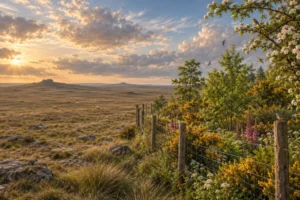
Cornwall’s answer to the wind has been in the landscape for centuries. There are more than 30,000 miles of Cornish hedges: stone-faced banks with an earth core, most of them medieval and some prehistoric. They shelter crops and livestock, carry wildflowers, insects and small mammals, and make up the county’s largest semi-natural habitat. One structure doing several jobs is exactly what permaculture means by stacking functions. A good windbreak doesn’t have to be solid, either. The RHS advises one that filters around half the wind rather than blocking it, which avoids damaging eddies and shelters ground up to ten times the windbreak’s height behind it.
Seaweed and sea sand
Cornish farmers improved their thin, stony soils for generations by hauling up sand and seaweed from the shore. There was even an unfinished canal near Newquay meant to carry both to the fields. Seaweed is still one of the best free soil improvers a coastal gardener can get: a few bags of loose, storm-cast weed from the strandline, where collecting is allowed, rinsed and used as mulch or added to the compost. Our coastal foraging guide covers the seaweeds that are good for eating instead.
The principles that pay off in an ordinary garden
Watch before you change anything
The most useful permaculture habit costs nothing: spend a season noticing. Where does the wind come from, and where is the shelter? Where does frost sit, and which corner stays wet after rain? Where does the sun reach in December? A garden designed around what you’ve seen beats one designed from a book every time.
Feed the soil, not the plants
Healthy soil is alive: fungi, bacteria, worms and countless small creatures that make nutrients available and give the ground its structure. Keep it covered with mulch, compost, leaf mould or plants, because bare soil erodes and dries out. Add organic matter rather than relying on bags of fertiliser, and dig as little as you can, because digging breaks up the networks that do the work. One of the best tools is free: lay cardboard over bare ground and keep it wet. The worms come up to eat it and pull it down into the soil for you. Even soil that looks dead comes back if you feed it and leave it alone.
Catch and keep the water
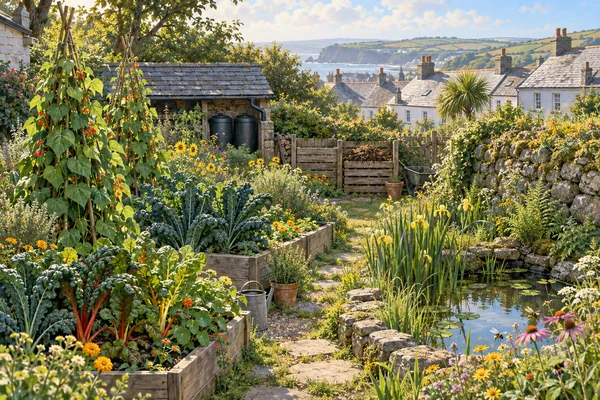
Every roof is a rainwater harvest. Put water butts on the downpipes and link them together, with the first overflowing into the second, so one storm fills them all. Keep the stored water in complete darkness: no light, no algae, and the water stays clean for months. On a slope, the permaculture tools are swales and contour beds, shallow ditches and mounds that follow the level of the land and slow water down so it soaks in rather than running off. They’re the same principle as a beaver dam, at the scale of a garden. We make the landscape-scale version of the argument in The Green Desert.
Make everything do more than one job
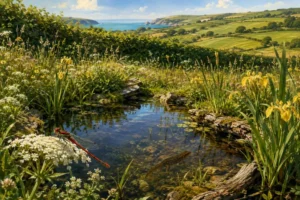
This is permaculture’s favourite idea. A pond gives you a water supply, a home for wildlife, and frogs and newts to deal with the slugs. A mixed hedge of hawthorn, blackthorn and hazel gives shelter, nesting birds, sloes and nuts, and poles for your beans. Along the coast, salt-tolerant shrubs like escallonia and griselinia make windbreaks that flower. Before you add anything to a garden, ask what else it could do.
Think in perennials
Annual vegetables are hard work: sow, weed, water and start again every year. Perennials such as fruit trees, currants and gooseberries, rhubarb, herbs and perennial greens come back without being asked. The mild climate suits them well. The forest garden takes the idea to its limit: layers of trees, shrubs and ground cover arranged like a woodland edge, all of it edible. You can start with one apple tree and a currant bush underneath.
Let the living layer do the work
The thread running through all of it: design so that living things do the maintenance. A wildlife pond with the right plants needs no pump or filter, because the plants and microbes keep it clear. A meadow needs one cut a year, not a mowing every week. Healthy soil feeds the plants. The work you put in at the start is the work you don’t have to do every year after. Our rewilding guide includes a pond built this way, with a diary of what moved in.
You don’t need to own your garden
Much of the advice on permaculture assumes you own land and will be staying for decades. Most people rent or move on. The principles still work. Ask the landlord before you change anything significant; many will agree to improvements that make the place better. Everything else can be built to move with you: raised beds, container fruit, water butts and a pond in a preformed liner. Soil you’ve brought back to life stays behind as a gift to the next tenant, and that counts as fair shares too.
Where to see and learn permaculture in Cornwall
Cornwall has one of the liveliest permaculture scenes in the country. These places are worth knowing about. Most welcome visitors or volunteers by arrangement, so check before you turn up.
- The Forest Garden, Budock Water, near Falmouth: a demonstration forest garden of over three acres, with a nursery, tours and courses.
- Plants For A Future, Penpol, near Lostwithiel: a perennial and forest-garden demonstration site established in 1989, and one of the oldest food forests in the country. Volunteering is by arrangement.
- Bosavern Community Farm, St Just: a not-for-profit community farm with polytunnels, woodland and allotments. It welcomes volunteers and runs workshops.
- Community Roots, Mount Pleasant Eco Park, Porthtowan: a community-supported market garden with regular drop-in volunteer days.
- Earthbound, near Lostwithiel: a regenerative farm on the River Fowey with courses and volunteer days.
- Keveral Farm, near Seaton: a community of growers since the early 1970s, and one of the first certified organic farms in the country.
- Permaculture Kernow, Rame Peninsula: design courses, workshops and community growing projects, including the community orchard at Millbrook.
To learn it properly, the standard qualification is the 72-hour Permaculture Design Certificate. Cornwall courses run through the spring and summer, including Design to Thrive at Porthtowan and Aranya’s Learn Permaculture at sites near Looe and Bude. For a quick look at the principles, Cornwall’s community orchards are a good place to start. Around twenty of them are linked through the Cornwall Orchard Network, and most welcome help at their workdays.
Personal insights and experiences
I’m permaculture-adjacent: I use the principles where they’re practical and skip the dogma. The garden I have now is a rented one, the back yard of a former student house. It was gravel laid over several layers of weed membrane, and underneath was grey, dead, compacted soil. With the landlord’s permission the gravel and membrane came up, and I hand-sifted the top twelve inches of the whole garden to get the rocks and rubble out, leaving only the smallest stones for drainage.
Then came the slow part: three years of feeding it. Compost, horse manure from a local stable I found on Facebook Marketplace, leaf mould, kitchen scraps and green manures in the first year. Sand, perlite, coir and bark went in to open up the structure. Most of all I worked on bringing the worms back, laying cardboard and keeping it wet so they would come up, eat it and drag it down into the ground. It took three years before the soil was properly alive again, and two more before sown grass would make it through a winter. Now it grows potatoes, tomatoes, strawberries, onions, garlic, carrots, pumpkins and cucumbers, and it has come together fantastically. None of it needed ownership, only permission and patience.
At our previous house we had a big garden against the edge of a woodland, and we turned lawn into meadow by letting nature do the heavy lifting. We scattered yellow rattle around the borders and let it spread inwards, weakening the grass as it went. We sowed wildflower seed and cut the grass hard. The next year we let everything grow and set seed before cutting, and by the third year it was a genuine wild meadow. The ponds filled themselves with daphnia, pond skaters, water beetles and newts, and one summer a dragonfly’s empty nymph case appeared on a stem, the best reward a pond can give.
My most useful small lesson is about water: linked butts, the first overflowing into the second, with the stored water kept in complete darkness so algae never gets started. It’s a small detail, but it sums up the whole approach. Work out what nature will do anyway, and set things up so it works in your favour.
FAQ
Q: What is permaculture in simple terms?
A: A way of designing gardens and growing spaces to work with nature: building living soil, catching and storing water, choosing plants and features that do several jobs, and favouring perennials, so the system does more of the work over time. It was developed by Bill Mollison and David Holmgren in Tasmania in the 1970s.
Q: What are the three ethics of permaculture?
A: Earth care, people care and fair shares: look after the living systems everything depends on, meet human needs in lasting ways, and share the surplus.
Q: Does permaculture work in Cornwall’s climate?
A: Very well. Mild winters, rare coastal frosts and good rainfall give a long growing season and suit perennial crops. The main challenge is wind and salt near the coast, which permaculture answers with filtering windbreaks and hedges, including Cornwall’s traditional stone-faced hedges.
Q: Can you do permaculture in a rented garden?
A: Yes. Ask the landlord before major changes, and keep the rest movable: raised beds, containers, water butts and preformed ponds. Building soil and habitat improves the property, and many landlords welcome it.
Q: Where can I learn permaculture in Cornwall?
A: Design courses run at Porthtowan and near Looe and Bude, and demonstration sites include The Forest Garden near Falmouth and Plants For A Future near Lostwithiel. Community farms such as Bosavern at St Just and Community Roots at Porthtowan welcome volunteers.
References and resources
- Permaculture Association — what is permaculture: www.permaculture.org.uk
- David Holmgren — what is permaculture: holmgren.com.au
- Met Office — the climate of South West England: www.metoffice.gov.uk
- Cornwall Council — Cornish hedges: www.cornwall.gov.uk
- RHS — windbreaks and shelterbelts: www.rhs.org.uk
- Cornwall Heritage Trust — how Cornish farmers improved their soils: www.cornwallheritage.com
- The Forest Garden, Budock Water: theforestgarden.co.uk
- Plants For A Future — volunteering at The Field: plantsforafuture.theferns.info
- Bosavern Community Farm: www.bosaverncommunityfarm.org.uk
- Community Roots, Porthtowan: www.communityroots.uk
- Design to Thrive — permaculture courses in Cornwall: designtothrive.co.uk
- Cornwall Orchard Network: www.resilientorchards.org.uk