Quick answer: Cornwall is one of the best places in Britain to see grey seals in the wild — from the clifftop at Godrevy’s Mutton Cove, around Looe Island, on boat trips from St Ives, Padstow and Falmouth, and sometimes bobbing up beside a harbour wall while you eat your chips. Autumn is special: pupping season runs from roughly September into the winter, when white-coated pups appear on remote beaches. Watch from a distance, keep dogs close, never approach a pup — and if you want guaranteed seals with a conservation story, the Cornish Seal Sanctuary at Gweek rescues and releases dozens of pups every year. Where, when, and how to do it right — below.
The grey seal is Cornwall’s biggest wild animal and one of its best-kept ordinary secrets: a species with a world population smaller than you’d ever guess — Britain holds a large share of it — hauling out, pupping and fishing along this coast all year round, mostly unnoticed by the people on the beach above. This guide covers where you can reliably see them, when the season peaks, the watching code that keeps them safe, and — in the personal section — what it’s like when a seal decides to come and see you, because that part I know from experience.
Table of Contents
- Cornwall’s grey seals
- Where to see seals in Cornwall
- When to see them: pups and seasons
- The Cornish Seal Sanctuary at Gweek
- The seal-watching code
- Personal insights and experiences
- FAQ
- References and resources
Cornwall’s grey seals
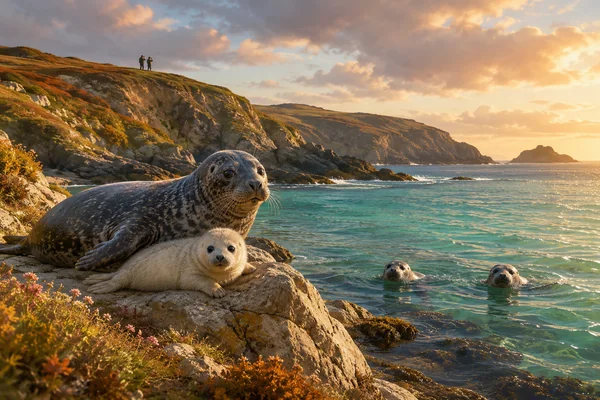
The seals you’ll see in Cornwall are Atlantic grey seals — the males huge, roman-nosed and battle-scarred, the females sleeker and mottled, both capable of that unnerving trick of hanging vertically in the water (“bottling”) while they inspect you with enormous dark eyes. They are genuinely significant animals: the grey seal is one of the rarer seal species on Earth, and the British Isles host a substantial share of the entire world population, with Cornwall’s coves and offshore rocks holding an important, closely studied part of it. Researchers at the Cornwall Seal Group Research Trust identify individual seals by their unique fur patterns and have tracked some of the same animals returning to the same Cornish beaches for decades. The seal watching you do here, done well, feeds real science — done badly, it drives exhausted animals off the beaches they need. Hence the code, below.
Where to see seals in Cornwall
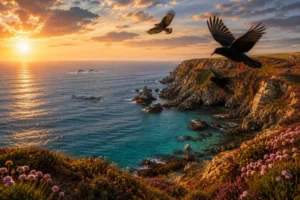
- Godrevy and Mutton Cove (near Hayle) — the classic: from the National Trust clifftop you look down on a beach where dozens of seals haul out, especially in autumn and winter. Bring binoculars, stay on the cliff, and never go down; this is the easiest truly wild seal-watching in Cornwall.
- Looe Island — the Cornwall Wildlife Trust reserve just off Looe, with well-known resident seals often seen from the town’s coast path or on the summer boat trips across; some individuals are local celebrities with names.
- St Ives boat trips — the short trip out to Seal Island (the Carracks) is a Cornish institution; seals haul out on the rocks and often swim to the boats entirely on their own terms.
- Padstow, Newquay and Falmouth trips — wildlife cruises from all three regularly deliver seals, with dolphins as the bonus lottery; around Falmouth, the Helford’s quiet creeks hide them too.
- Chance encounters — harbours where fish are landed (a seal working Newquay or Mevagissey harbour is not rare), quiet coves on the coast path, and beside surfers and kayakers who never asked for company. If a head pops up near you in the water, enjoy it — and let the seal decide the distance.
When to see them: pups and seasons
Seals are here all year, but autumn changes everything: grey seal pupping in Cornwall runs from roughly late August or September through into winter, peaking in the autumn months. Mothers haul out on remote, sheltered beaches to give birth to white-coated pups, feed them an astonishingly rich milk for around three weeks, then leave them to moult and teach themselves the sea. Two things follow. First, autumn and winter are the best watching seasons — haul-outs at places like Mutton Cove can reach their biggest counts in the colder months (our October guide calls it one of the month’s quiet wonders, and our wildlife calendar maps the whole year). Second, this is when people find “abandoned” pups on beaches. A white pup alone on a beach is almost always fine — its mother is offshore, and your presence is the actual danger. Keep away, keep dogs away, and if a pup looks genuinely injured or in trouble, call the British Divers Marine Life Rescue hotline rather than approaching.
The Cornish Seal Sanctuary at Gweek
Tucked up the Helford estuary at Gweek, the Cornish Seal Sanctuary has been rescuing, rehabilitating and releasing seals for decades — busiest in exactly the season the wild pups arrive, when storm-battered and underweight youngsters come in from beaches all around the coast. For families it solves the honest problem with wild seal-watching (no guarantees, long lenses, cold cliffs): here the seals are certain, close, and every one has a story that teaches the conservation message better than any sign. It pairs naturally with our wildlife conservation guide — this is one of the places where “supporting Cornwall’s wildlife” is a till you can actually walk up to.
The seal-watching code
- Watch from above and afar — clifftops beat beaches; binoculars beat closeness. If seals are looking at you, you’re already too close; if they move toward the water, back off immediately.
- Never approach a hauled-out seal or pup — stampeding adults injure themselves on rocks, and a disturbed mother may abandon her pup.
- Don’t feed seals — it teaches them to approach boats and people, and that habituation gets seals injured and killed.
- Dogs on leads anywhere seals haul out.
- No drones over haul-outs — they cause proper panic.
- In the water, be passive — swimmers, surfers and kayakers should let curious seals set every term of the encounter.
- Report: injured or genuinely distressed seals to BDMLR’s rescue hotline; identifiable seal photos (taken from distance) are welcomed by the Cornwall Seal Group’s research.
Personal insights and experiences
My seals, so far, are Devon seals — Slapton Sands, where I shore fish — and they are anything but distant. Seals have learned exactly what a fisherman on a beach means, and at Slapton they don’t just watch from the water: they come out of it, hauling up the shingle and edging to within six feet of us, unhurried and entirely certain of their welcome, waiting to see what the session produces. The first time a full-grown grey seal walks out of the sea toward you in the dark, you understand immediately that this is a large wild predator that has chosen to be polite — it is thrilling and slightly unnerving in about equal measure, and it never gets old. I should say plainly: the watching code above is right and our fishing encounters sit in a grey area the seals themselves created — we didn’t invite them, but generations of anglers before us taught them that fishermen are worth investigating. Don’t seek that encounter out; let it find you. As for Cornwall’s seals — Mutton Cove in pup season is now on the same list as the Perranporth coast path, and when the family and I finally lie on that clifftop with binoculars, this article gets its update.
FAQ
Q: Where is the best place to see seals in Cornwall?
A: Mutton Cove at Godrevy, viewed from the clifftop, is the most reliable wild spot — biggest haul-outs in autumn and winter. Looe Island and the St Ives Seal Island boat trip are the other classics; Gweek’s Seal Sanctuary is the guaranteed family option.
Q: When is seal pupping season in Cornwall?
A: Roughly September through the winter, peaking in autumn. White-coated pups appear on remote beaches — normal, and best left entirely alone.
Q: I found a seal pup alone on a beach — what should I do?
A: Almost always nothing: its mother is nearby offshore. Keep people and dogs well away. If it’s visibly injured, tangled or in danger, call the BDMLR marine mammal rescue hotline — don’t touch or move it.
Q: Can you swim with seals in Cornwall?
A: Seals sometimes choose to investigate swimmers, surfers and kayakers — a magical encounter when it’s on their terms. Never pursue, corner, touch or feed them; stay passive and let them decide everything.
Q: Are grey seals rare?
A: Globally, yes — the world population is modest and the British Isles hold a large share of it, which makes Cornwall’s colonies genuinely internationally important. That’s why the watching code matters.
References and resources
- Cornwall Seal Group Research Trust — research and the watching code: www.cornwallsealgroup.co.uk
- British Divers Marine Life Rescue — 24hr hotline for injured marine mammals: bdmlr.org.uk
- Cornish Seal Sanctuary, Gweek: www.sealsanctuary.co.uk
- Cornwall Wildlife Trust — Looe Island reserve: www.cornwallwildlifetrust.org.uk
- National Trust — Godrevy: www.nationaltrust.org.uk