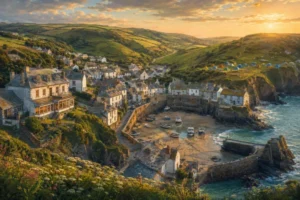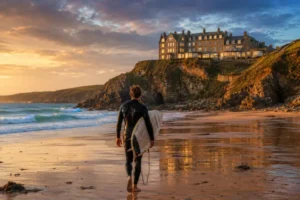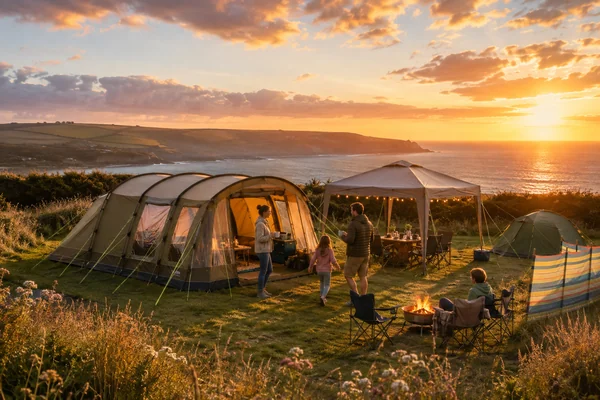
Quick answer: Cornwall is Britain’s best camping county — hundreds of sites from clifftop farm fields with nothing but a tap and a view to big family parks with pools and clubs, all within reach of a beach. Book early for July and August, come in September if you possibly can, pitch for the wind, and pack for every kind of weather in the same day. The best areas, how to choose a site, what to bring, and the honest truth about Cornish campsite weather from a family that has had all of it — below.
Some of the best nights we’ve ever spent in Cornwall cost less than a round of drinks: a tent in a field above the sea, the sound of surf, and a sky you don’t get anywhere near a streetlight. Camping is how our family — six children and, these days, three generations — has done Cornwall for years, in glorious weather and in gales, and it’s how a lot of families make a Cornish week affordable. This guide covers where to camp, how to choose between the farm field and the holiday park, what to pack, and what the weather will really do to your tent.
Table of Contents
- Two kinds of Cornish campsite
- Where to camp, by area
- Choosing and booking
- What to pack for Cornish camping
- The weather, honestly
- Personal insights and experiences
- FAQ
- References and resources
Two kinds of Cornish campsite
- The farm field — a small site on a working farm, often on the cliffs or a few fields back: basic facilities, wide pitches, no entertainment but the sky, and frequently the best location in the county. Quiet, cheap, and the choice for people who want to feel genuinely far from everyone. Some are so small they don’t take bookings; some take one phone call.
- The holiday park — bigger, busier, with the pool, the playground, the bar, the shop, the kids’ club, and other children for yours to run with. More expensive, far more organised, and the right answer for a family with young children who need entertaining when the rain sets in.
- In between — the well-run mid-sized sites, glamping fields with bell tents and huts, and campsites attached to surf beaches with a café at the gate. Our unique stays guide covers the huts and pods.
Where to camp, by area
- North coast — Bude to Tintagel: clifftop farm sites above coves, big skies, big weather; the sort of place you camp above the sea and walk down to it. Boscastle, Tintagel and Bude for days out; see our Tintagel guide.
- North coast — Padstow to St Agnes: the surf-beach belt. Sites near Perranporth, Newquay, Watergate and Polzeath range from family parks to farm fields; convenient for rock pooling, surf lessons and the busiest beaches in the county.
- The far west: small sites around St Just, Sennen and the Lizard — wild, exposed, gorgeous, and further from everything.
- The south coast: gentler, greener, more sheltered — sites around Looe, Fowey, the Roseland and the Helford, with calmer swimming and creek walks; see our family beaches guide.
- Bodmin Moor: for the walkers and stargazers — dark skies, tors, and a completely different Cornwall.
Choosing and booking
- Book early for the school holidays — the good sites are full by spring for August; September is easier, cheaper and warmer in the sea (see our September guide).
- Ask about shelter. A site with hedges or a dip is worth more than a site with a view when the wind gets up — and it will.
- Check the walk to the beach — “near the beach” can mean a mile of lane with a windbreak convoy.
- Facilities that matter with children: hot showers that don’t need coins, a washing-up shelter, somewhere to dry things, and a shop or a van for milk. A pool matters more than you’d think on a wet day.
- Dogs — most Cornish sites welcome them; check, and see our dog-friendly guide.
- Where to look: the sites’ own websites for the small farms; the big booking platforms and Cool Camping-style curated lists for the rest.
What to pack for Cornish camping
- A tent that can take wind, pitched tail to the prevailing south-westerly, with every guy rope out and pegged properly. Storm pegs for the corners. For a family, that means a proper tunnel or family tent with bedrooms and standing height — the weekend backpacking tent is not the tool for a week with children.
- A gazebo pitched hard against the porch: it becomes the living room, the wet-day room and the kitchen, and it’s the difference between a rainy afternoon and a rainy holiday. (Take it down when the forecast turns properly windy — see below.)
- A windbreak or two — the Cornish family’s most versatile possession: shelter, privacy screen, and (with a beach towel) an emergency roof.
- Layers and waterproofs for everyone, whatever the forecast, plus something warm to sleep in for late-season nights. Our weather guide is not exaggerating.
- A good air bed and a decent sleeping bag — the ground is where the cold comes from.
- A stove, a kettle, and more tea than seems reasonable.
- Head torches, a mallet, spare pegs, gaffer tape, and a bag for wet things.
- The beach kit: swim stuff, wetsuits, buckets, a crab line, and a tide table.
The weather, honestly
Cornwall’s campsites can give you the finest nights in Britain — clear skies, warm still evenings, a slight delicious breeze — and they can give you the tail of an Atlantic storm, sometimes in the same week. Summer is generally kind; late August and September bring the odd proper blow; and any month can produce a wet day that a tent turns into a long day. The trick isn’t to plan around it but to be ready for it: a well-pitched tent, a plan B for rain (woods, museums, a swim regardless — see our August guide), and the attitude that weather is part of the holiday rather than an interruption to it. Bad-weather camping trips are the ones families talk about for years.
Personal insights and experiences
Our camping runs the whole spectrum. At one end is Lower Pennycrocker Farm, above the coast between Boscastle and Bude — a farm field where you feel genuinely far from people, and where we’ve camped in a summer week of glorious clear skies with the site nearly to ourselves, and in an autumn week when gale-force winds battered the tent sides in around us and some of our neighbours’ tents lost the battle entirely. We took the gazebo down on day one and spent most of that week inside the tents; it’s still a holiday we talk about. Same field, two Cornwalls. At the other end is the family park — most recently Monkey Tree near Perranporth this August, four days because that was all our calendars would allow, with the pool and the facilities that make it work for grandchildren, and days out to Newquay Zoo and Perranporth’s rock pools in between.
What years of it have taught us: pitch for the wind, not the view; the windbreak-and-towel shelter is standard kit; a tent full of six children in a storm is louder than the storm; and the nights that make it worth it — the still ones, with the sea audible and the stars out — arrive often enough that we keep going back. If you’re new to it, start with a well-run site in September, and let Cornwall make its case.
FAQ
Q: When is the best time to camp in Cornwall?
A: June for long light evenings and quiet sites; September for the warmest sea, fewer people and lower prices; July and August for the busiest, most reliable weather — book months ahead.
Q: Can you wild camp in Cornwall?
A: Not legally without the landowner’s permission — unlike parts of Dartmoor, Cornwall has no wild-camping right. Use the many small farm sites instead, which offer the same feeling.
Q: Are Cornish campsites dog-friendly?
A: Most are — check individual sites, and keep dogs on leads on the fields.
Q: Is it too windy to camp on the Cornish coast?
A: Not usually — but pitch low, use every guy rope, choose a sheltered pitch, and be ready to sit out a blow. Autumn is windier than summer.
References and resources
- Visit Cornwall — camping and caravanning: www.visitcornwall.com
- Camping and Caravanning Club — Cornwall sites: www.campingandcaravanningclub.co.uk
- Met Office — Cornwall forecast: www.metoffice.gov.uk