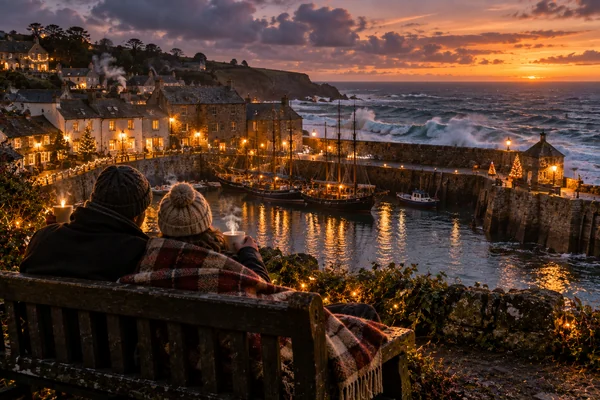
Quick answer: winter is Cornwall’s best-kept romantic secret. The couples who come between November and February get the county the honeymoon brochures only pretend to sell: empty famous beaches, storm theatre from a warm window, firelit pubs, harbour villages strung with lights, and hotel prices at half their August swagger. The recipe is simple — a cosy base, a wild coast, and no agenda beyond the two of you. Where to stay, what to do, and how to time it — below.
Summer Cornwall is for families; winter Cornwall is for couples. It’s the season the county empties, slows and turns inward — log fires, early dusks, enormous seas — and everything that makes a romantic break work is suddenly abundant: privacy, drama, cosiness and value. Our romantic getaways guide covers the where-to-hide of it year-round; this one is the winter playbook.
Table of Contents
- Why winter is the romantic season
- Choosing your base
- The winter date list
- Month by month: November to February
- The practicalities
- Personal insights and experiences
- FAQ
- References and resources
Why winter is the romantic season
Romance needs three things Cornwall’s winter supplies by the lorry-load. Privacy: beaches that hold ten thousand people in August hold the two of you and a dog-walker in January. Drama: the Atlantic in storm season is the best free theatre in Britain, and watching it from behind glass with someone you love — or from a headland in matching waterproofs — beats most West End evenings. Cosiness earned: the fireside, the deep bath and the long dinner all mean more when you’ve come in from weather that meant it. Add prices that drop by a third to a half outside the festive peaks, and the honest question isn’t why you’d take a winter break in Cornwall — it’s why everyone doesn’t.
Choosing your base
- The spa hotel — winter is when Cornwall’s spa and wellness places make most sense: sea view, treatment, pool, storm outside. Book the room with the bath worth writing home about.
- The harbour-town bolthole — a cottage or inn room in a working village (Fowey, Mevagissey, Port Isaac, Mousehole, Charlestown) puts dinner, a pub fire and a lit-up harbour within a fifty-metre stumble.
- The genuinely different — winter availability is the best of the year for the unique stays: a lighthouse cottage in a gale is a honeymoon story regardless of the anniversary count.
- The hideaway with a wood burner — the off-grid cabin/hut end of the market is made for this season; our area guide helps you pick the coast to hide on.
The winter date list
- Storm-watching for two — from the safe classics (a harbour-front café, a headland car park with the flask) while the Atlantic performs. The rules in our November guide apply doubly when you’re showing off for someone.
- An empty-beach walk — the great romantic cliché, and clichés get that way by working: a huge winter beach, two sets of footprints, chips after.
- Harbour dinner, lights on the water — the year-round core of Cornish date nights, at its candlelit best now; Charlestown’s Georgian harbour and tall ships need no set dressing.
- Mousehole’s lights (mid-December) — the county’s most romantic single evening: wrap up, arrive at dusk, share the flask.
- A murmuration at dusk — starlings over a winter reedbed rank among the best free spectacles in Britain; our wildlife calendar has the season’s timings, seal-watching included.
- Dark skies — Bodmin Moor on a clear, moonless winter night is a planetarium with no roof; take blankets, cocoa, and low expectations of getting home early.
- The fireside pub crawl of one pub — find the inn with the fire, the dog, and the corner table, and stay there. This is not a failure of itinerary; it is the itinerary.
- The brave option — a wetsuited winter dip or one of the wood-fired saunas appearing on Cornish beaches, followed immediately by the fireside item above.
Month by month: November to February
November is the quietest and most private — the county to yourselves, storm season warming up (the honest weather picture). December is the candlelit one: harbour lights, festive menus, Mousehole — and the best-value pocket sits in the early-December lull between half-term and Christmas (December’s guide has the detail). January is the recovery month: cheapest, wildest, emptiest — the connoisseur’s pick for a fireside-and-storms week. February brings Valentine’s (book the good tables and sea-view rooms well ahead — the county’s couples all have the same idea) and, by its end, the first stirrings of spring in the sheltered gardens. All four share the fundamentals: dramatic seas, early dusks made for long dinners, and a county operating at conversation volume.
The practicalities
- Book character, not just location — in winter you’ll spend real hours in the room, so the fireplace, the bath and the view stop being brochure garnish and become the holiday.
- Check winter opening — many restaurants and attractions run reduced days November–February; book dinner ahead in the villages, especially Sunday–Wednesday.
- Pack for the truth — proper coats and boots turn “trapped inside” into “gloriously out in it”; the romance of a winter beach is directly proportional to how warm your hands are.
- Drive in daylight where you can — lanes, rain and 4.30pm dusk are a poor cocktail for arrival-day nerves.
- Time it to the tide and forecast, not the itinerary — the best winter break plans one thing a day and lets Cornwall improvise the rest.
Personal insights and experiences
Lisa and I do our courting the Cornish way, which is to say mostly outdoors and mostly near water. Looe is ours — harbour days, the walk along the river to the sea, cockles and mussels from the fish market eaten with our backs to the wind — and Charlestown is the treat: we’ve sat over dinner by that Georgian harbour a good few times, and I can report that tall ships and masthead lights do half the work of any romantic evening for you. What winter changes is the ratio of world to couple: the same harbours, the same walks, the same tables, with almost everyone else subtracted. My honest counsel after years of Cornish twosomes is the unfashionable kind: the county does the romancing if you let it — pick one cosy base, keep the plans loose, walk in whatever weather arrives, and be back somewhere warm by dusk with no intention of leaving it. The couples who come home glowing aren’t the ones who did the most; they’re the ones who stopped counting.
FAQ
Q: Is Cornwall good for a romantic break in winter?
A: Arguably at its best: empty beaches, storm drama, firelit pubs, harbour lights and prices well below summer. It suits couples who like weather and cosiness in alternation.
Q: Where should couples stay in Cornwall in winter?
A: A harbour-town bolthole (Fowey, Mousehole, Charlestown, Port Isaac), a sea-view spa hotel, or a wood-burner hideaway — chosen for the room itself, since winter evenings are long and indoors.
Q: When is the cheapest romantic time to visit Cornwall?
A: January and early February (outside Valentine’s), and the early-December lull. November runs close. All offer the same empty coast; only the festive trimmings differ.
Q: What is there actually to do in Cornwall in winter as a couple?
A: Storm-watching, huge empty beach walks, harbour dinners, the Mousehole lights in December, murmurations and seal-watching, dark-sky stargazing on Bodmin Moor, spa days — and the fireside, which is not a consolation prize but the point.
Q: Is Valentine’s in Cornwall worth it?
A: Yes, with planning: the good restaurants and sea-view rooms book out well ahead. Going the weekend before or after gets the same coast for less money and more table choice.
References and resources
- Met Office — forecasts for planning around the weather: www.metoffice.gov.uk
- Mousehole Harbour Lights — December dates: www.mouseholelights.org.uk
- Bodmin Moor dark skies — designated International Dark Sky Landscape: www.cornwall.gov.uk
- Visit Cornwall — winter events: www.visitcornwall.com