Quick answer: for two thousand years Cornwall was one of the world’s great mining regions — tin above all, then copper — and it shaped everything: the engine houses on the cliffs, the pasty, the Methodist chapels, the surname on your gran’s side, and the “Cousin Jacks” who took Cornish mining to every continent. The last tin mine closed in 1998; the landscape it left is now a UNESCO World Heritage Site. To explore it: Geevor and Levant in the far west, Botallack’s clifftop engine houses, the walks around St Agnes and the Mineral Tramways, and the underground tours that take you into the dark. History, the miner’s life, and where to go, below.
You can’t understand Cornwall without the mines. The ruined engine houses standing on every headland aren’t picturesque accidents; they’re the bones of an industry that once led the world, employed a third of the county, sent its people across the globe when it collapsed, and left behind the pasty, the chapel, the granite towns and a stubborn sense of difference. This guide covers the story from the Bronze Age to the last shift, what life was like underground, the great sites you can visit today, and why the mines might not be finished with Cornwall yet.
For tin’s place in the wider sweep of Cornish history, from Bronze Age traders to today’s lithium revival, see The Story of Cornwall.
Table of Contents
- Two thousand years of tin
- The golden age and the collapse
- The Cornish miner: life underground
- Cousin Jacks: mining and migration
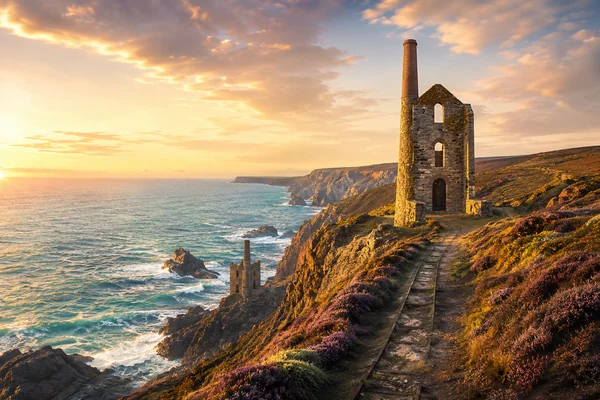
- Engine houses: what you’re looking at
- Where to explore Cornwall’s mining heritage
- Poldark: the mines on page and screen
- Mining today: not quite over
- Personal insights and experiences
- FAQ
- References and resources
Two thousand years of tin
Cornwall’s granite is shot through with mineral veins — lodes — of tin, copper, and much else, and people have been getting metal out of them since the Bronze Age, when Cornish tin (alloyed with copper to make bronze) was traded across Europe; classical writers wrote of the tin islands in the far west. For centuries the work was “streaming” — washing tin from river gravels — governed by the ancient Stannary courts and parliaments that gave Cornish tinners their own laws. Real underground mining came later, and it was the arrival of steam that changed everything.
The golden age and the collapse
By the 18th century Cornish mines were going deep — and deep mines flood. Steam pumping engines, refined by Cornish engineers into the famously efficient Cornish beam engine, drained the depths and made the county the technological frontier of the age; Richard Trevithick of Camborne ran the world’s first steam road locomotive up Camborne Hill in 1801. Through the early 1800s Cornwall was the world’s greatest producer of copper and later tin, with hundreds of mines, thousands of engine houses, and towns like Camborne, Redruth and St Just booming.
Then the world caught up. Copper and tin discoveries in the Americas, Australia and Malaya crashed prices from the 1860s; mines closed by the score; and the “Great Migration” began. The 20th century saw a long tail of survival — a few big mines, wartime demand, the tin-price collapse of 1985 — until South Crofty at Pool, the last working tin mine in Europe, closed in 1998. Someone painted on its wall: “Cornish lads are fishermen and Cornish lads are miners too / But when the fish and tin are gone, what are the Cornish boys to do?”
The Cornish miner: life underground
- The descent — hundreds of fathoms down wooden ladders, hours of climbing before and after a shift, until the man-engine (a moving ladder driven by the beam engine) arrived at some mines in the 1840s. Levant’s man-engine collapsed in 1919, killing 31 men.
- The work — hand-drilling shot holes by candlelight in heat and bad air, blasting, hauling; miners worked as “pares” (small teams) bidding for pitches on “tribute” (a share of the ore’s value) — gambling their wages on the rock.
- Croust — the meal break underground, and the reason for the Cornish pasty: a whole dinner in a crust that survived the descent.
- The knockers — the small spirits heard tapping in the workings, who could lead you to ore or warn of a fall; a crumb of pasty left for them was insurance. See our storytelling guide.
- The bal maidens — the women and girls who broke and dressed the ore on the surface, in all weathers, in their thousands.
- The cost — lung disease, accidents, and a life expectancy that shocked Victorian reformers; and the chapels — Methodism swept the mining districts — that gave the communities their strength.
Cousin Jacks: mining and migration
When the mines failed, the miners left — a quarter of a million or more through the 19th century, to the copper of South Australia’s Moonta and Burra, the goldfields of Victoria and the Rand, the silver of Mexico, the copper of Michigan’s Upper Peninsula and the tin of Malaya. “Wherever there’s a hole in the ground,” the saying went, “you’ll find a Cornishman at the bottom of it.” They took their skills, their chapels, their choirs, their pasties, and the nickname Cousin Jack; and there are still Cornish festivals in South Australia and pasty shops in Mexico’s Real del Monte because of them. Half of Cornwall has a family story of someone who went, and some of the money they sent home built the terraces you walk past.
Engine houses: what you’re looking at
That granite tower with a chimney beside it, standing alone on the cliff or the moor: it held a Cornish beam engine — a great rocking beam pivoted through the thick front wall, one end over the shaft to drive the pumps (or wind the ore, or stamp it), the other in the house over the cylinder. The chimney served the boilers. The thick “bob wall” is the strong one; the rest was just shelter. Most were pumping engines, which is why they cluster at shafts; the ones on the cliffs at Botallack pumped from workings that ran out under the sea, where miners could hear the boulders rolling overhead in storms. And those barred tunnel mouths in the cliffs at Perranporth and along the north coast? Adits — the drainage tunnels of the mines above — but the children who insist they were smugglers’ dens are also right: the free-traders of the 1700s used the same tunnels and caverns, hauling brandy up an eighty-foot shaft at Droskyn Point. The miners and the smugglers shared these cliffs, and often the same men did both.
Where to explore Cornwall’s mining heritage
- Geevor Tin Mine, Pendeen — the last mine in the far west, closed 1990, now the biggest mining museum in the country: the surface works, the dry where the men changed, and a guided walk into the 18th-century workings underground. Start here.
- Levant Mine and Beam Engine (National Trust), next door — the oldest working beam engine still in steam on its original site, running on steaming days, and the memorial to the 1919 disaster.
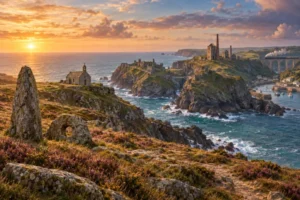
- Botallack — the Crowns engine houses clinging to the cliff face; the most photographed mining ruins in Britain, and Poldark‘s Wheal Leisure.
- Wheal Coates, St Agnes — the engine house on the heather above Chapel Porth, on the coast path; see our walking guide.
- East Pool Mine (National Trust), Pool — two great beam engines in their houses, one of them among the largest surviving.
- Poldark Mine, Wendron — an 18th-century tin mine with underground tours; and King Edward Mine, Camborne — the old training mine of the Camborne School of Mines, with working ore-dressing machinery.
- The Mineral Tramways — walk or cycle the old ore routes from Portreath to Devoran through engine-house country; see our cycling guide.
- Luxulyan Valley and the Tamar valley around Calstock and Cotehele — mining’s eastern chapters, in the woods; see our woodland walks guide. And Wheal Martyn near St Austell for the china-clay story that carried on where metal stopped.
Poldark: the mines on page and screen
For most people outside Cornwall, the mines arrived by television. Winston Graham’s twelve Poldark novels — begun in 1945, set in the 1780s and after — put a returning soldier, a failing family mine and the whole world of tributers, tin prices and bal maidens at the centre of a story that has never really stopped being adapted: the BBC’s 1970s series, and then the 2015 series with Aidan Turner that sent a new generation to the coast path. Graham knew his mining; the desperate reopening of Wheal Leisure, the bank collapses, the smuggling that kept the miners’ families fed — all of it is drawn from the county’s real history, and it’s as good an introduction to this whole subject as any museum.
The 2015 series filmed on the real thing: Botallack‘s Crowns engine houses stood in for Wheal Leisure and Grambler; Levant and the West Penwith coast provided the mining country; Charlestown‘s Georgian harbour played Truro’s quays; the beaches at Holywell Bay, Porthgwarra and Gunwalloe did the rest. Poldark Mine at Wendron, an 18th-century tin mine you can go down, took its name from the novels decades ago. Watch the series, then walk Botallack — you’ll recognise every cliff.
Mining today: not quite over
Since 2006 the Cornwall and West Devon Mining Landscape has been a UNESCO World Heritage Site — ten areas across the county recognised as globally important. And the story has a twist: the same granite holds lithium and the tin the modern world suddenly wants again, and South Crofty is being dewatered with a view to reopening, while lithium projects test the old ground. It’s possible that a Cornish child today will grow up with working mines. The Cousin Jacks would recognise the ambition.
Personal insights and experiences
My father’s family is Cornish, but as far as I know there’s no mining in it — which puts us in a minority round here, and means my own sense of the mines came from elsewhere. It came, specifically, from going underground at Morwellham Quay, just over the Tamar in Devon, where a little train takes you into a copper mine and the daylight goes: I still remember how that felt — the cold, the wet, the ceiling of rock, the sudden understanding of what men did down here for a wage. Nobody who has been in a mine looks at an engine house the same way afterwards.
Beyond that, I’ll admit my Cornish mining education is largely Poldark — every series, and the landscape it made famous is the landscape I most want to see: Botallack’s engine houses on the cliff, Levant in steam, and half an hour underground at Geevor. I haven’t visited a Cornish mine yet; it’s high on the family list, and I want to take the grandchildren, because the pasty in their hands and the accent around them both came out of the dark. When we go, I’ll report back. If you go first — start at Geevor.
FAQ
Q: When did tin mining end in Cornwall?
A: South Crofty at Pool, the last working tin mine, closed in 1998 — though it’s now being prepared to reopen, and Cornish lithium is under exploration.
Q: Can you go down a Cornish tin mine?
A: Yes — Geevor Tin Mine at Pendeen and Poldark Mine at Wendron both offer underground tours; Levant, East Pool and King Edward Mine show the surface works and engines.
Q: What are the engine houses in Cornwall?
A: The granite houses that held Cornish beam engines, mostly for pumping water from the mines; the great beam pivoted through the thick front wall and the chimney served the boilers. Thousands were built; hundreds survive.
Q: Where was Poldark filmed?
A: Botallack’s Crowns engine houses stood in for Wheal Leisure; the series used mining sites and beaches across west Cornwall, with the Levant and Botallack area at its heart.
Q: Why did Cornish miners emigrate?
A: The collapse of copper and tin prices from the 1860s closed mines by the score, and skilled Cornish miners — “Cousin Jacks” — took their expertise to Australia, the Americas and South Africa in their hundreds of thousands.
References and resources
- Cornish Mining World Heritage Site: www.cornishmining.org.uk
- Geevor Tin Mine: geevor.com
- National Trust — Levant Mine and East Pool Mine: www.nationaltrust.org.uk
- Poldark Mine: www.poldarkmine.org.uk
- King Edward Mine: kingedwardmine.co.uk