Quick answer: Cornwall has one main line and five branch lines, and between them they reach St Ives, Falmouth, Looe, Newquay and the Tamar Valley without a car. The ticket that makes it work is the Ride Cornwall day pass — £21 adult, £10.50 child, £42 family — which covers trains and buses across Cornwall, between Cornwall and Plymouth, and on the Tamar Valley Line. It is valid after 9am on weekdays and all day at weekends. The branch lines are also, in themselves, among the best short journeys in Britain.
Cornwall is a difficult place to drive and a surprisingly good place to take the train. The branch lines survived Beeching mostly by luck, and they now deliver you to the top of a beach rather than to a car park two miles away. This is how the network works and what each line is for. For getting to Cornwall in the first place, see our guide to reaching Cornwall.
Table of Contents
- The network: one main line and five branches
- The ticket that makes it worth doing
- St Ives Bay Line: the one everybody should do
- Maritime Line: Truro to Falmouth
- Looe Valley Line: the river line
- Atlantic Coast Line: Par to Newquay
- Tamar Valley Line: the one nobody takes
- Making a car-free trip actually work
- FAQ
- References and resources
The network: one main line and five branches
The main line runs Penzance to Plymouth and onward to London Paddington, and it is the spine. Everything else hangs off it.
| Branch line | Runs between | Roughly |
|---|---|---|
| St Ives Bay Line | St Erth and St Ives | 12 minutes |
| Maritime Line | Truro and Falmouth | 20 minutes |
| Atlantic Coast Line | Par and Newquay | 50 minutes |
| Looe Valley Line | Liskeard and Looe | about half an hour |
| Tamar Valley Line | Plymouth and Gunnislake | about three quarters of an hour |
One warning before you plan anything. Cornwall Council states plainly that while main line services run seven days a week, some branch lines do not operate on Sundays. It does not say which, and it varies with the timetable, so check the specific line and date rather than assuming.
The ticket that makes it worth doing
Buying singles will cost you more than the car. The Ride Cornwall day pass is the thing to know about, and most visitors never hear of it.
| Ticket | Price |
|---|---|
| Adult | £21.00 |
| Child (5–15) | £10.50 |
| Family (up to two adults and three children) | £42.00 |
- One day’s unlimited travel on trains and buses.
- Valid after 9am Monday to Friday, and at any time on weekends and bank holidays.
- Covers travel within Cornwall, between Cornwall and Plymouth, and the Tamar Valley Line.
- Trains: Great Western Railway and CrossCountry, off-peak services.
- Buses: routes operated by Go Cornwall Bus and Stagecoach.
The family price is the one that changes the maths: £42 moves five people around Cornwall for a day, with no parking, no queue for a space at a beach car park in August, and no driver who cannot have a drink with lunch.
There is also a rail-only Cornwall Ranger if you are not using buses, and PlusBus for adding local buses to a longer rail ticket. Prices for these vary between listings, so take them from Transport for Cornwall rather than from a blog, including this one.
St Ives Bay Line: the one everybody should do
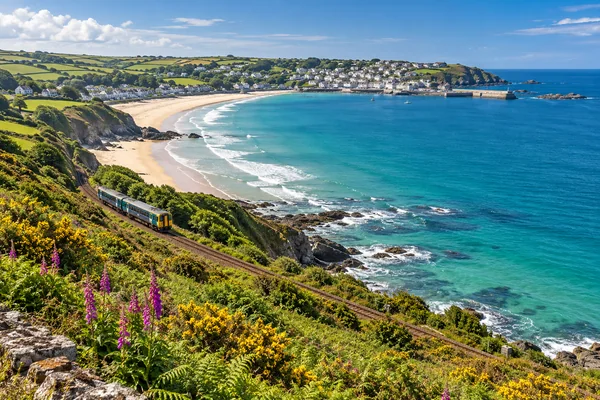
St Erth to St Ives, about twelve minutes, and comfortably the most scenic short rail journey in England. The line runs along the edge of the bay above Porth Kidney Sands and Carbis Bay, with the track cut into the slope so the carriage windows look straight down onto the water.
The practical point is better than the scenery. St Ives is a nightmare to drive into and park in — the town is medieval and the car parks fill by mid-morning in summer. St Erth station has a large park and ride designed for exactly this. You leave the car, take the train in, and arrive a two-minute walk from the harbour.
Get off at Carbis Bay (about eight minutes) if you want the beach rather than the town, and walk the coast path into St Ives from there.
Maritime Line: Truro to Falmouth
About twenty minutes, running down from the cathedral city to the water at Falmouth, with three stops in the town itself — the last, Falmouth Docks, is the one for Pendennis Castle.
This is the most useful line for a day out without a car: Truro for shops and the cathedral, Falmouth for the National Maritime Museum, the harbour and the ferries to St Mawes and the Helford. Our where to stay guide covers basing yourself at either end.
Looe Valley Line: the river line
Liskeard to Looe, and a genuine curiosity: the train leaves Liskeard, reverses at a junction below the main line, then follows the East Looe River down the wooded valley to the coast. It is slow, single-track, and almost entirely green.
It is also a lesson in why these lines survive. There is no sensible road alternative down that valley, the parking in Looe is awful, and the station puts you on the quay. Our cosy pubs guide covers where to eat at the bottom.
Atlantic Coast Line: Par to Newquay
About fifty minutes across the middle of Cornwall from the main line at Par to the north coast at Newquay, through the clay country. It is the least scenic of the five and the most useful, because Newquay is otherwise a long drive and an expensive park. Our Newquay guide covers what to do at the end of it.
Par is also the station for the Eden Project side of Cornwall, though St Austell is the usual stop with a direct bus — see our Eden Project guide, which covers the National Rail Days Out Guide two-for-one offer worth using if you arrive by train.
Check this line specifically before travelling. It has been subject to engineering work and bus replacement in recent years as part of wider rail improvements in mid Cornwall.
Tamar Valley Line: the one nobody takes
Plymouth to Gunnislake, crossing out of Devon and into Cornwall over the Tamar, and the most underrated journey of the five. It threads along the wooded river valley through Bere Ferrers and Calstock, crossing the river on a tall viaduct with the water directly beneath you.
It is included in the Ride Cornwall ticket, which is a quiet bargain given it also gets you into Plymouth. The valley at the end is old mining and market-garden country — steep, green and almost unvisited — and the field patterns there are a good place to see what our Cornish hedges piece describes.
Making a car-free trip actually work
- Pick a line and stay at the end of it. Falmouth, St Ives, Looe and Newquay all work as car-free bases with enough to walk to. Our where to stay guide and off-season guide cover what is open when.
- Use the park and ride at St Erth if you are driving down but want to avoid St Ives.
- Combine rail with the coast path. Train out, walk back along the coast, train home — our coast path guide covers one of the best stretches for it.
- Or rail and bike. The Camel Trail starts at Bodmin and the Clay Trails run near Par and St Austell; our cycling guide has the detail.
- Check Sundays and check engineering work, every time. This is the one thing that catches people out.
- Evenings are the reward. A late train back after a sunset on the coast is the best argument for the whole exercise — see our sunset spots guide.
FAQ
Q: How many branch lines does Cornwall have?
A: Five: the St Ives Bay Line, the Maritime Line to Falmouth, the Atlantic Coast Line to Newquay, the Looe Valley Line and the Tamar Valley Line. They all connect to the Penzance to Plymouth main line.
Q: What is the Ride Cornwall ticket?
A: A one-day pass covering trains and buses within Cornwall, between Cornwall and Plymouth, and on the Tamar Valley Line. It costs £21 adult, £10.50 for a child aged 5–15 and £42 for a family of up to two adults and three children, and is valid after 9am on weekdays and all day at weekends and bank holidays.
Q: Can you visit St Ives by train?
A: Yes, and it is the best way to do it. The St Ives Bay Line runs from St Erth in about twelve minutes, along the edge of the bay. St Erth has a large park and ride, which avoids St Ives’ car parks filling by mid-morning in summer.
Q: Do Cornwall’s branch lines run on Sundays?
A: Not all of them. Cornwall Council states that main line services run seven days a week but some branch lines do not operate Sunday services. It varies by line and timetable, so check the specific line for your date.
Q: Is it practical to visit Cornwall without a car?
A: Yes, if you pick a base at the end of a branch line. Falmouth, St Ives, Looe and Newquay all have enough within walking distance, and the Ride Cornwall ticket covers buses to fill the gaps. It is less practical if you want remote beaches or moorland daily.
Q: Which is the most scenic railway line in Cornwall?
A: The St Ives Bay Line is the famous one, running along the slope above Carbis Bay with the sea below the windows. The Tamar Valley Line is the underrated alternative, following the wooded river valley and crossing the Tamar on a tall viaduct at Calstock.
References and resources
- Cornwall Council — train services: www.cornwall.gov.uk
- Transport for Cornwall — Ride Cornwall: www.transportforcornwall.co.uk
- Great Western Railway: www.gwr.com
- National Rail — Days Out Guide: www.daysoutguide.co.uk