Quick answer: Launceston is the town almost everyone drives past. It sits just off the A30 at the Devon border, it was Cornwall’s ancient capital, and it has a Norman castle with a keep you can climb standing over the middle of it. Give it half a day. The castle, a remarkable early-1500s granite church, a two-and-a-half-mile steam railway and a town museum are all within a few minutes’ walk of the same car park — which is more than most Cornish towns manage, and nobody tells you about it.
Everyone heading into Cornwall passes Launceston, and almost nobody stops. The A30 takes you round it in ninety seconds and the holiday is somewhere further west, so the town gets treated as a road sign. That is a mistake, and this is the case for the detour. Our guide to reaching Cornwall covers the drive itself.
Table of Contents
- The town everybody drives past
- Launceston Castle
- The town itself
- Launceston Steam Railway
- Practical notes
- A town we know well
- FAQ
- References and resources
The town everybody drives past
Launceston stands at the top of Cornwall where the A30 crosses from Devon, which made it the gateway for most of its history and is now the reason it gets ignored. It was Cornwall’s ancient capital, and it is one of the few Cornish towns with any surviving medieval wall and gate at all.
What that means in practice is a proper hilltop town with a castle, rather than a harbour village — a genuinely different flavour from the coast, and a useful one if you have had a week of beaches. It is also the obvious first or last stop of a Cornish trip, because it is the first real town after the border. The wider historical context is in The Story of Cornwall.
Launceston Castle
The reason to come. The castle sits on a high motte right above the town centre, and it controlled the main route into Cornwall for centuries.
- The keep is unusual and you can climb it. Richard, Earl of Cornwall, built a multi-tiered stone keep here in the 13th century — a design not repeated elsewhere — and the climb is rewarded with views over the town and out towards Dartmoor.
- You can go into the gatehouses.
- It became a notorious prison, nicknamed Castle Terrible. The prison buildings are gone, but the displays cover that stretch of its history.
- The grounds are a good picnic spot, and free to walk through as a park even if you are not going into the castle itself.
- For children there is a family trail following Rupert, the cat belonging to the Launceston poet Charles Causley, and a World Builder trail.
Opening: Wednesday to Sunday and bank holidays, 10am to 4pm. Booking in advance saves 15%, and entry is free to English Heritage members — membership starts from £44 and includes up to six accompanying children per adult member.
One archaeological detail worth knowing: excavations here turned up whale bones, possibly the remains of a medieval feast. Our Tintagel guide covers the other great English Heritage site in Cornwall, which is a very different proposition.
The town itself
St Mary Magdalene
The outstanding building in Launceston and genuinely unusual in Britain. Begun in about 1511 and completed in 1524, the church is covered on its outside with intricate carving — cut into granite, which is the hard, unforgiving stone that most of Cornwall is built from and which almost nobody carved at this level of detail. It is Grade I listed and the exterior is the thing to look at.
The South Gate
The surviving gate of the old town wall still spans the street, and it is the most obvious piece of medieval Launceston left standing. Sources disagree about whether it is Norman or 13th-century work, so we will not pretend to settle it, but it is the real thing either way.
Lawrence House Museum
A few minutes from the castle, the town museum covers local life with a toy room, a Victorian kitchen and costumes running from the 18th century to the 1960s. Worth an hour, particularly with children or on a wet day.
Launceston Steam Railway
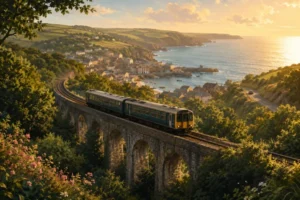
A two-and-a-half-mile narrow gauge line running from Launceston along the Kensey Valley to Newmills, and the thing that turns half a day into a full one with children.
Tickets are bought at the ticket office on the day — no booking needed — and a return allows unlimited travel on the same day, so children can simply go back and forth. Show your train ticket at Launceston Castle and you get 20% off.
It runs seasonally and the operating days are not published on the front page, so check before building a day around it. For Cornwall’s full-size branch lines, see our branch lines guide.
Practical notes
- Everything is walkable. The castle, the church, the South Gate and the museum are all within a few minutes of the town centre car park — unusual for Cornwall, where attractions are normally a drive apart.
- Half a day is right, or a full day with the steam railway and lunch.
- Check the castle’s days. Wednesday to Sunday means a Monday or Tuesday visit gets you the town but not the keep.
- Homeleigh Garden Centre, on the Dutson road just outside town, is the local wet-day fallback — animals for children, plants, and somewhere warm.
- It is a good wet-weather town, because the museum, the church and the shops do not depend on sunshine — see our off-season guide for the wider off-season picture.
- Combine it with Bodmin Moor, which starts just down the road, or use it as a staging post on the way west. Our Bodmin Moor piece and where to stay guide cover the area.
- The lanes around it are some of the best places in Cornwall to see what our Cornish hedges piece describes, if you take the back roads rather than the A30.
A town we know well
I should declare an interest. My parents and both of my sisters have lived in Launceston for the past twenty years. This is not a town I have passed on the way to somewhere else — my parents retired here (that story is in our retiring to Cornwall guide), Boxing Day at theirs is the one fixed point in our Cornish year, and my sister got married here last month.
The walk I would actually send you on is not in any guidebook. Out along Dutson Road on the town’s north-east edge, around the farm lanes, and back along Ridgegrove Lane above the Kensey valley — the same valley the steam railway runs up. Late autumn strips the hedges so the views open out, the lanes are quiet enough to hear your own boots, and every so often you pass one of those old houses standing alone in the middle of nowhere and spend the next half-mile deciding which one you would take. More on that month in our November guide.
The traditional halt is Homeleigh Garden Centre, on the Dutson road. Animals for the children to visit, house plants nobody needs and everybody buys, and somewhere warm before the last leg. If you are in Launceston with children on a cold day and the castle is shut, that is where to go, and it is the sort of place a visitor guide would never think to mention.
One recent illustration of how tightly the town is arranged: the registry office is literally next door to the main car park, and across the road from the castle. You park, you walk twenty yards, you get married, and there is a Norman keep on a hill looking down at you the whole time — a remarkably good backdrop to have simply by default.
And the argument I would genuinely make to a visitor: stay here rather than on the coast. From Launceston you can reach the north coast, the south coast and Bodmin Moor inside about forty minutes each, you can park everywhere, and you come home through farm lanes instead of traffic. Our where to stay guide makes the case at length, and our December guide covers what the town is like at the one time of year we are always here.
FAQ
Q: Is Launceston worth visiting?
A: Yes, for half a day. It was Cornwall’s ancient capital and has a Norman castle with a climbable keep, an exceptional early-1500s granite church, a town museum and a narrow gauge steam railway — all within walking distance of the same car park.
Q: What is there to do in Launceston?
A: Launceston Castle, the church of St Mary Magdalene with its carved granite exterior, the surviving South Gate of the medieval town wall, Lawrence House Museum, and the Launceston Steam Railway along the Kensey Valley.
Q: When is Launceston Castle open?
A: Wednesday to Sunday and bank holidays, 10am to 4pm. Booking in advance saves 15%, and English Heritage members go free. If you visit on a Monday or Tuesday you will get the town but not the castle.
Q: How long is the Launceston Steam Railway?
A: Two and a half miles of narrow gauge line from Launceston through the Kensey Valley to Newmills. Tickets are bought on the day with no booking needed, a return gives unlimited same-day travel, and showing your ticket gets 20% off Launceston Castle.
Q: Why is Launceston called Cornwall’s gateway?
A: It stands at the top of the county where the main road crosses from Devon, and controlled the principal route into Cornwall for centuries — which is why a castle was built above it. The modern A30 bypasses the town, which is why most visitors now pass it without stopping.
Q: What is special about St Mary Magdalene church?
A: It was begun in about 1511 and completed in 1524, and its exterior is covered in intricate carving cut directly into granite — an extremely hard stone that was rarely worked to that level of detail. It is Grade I listed.
References and resources
- English Heritage — Launceston Castle: www.english-heritage.org.uk
- Launceston Steam Railway: www.launcestonsr.co.uk
- Lawrence House Museum: lawrencehousemuseum.org.uk
- Homeleigh Garden Centre, Launceston: www.homeleigh.co.uk
- Visit Cornwall — Launceston: www.visitcornwall.com