Quick answer: Cornwall has around a dozen working ferries, and they fall into two groups. Vehicle ferries — King Harry, Bodinnick and Torpoint — exist to save you a long drive, and all three run year-round. Foot ferries — Padstow–Rock, Fowey–Polruan, Falmouth–St Mawes, Helford and the rest — are mostly seasonal, and several stop entirely at the end of October. The two things that catch people out: most of the small ones do not run in winter, and wind cancels them at any time of year. Check on the day, not the week before.
Cornwall is shaped by water that gets in the way. Its rivers run deep inland, its estuaries are wide, and the road has to go round all of them — which is why the county still runs more working ferries than almost anywhere else in England. Some are shortcuts worth half an hour of your life; one or two are the only sensible way across at all. This is what runs, when, and which ones stop for the winter. For getting to Cornwall in the first place, see our guide to reaching Cornwall, and for the rail network our branch lines guide.
Table of Contents
- The three vehicle ferries, and why they exist
- The foot ferries, and when they stop
- What it costs you to miss one
- Wind stops them, and more often than you think
- The real ferry: Penzance to the Isles of Scilly
- The ones worth riding for their own sake
- Before you go
- FAQ
- References and resources
The three vehicle ferries, and why they exist
These are not attractions. They are pieces of road infrastructure that happen to float, and each one replaces a drive you would rather not do.
King Harry Ferry (Feock to Philleigh)
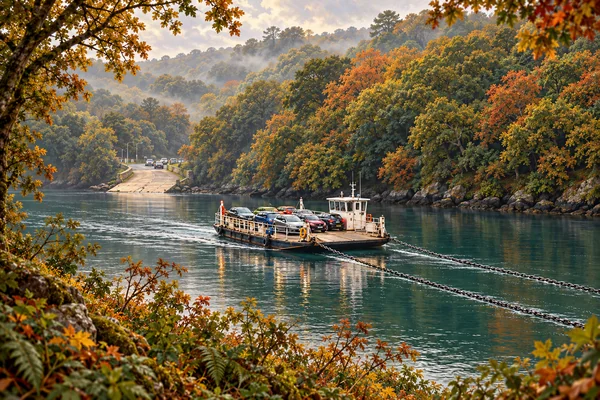
The famous one, and the most useful. It crosses the Fal between Feock and Philleigh in five minutes, running every 20 minutes, seven days a week, all year round. Established in 1888, it is a chain ferry — the operator describes it as one of only five left in England — and it connects the Roseland peninsula with Truro and Falmouth.
The number that makes the case: without it, the same journey is 27 miles round through Truro and Tresillian. It carries over 300,000 cars a year and up to 650 vehicle crossings a day, and the operator reckons it saves around five million car miles annually. If you are staying on the Roseland and ignoring it, you are adding an hour to every trip.
Regular users buy a Fal Mussel Card rather than paying each crossing. Bikes are carried.
Bodinnick Ferry (Bodinnick to Fowey)
A small car ferry across the River Fowey, run by C. Toms and Son, and the way into Fowey from the east without going round by Lostwithiel. It runs year-round, with longer hours in summer and roughly 07:00 to 19:00 through the winter — and it is cancelled in rough weather.
A warning specific to this one: the operator’s published hours have historically lagged behind reality, and changes get posted to the Bodinnick Ferry Facebook page rather than the website. If your plan depends on a late crossing, phone first.
Torpoint Ferry (Torpoint to Plymouth)
Not a scenic crossing — a commuter route across the Hamoaze, and the busiest of the three. Three chain ferries run it 24 hours a day, 365 days a year, every 10 minutes at peak times and never less than half-hourly at night. The crossing takes six or seven minutes.
The quirk worth knowing: the toll is charged one way only, on the trip from Torpoint into Plymouth — so you leave Cornwall paying and return free. Motorcycles are charged in the opposite direction. Pedestrians and cyclists go free in both directions.
Car tolls are £3.00 cash or card, or £1.50 with a TamarTag account; vehicles over 3.5 tonnes pay £7.30. The alternative is the Tamar Bridge a few miles upstream.
The foot ferries, and when they stop
This is where plans come apart. Most of Cornwall’s passenger ferries are seasonal, and the season ends earlier than people assume.
| Crossing | River | Season | Notes |
|---|---|---|---|
| Padstow – Rock | Camel | All year | First 08:00; last 17:00 from Padstow, 16:45 from Rock, 26 Oct–31 Mar. Foot and bikes only |
| Newquay – Crantock | Gannel | Late May to mid-Sept | Fern Pit Ferry, 09:30–18:00, weather dependent |
| Fowey – Polruan | Fowey | All year | Winter Mon–Fri 07:00–19:00, Sat 08:00–19:00, Sun 10:00–17:00 |
| Falmouth – St Mawes | Fal | All year, 7 days | Twice hourly in summer, hourly in winter |
| St Mawes – Place | Percuil | April to October only | 09:15–16:00. Stops dead at the end of October |
| Helford Passage – Helford | Helford | 1 April to 31 October | 09:30–17:00, on demand |
| Gillan Creek | Gillan | 1 April to 31 October | Stepping stones at low water, submerged either side of high tide |
| Falmouth – Flushing | Penryn | All year | Short hop across the harbour |
| Cremyll – Plymouth | Tamar | All year | For Mount Edgcumbe; run by Plymouth Boat Trips |
The Place Ferry is the one that ruins walks. It runs April to October and not otherwise, and it is the crossing that links St Mawes to the Roseland side of the coast path. Miss the season and there is no short way round. Our coast path guide covers a stretch with no such problem.
Fowey–Polruan moves its landing stage. In summer, daytime crossings run from Whitehouse Quay rather than Town Quay. If you are waiting at the wrong quay watching ferries go past, that is why.
What it costs you to miss one
The reason to take any of this seriously is that the alternative is rarely a short detour. Estuaries are long.
- The Helford is the worst. The walk around the river is 13 miles. The ferry crossing takes a few minutes, and it does not run from November to March.
- The Fal at King Harry — 27 miles by road, round through Truro.
- The Gannel at Crantock can be crossed on foot at low tide, but the tidal footbridge is under water either side of high water, and the ferry only runs in high summer.
- Gillan Creek has stepping stones, submerged for roughly three hours either side of high tide. There is a taxi number published for the rest of the time, which tells you how long the walk is.
If you are walking the coast path, the ferries are not optional extras — they are part of the route, and the official guide treats them that way. Plan the tide and the season before the mileage. Our road trip itinerary covers the driving version of the same problem.
Wind stops them, and more often than you think
This is the part the timetables do not tell you, and it is worth a paragraph of its own.
On the afternoon this guide was written — an ordinary blustery Friday in October — four of the five Fal River ferries were cancelled and the King Harry was on hold, all for strong winds. Not a storm. Just wind.
Small boats on open water stop for weather, and Cornish estuaries funnel it. Every operator publishes the same caveat about tides, weather and circumstances, and they mean it. Our weather guide covers what to expect, and the storm watching guide covers the days when nothing floats at all.
- Check a live status page on the day, not a timetable the week before. Fal River publishes a running red, amber and green status for its fleet.
- Have a plan B that involves a road. If the ferry is your only way back to the car, a cancellation is not an inconvenience, it is a taxi fare.
- The chain ferries are the most reliable, because they are winched rather than steered — but King Harry still stops in a strong enough blow.
- Phone numbers beat websites. Most of these are small family operations, and the person answering knows more than the page does.
The real ferry: Penzance to the Isles of Scilly
Everything above is a river crossing. There is one proper sea passage, and it is a different kind of trip.
Scillonian III sails from Penzance to St Mary’s in about two hours forty-five minutes, operating March to November. Dogs are allowed, and the quay connects to rail, coach and bus. There is a Fly+Sail option if you want to come back by air.
It has a reputation for being lively in a swell, which is honestly earned — it is open water, and not a ferry ride in the sheltered-estuary sense.
And it is being replaced. Scillonian IV was launched in Vietnam on 28 March 2026 and technically accepted by the Isles of Scilly Steamship Group on 7 October 2026. She is due to leave Ho Chi Minh City at the end of October for a passage of roughly two months via the Cape of Good Hope, and the operator plans to introduce her on the route in March 2027. She is about 75 metres long and carries up to 600 passengers, replacing a ship that has worked the route since 1977. The 2027 schedule had not been published when this was written.
The ones worth riding for their own sake
Three of these are a day out rather than a shortcut.
- Falmouth to St Mawes, then St Mawes to Place in season, which puts you on the Roseland with no car at all. Our where to stay guide covers basing yourself at either end.
- Enterprise Boats, Falmouth up the Fal to Truro or Malpas via Trelissick — seasonal, and the best way to see a river that is mostly hidden from the road. The maritime heritage guide covers the working history of the same water.
- Fowey to Polruan, which costs very little, takes a few minutes, and lands you in a village most people only ever look at from the other side. Our cosy pubs guide covers where to go once you are there.
The Pandora Ferry runs on selected dates only and had finished for the 2026 season when this was written, returning in 2027. It exists to land you at a thatched waterside pub, which is a sound reason for a ferry to exist.
And in winter, when half of these have stopped, the ones that keep going are better: empty, cold, and genuinely the way people get to work. Our off-season guide covers what else is open, and the Newquay guide covers the north coast end.
Before you go
- Check the season first, the timetable second, the live status third. In that order. A perfect timetable for a ferry that stopped in October is no use.
- Several are cash-friendly but not card-guaranteed. Small operators, small boats. Carry some cash.
- Vehicle ferries queue in summer. King Harry runs every 20 minutes and can still back up in August.
- Bikes are generally fine; check dogs individually. Most are relaxed about both.
- Landing points move. Padstow–Rock and Fowey–Polruan both shift their quays with tide or season.
- Phone rather than email. These are not call centres.
FAQ
Q: How many ferries are there in Cornwall?
A: Around a dozen working crossings. Three carry vehicles — King Harry on the Fal, Bodinnick near Fowey and the Torpoint Ferry across the Tamar — and the rest are foot ferries across estuaries, plus the Scillonian III sea crossing from Penzance to the Isles of Scilly.
Q: Do Cornwall’s ferries run in winter?
A: Some do and many do not. King Harry, Torpoint, Bodinnick, Padstow–Rock, Fowey–Polruan, Falmouth–St Mawes and Falmouth–Flushing run year-round. The Place Ferry, the Helford ferry, Gillan Creek and the Newquay–Crantock crossing are seasonal and stop around the end of October.
Q: How much is the Torpoint Ferry?
A: A car is £3.00 paying by cash or card, or £1.50 with a TamarTag account; vehicles over 3.5 tonnes pay £7.30 and motorcycles £1.00. The toll is charged one way only, from Torpoint into Plymouth. Pedestrians and cyclists cross free.
Q: How often does the King Harry Ferry run?
A: Every 20 minutes from each side, seven days a week, all year round. The crossing takes about five minutes and saves a 27-mile road journey round through Truro and Tresillian.
Q: Can Cornwall’s ferries be cancelled by weather?
A: Yes, routinely, and not only in storms. On an ordinary windy October afternoon four of the five Fal River ferries were cancelled and the King Harry was on hold. Check the operator’s live status on the day you travel rather than relying on a timetable.
Q: How long is the ferry from Penzance to the Isles of Scilly?
A: About two hours and forty-five minutes on Scillonian III, which operates March to November. A new ship, Scillonian IV, is due to take over the route in March 2027.
Q: What happens if I miss the Helford ferry?
A: You walk. The route around the Helford River is about 13 miles, and the ferry only runs from 1 April to 31 October. There is a local taxi service as an alternative, which is the sensible option outside the season.
References and resources
- South West Coast Path Association — estuaries and ferries: www.southwestcoastpath.org.uk
- Fal River — ferries and live status: www.falriver.co.uk
- Tamar Crossings — Torpoint Ferry tolls: www.tamarcrossings.org.uk
- C. Toms and Son — Polruan and Bodinnick ferries: ctomsandson.co.uk
- Isles of Scilly Travel — Scillonian III: www.islesofscilly-travel.co.uk