Quick answer: parking is the single most predictable way to waste a day in Cornwall, and almost all of it is avoidable. Cornwall Council runs 280 car parks, 145 of them free; the other 135 are chargeable, in three zones, paid through the JustPark app using the location ID on the sign. A new parking order took effect in 2026, raising tariffs by 3.8% and bringing in motorhome charges at ten named sites. For the towns where parking is genuinely the problem — St Ives above all — the answer is not a better car park, it is park and ride: St Erth for St Ives, Langarth or Tregurra for Truro. And in summer, beach car parks fill by mid-morning, which no app will fix.
Everything else about a Cornish holiday can be improvised. Parking cannot, because the county has medieval harbour villages with one lane in, beaches at the bottom of valleys with nowhere to put a car, and six million visitors a year. This is how the system actually works, what changed in 2026, and where to leave the car in the places that are hardest. Our guide to reaching Cornwall covers getting here, and the road trip itinerary covers the driving itself.
Table of Contents
- How Cornish parking actually works
- What changed in 2026
- Park and ride: the answer for the worst towns
- The places where parking is the whole problem
- Beach parking, and the mid-morning rule
- Attraction car parks
- The rules that catch visitors out
- FAQ
- References and resources
How Cornish parking actually works
Three separate systems, and knowing which one you are standing in saves the argument.
Cornwall Council car parks
The backbone, and the number is better than people assume. Cornwall Council runs 280 car parks, and 145 of them are free. The other 135 are pay-and-display or pay-on-foot, grouped into three zones — Zone A being the busiest places, which are also the best served by public transport, walking and cycling. Zone pricing is deliberate policy, not an accident: the busiest places cost most, to push people onto buses and trains.
So more than half of Cornwall’s council car parks cost nothing — they are simply not the ones next to the famous beaches.
- Pay through JustPark. Every council sign carries a location ID; you enter it in the app rather than hunting for the car park by name. There is a phone line for anyone without a smartphone.
- Phone signal is the catch. Cornish valleys and coves frequently have none, and that is exactly where the car parks are. Start the session before you drop down the hill, or register it as soon as you get signal back.
- Regular users should buy multi-use tickets through the app rather than paying each time — the council prices them well below the daily rate.
- Blue Badge holders can park free in some circumstances, including adapted vehicles and vehicles exempt from vehicle tax. Check the specific car park’s conditions.
National Trust car parks
A large share of Cornwall’s best coastline and gardens sits behind a National Trust car park. Free to members, charged for everyone else, and increasingly run through JustPark with the property’s own location code. Glendurgan, to pick one, charges £5 all day or £2.50 for four hours, and members register their membership card in the app rather than paying. If you are visiting two or three NT places, the membership pays for itself in parking alone. Our great gardens guide covers which gardens are Trust and which are independent.
Everybody else
Town councils, parish councils, farmers, pubs and private operators run the rest, and they set their own terms. Field car parks at beaches are usually cash, usually cheap, and usually the easiest option in August — but take cash, because many have no card machine and no signal.
What changed in 2026
Worth knowing, because a lot of published advice predates it.
Cornwall Council made a new Off Street Parking Order on 26 March 2026, replacing the 2024 order. It went through after a scrutiny committee had voted against recommending the proposals, which tells you how contested parking is here.
- Tariffs rose 3.8% across all chargeable council car parks, in line with inflation.
- Motorhome charges were introduced at ten named sites: Link Road in Padstow, Watergate Bay, Trenwith in St Ives, Wheal Leisure in Perranporth, Main car park in Fowey, Marazion Station, the Gyllyngvase coach park in Falmouth, Seaton Bridge, Cattle Market in Launceston and Victoria Square in Bodmin.
- The 2-3 hour tariff was removed from long-stay car parks, which pushes a half-day visit onto the all-day rate — the change most likely to catch a visitor out.
- Some free car parks at beauty spots began charging. Do not assume a scenic pull-in is still free because it was last year.
- In Truro, Moresk and Edward Street became free after 4pm, with other Truro tariffs raised to offset it.
- The JustPark Wallet minimum top-up dropped to £35.
We have deliberately not printed a tariff table. Rates differ by zone and by car park, they moved in 2026 and they will move again, and a wrong price is worse than none. Check the council’s parking pages or the sign in front of you.
Park and ride: the answer for the worst towns
This is the part most visitors never discover, and it solves the two hardest places in Cornwall.
St Ives — use St Erth
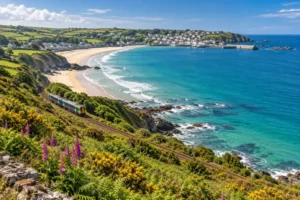
St Ives is a medieval town with lanes built for handcarts, and its car parks fill by mid-morning through the summer. St Erth station has a car park of over 500 spaces, and the St Ives Bay Line runs from there into the town in about twelve minutes, along the edge of the bay. You arrive two minutes from the harbour having paid for a train ticket instead of circling. Our branch lines guide covers the line, which is worth riding on its own merits.
Truro — Park for Truro
Two sites, one each side of the city, run Monday to Saturday excluding bank holidays:
| Site | Spaces | Where |
|---|---|---|
| Langarth Park | 1,209 | West, off the A390 at Threemilestone |
| Tregurra Park | 1,379 | East side of the city |
Between them that is over 2,500 spaces for a city whose central car parks are small and expensive. For a day’s shopping or the cathedral it is the obvious move.
Elsewhere, there is no park and ride worth the name — Padstow, Port Isaac and the harbour villages have none, which is why the advice for those is different. The ferries guide is the genuine alternative for several of them.
The places where parking is the whole problem
Some Cornish destinations are difficult enough that where you leave the car decides whether the visit works.
- St Ives. Use St Erth and the train, or Trenwith at the top of the town and walk down. Do not drive into the centre in August.
- Port Isaac. One road in, famously narrow lanes, and a village of a few hundred people. Park at the top and walk down — it is steep, and it is still the right answer. Our filming locations guide covers why it is so busy.
- Padstow. Link Road is the main option and now carries a motorhome charge. The alternative is to park at Rock and take the ferry across, which is a better arrival anyway.
- Fowey. Steep, narrow and largely residential. Use the park and ride arrangement into town rather than attempting the centre, and remember the Bodinnick and Polruan ferries exist.
- Tintagel. Village car parks, then a walk down to the castle, and a Land Rover shuttle for those who need it. Our Tintagel guide covers the terrain, which is the real constraint.
- Mousehole and the small harbours. Assume you cannot park in the village. Park above and walk in.
- Launceston is the opposite case and worth noting as relief: the castle, the church, the museum and the shops are all a few minutes from the same town car park. Our Launceston guide covers it.
Beach parking, and the mid-morning rule
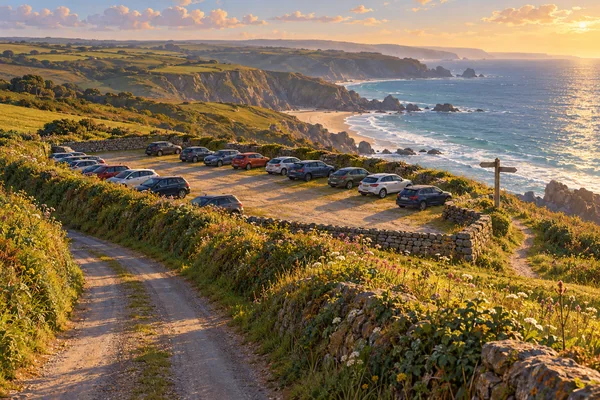
The rule that matters: in July and August, popular beach car parks fill by mid-morning. Not lunchtime. Mid-morning. There is no app, no permit and no trick that changes this, and the beaches with the best facilities fill first.
- Arrive before about half past nine, or arrive after four when the first wave leaves. The late option is better anyway — the light is better and the car park is emptying.
- Take cash for field car parks. The overflow fields that open in summer are often cash-only, with no signal to pay any other way.
- Do not park on the verge. Cornish lanes are bounded by stone-faced banks, not hedges — our Cornish hedges piece explains what you would be driving into — and a car half on the road blocks the lane for an ambulance.
- Check the tide before a long stay at a beach where the car park sits low. Our family beaches guide covers which beaches suit which group.
- Out of season this all evaporates. The same car parks are half empty from October, which is one of the better arguments in our off-season guide.
Attraction car parks
A few behave differently enough to mention.
- The Eden Project parks you a walk from the entrance with a shuttle, and the car park is free — the ticket is the cost. See our Eden Project guide.
- National Trust sites charge non-members for parking even where the site itself is open land, which surprises people walking a clifftop that is otherwise free.
- English Heritage and private attractions vary; check whether parking is included in the admission price or charged separately.
- Garden car parks are small. Several of the great gardens have limited parking and no overflow — arrive early on a bank holiday or do not bother. Our great gardens guide has the detail.
The rules that catch visitors out
- Double yellow lines mean the same here as anywhere, and enforcement in the honeypot villages is active, because residents complain.
- Passing places are not parking spaces. On a single-track lane this is the one that causes real anger, and real danger.
- Residents’ bays are enforced in St Ives, Falmouth, Penzance, Truro and the larger towns.
- Overnight sleeping in a car park is generally prohibited in council car parks regardless of what the vehicle is. Parking a motorhome and sleeping in it are two different questions.
- Beach access tracks are often private. A gate and a track to a cove is usually somebody’s farm, not a right of way for a vehicle.
- Check the ticket machine’s zone. With three zones and a change of tariff in 2026, the price you remember from last year is probably wrong.
FAQ
Q: How much is parking in Cornwall?
A: It depends on the zone and the individual car park. Cornwall Council runs around 135 chargeable car parks in three zones, with the busiest places costing most, and tariffs rose 3.8% under a new parking order made in March 2026. Check the council’s parking pages or the sign in the car park rather than any published figure, including this one.
Q: How do you pay for parking in Cornwall?
A: Most council car parks use the JustPark app. Each sign carries a location ID that you enter in the app, and there is a phone option for anyone without a smartphone. Signal is frequently poor in coves and valleys, so start the session before dropping down the hill. Regular users can buy discounted multi-use tickets through the app.
Q: Is there a park and ride in Cornwall?
A: Yes, in two places that matter. Park for Truro runs Langarth Park (1,209 spaces, west, off the A390 at Threemilestone) and Tregurra Park (1,379 spaces, east), Monday to Saturday excluding bank holidays. For St Ives, use the car park at St Erth station, which has over 500 spaces, and take the branch line in.
Q: What is the best way to park for St Ives?
A: Do not drive into St Ives. Park at St Erth station and take the St Ives Bay Line, about twelve minutes along the edge of the bay, arriving two minutes from the harbour. The alternative is Trenwith at the top of the town, then walk down. Central car parks fill by mid-morning in summer.
Q: What changed about Cornwall parking in 2026?
A: A new Off Street Parking Order was made on 26 March 2026. Tariffs rose 3.8%, motorhome charges were introduced at ten named sites including Padstow, Watergate Bay, St Ives and Fowey, the 2-3 hour tariff was removed from long-stay car parks, and some previously free beauty-spot car parks began charging.
Q: What time do Cornish beach car parks fill up?
A: By mid-morning in July and August at the popular beaches, not lunchtime. Arrive before about half past nine or come after four, when the first wave leaves. Outside the school holidays the problem largely disappears.
Q: Can you park free in Cornwall with a Blue Badge?
A: In some circumstances, including adapted vehicles and vehicles exempt from vehicle tax, but the conditions vary by car park. Check the specific car park’s terms rather than assuming.
References and resources
- Cornwall Council — parking: www.cornwall.gov.uk
- Cornwall Council — park and ride services: www.cornwall.gov.uk
- Cornwall Council — Park for Truro: www.cornwall.gov.uk
- Cornwall Council — Off Street Parking Order 2026: letstalk.cornwall.gov.uk
- National Trust — Cornwall: www.nationaltrust.org.uk