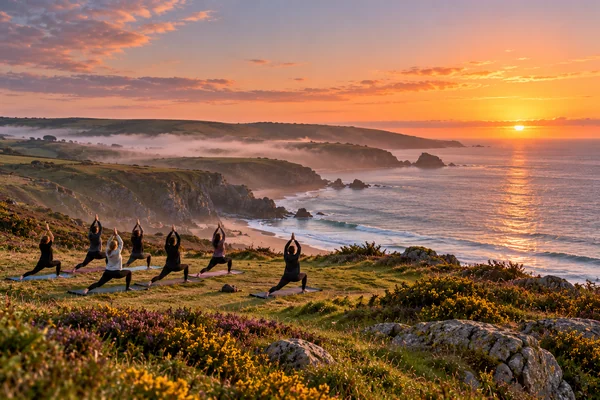
Quick answer: a Cornish retreat is not a spa break, and the difference matters before you pay. A spa break is a hotel with treatments you book individually. A retreat is a fixed group programme over two to seven nights, usually with twice-daily yoga, all meals included, and a schedule you are expected to keep. Cornwall’s signature is that it bolts the coast onto the practice — surf, cold-water swimming or coast-path walking alongside the yoga. Expect roughly £300 to £700 for a long weekend. The three things to pin down before booking are the room, the group size and the level, because the listings are vague about all three.
Cornwall has quietly become one of the busiest retreat destinations in Britain, for a simple reason: the things a retreat wants — sea, space, weather you have to respect and very little to do in the evening — are what the county has. But “retreat” covers everything from a serious silent week to a surf weekend with a yoga class, and the booking sites do not distinguish. This is what you are actually buying. Our spa breaks guide covers the hotel-and-treatment end, which is a different product entirely.
Table of Contents
- A retreat is not a spa break
- What Cornwall adds
- Six things to pin down before you pay
- What it costs, and why the listings disagree
- When to go
- Who a retreat actually suits
- FAQ
- References and resources
A retreat is not a spa break
The single most common booking mistake, and the most expensive.
| Spa break | Retreat | |
|---|---|---|
| What it is | A hotel stay with access to a spa | A fixed programme you join |
| Your time | Yours; treatments booked around it | Scheduled, and attendance expected |
| Food | Restaurant, charged separately | Usually all included, often set menus |
| Who else is there | Other hotel guests, strangers | The same small group all week |
| Typical length | One or two nights | Two to seven nights |
| Alcohol | Available | Frequently not served, sometimes not permitted |
Neither is better. If you want to read a book and have a massage, book a spa hotel and our spa breaks guide is the one to read. If you want to be taken out of your routine and handed a structure, book a retreat. Booking the second while wanting the first is how people end up resenting a 7am gong.
What Cornwall adds
The Cornish retreat has a recognisable shape, and it is not the Mediterranean one. The coast is not scenery here, it is part of the programme.
- Cold water. Sea swimming is built into a large share of Cornish retreats, often with a proper cold-water lesson rather than a dare. Our wild swimming guide covers what the immersion actually does and how to do it safely.
- Surfing. The north coast runs surf-and-yoga weekends as a standing format — beginner surf lessons paired with twice-daily yoga, usually around Newquay and the beaches north of it. Our surf accommodation guide covers the accommodation side.
- Walking. Coast-path retreats use the South West Coast Path as the day’s main event, with yoga at either end. Our coast path guide covers one of the better stretches and the walking for wellness guide covers the case for walking as the treatment itself.
- Sauna and plunge. The wood-fired sea sauna has spread along the Cornish coast fast, and retreats increasingly include it — see our sea saunas guide.
- Weather you cannot ignore. A Cornish retreat in February will put you outside in weather, by design. Our weather guide covers what that means in practice.
One structural point: most Cornish retreats are small operations in borrowed or hired venues — a country house, a farm, a campsite with yurts — rather than permanent retreat centres. That is why dates are scattered and why the same venue hosts different companies.
Six things to pin down before you pay
Retreat listings are consistently vague in the same places. These are the questions that decide whether you enjoy it.
- 1. Is the room private, and is it en suite? This is the big one. A great many retreat prices are for a shared room, with a single supplement that can add a third to the cost. Shared bathrooms are common. Find the exact room you are buying before comparing any two prices.
- 2. How many people? Group size changes the experience completely. Cornish retreats commonly run in the low to mid teens — one well-known coastal operator lists 13 to 17. Under ten is intimate and hard to hide in; over twenty starts to feel like a course.
- 3. What level is the yoga, honestly? “All levels welcome” is close to meaningless. Ask how many classes a day, how long, what style, and what a complete beginner actually does in them. Twice daily is the Cornish norm and is more than most people expect.
- 4. Is everything included, and what is not? Meals usually are. Treatments, surf hire, transfers and the sauna frequently are not. Ask for the list of extras rather than assuming.
- 5. Is attendance expected? Some retreats are genuinely relaxed about skipping a session; others are not, and a structured programme is the point. Neither is wrong, but find out.
- 6. What happens if the weather stops the outdoor part? On a surf or swim retreat in Cornwall, this is a realistic question, not a pedantic one. Ask what the substitute is.
What it costs, and why the listings disagree
Budget roughly £300 to £700 for a three-night Cornish retreat, with the coastal yoga, walking and swimming weekends clustering near the upper end of that and camping-based surf-and-yoga weekends well below it.
But treat every published figure as a starting point. Researching this guide, the same retreats appeared on aggregator sites at different prices, with partial dates, and in at least one case in the wrong currency. The aggregators gather a price once and do not go back.
- Book through the operator’s own site where you can. It is where the current price, the room options and the real inclusions live.
- Check what the single supplement is before comparing anything.
- Ask about the cancellation terms. Small operators running fixed-date programmes are often strict, because a late cancellation is a place they cannot refill.
- Check the venue, not just the company. The same farmhouse may host four different operators in a season, and reviews of one tell you little about another.
When to go
Spring and autumn are the sweet spot, and it is when most Cornish retreats actually run. The county is open, the coast path is empty, accommodation is cheaper and the weather is interesting without being punishing. Our March guide covers the month when Cornwall starts flowering and nothing is busy, and the great gardens guide covers where to go on a free afternoon.
Winter retreats are a real and growing category, and they suit the format better than you would think — a storm outside is not a problem for a programme built around being indoors between sessions. Our off-season guide covers what else is open.
Summer is the one to think twice about. You will pay most, the beaches are at their busiest, and the solitude a retreat is selling is harder to find in August. If you are coming to Cornwall anyway, our where to stay guide and woodland walks guide cover the quieter options.
Who a retreat actually suits
Worth being blunt, because it is a lot of money to discover you wanted a holiday.
- It suits you if you want decisions taken off you for a few days, you are willing to be in a small group of strangers, and a timetable sounds like relief rather than an imposition.
- It does not suit you if you want to lie in, eat what you like, drink wine with dinner and be left alone. That is a cottage with a sea view, and Cornwall does those superbly.
- It is a poor fit for a first couples’ trip. Retreats are a group experience, and shared rooms and fixed schedules are not romantic.
- And it is not treatment. A retreat can be genuinely restorative, but it is a holiday with structure, not healthcare. If you are struggling, talk to your GP as well.
FAQ
Q: What is the difference between a retreat and a spa break in Cornwall?
A: A spa break is a hotel stay with treatments you book around your own schedule. A retreat is a fixed group programme, usually two to seven nights, with a timetable, all meals included and attendance expected. They suit quite different moods and cost differently.
Q: How much does a yoga retreat in Cornwall cost?
A: Budget roughly £300 to £700 for three nights. Coastal yoga, walking and swimming weekends sit near the top of that range and camping-based surf-and-yoga weekends well below it. Check whether the price is for a shared or private room, as the single supplement can add substantially.
Q: What makes Cornish retreats different?
A: They bolt the coast onto the practice. Cold-water sea swimming, beginner surfing, coast-path walking and increasingly wood-fired sea saunas are built into the programme rather than offered as sightseeing, so you spend real time outdoors in real weather.
Q: What should I check before booking a retreat?
A: Whether the room is private and en suite, the group size, what level the yoga genuinely is and how many classes a day, exactly what is included, whether attendance is expected, and what happens if weather cancels the outdoor part.
Q: When is the best time for a retreat in Cornwall?
A: Spring and autumn, which is also when most of them run. The coast path is empty, prices are lower and the weather is interesting without being punishing. Winter retreats work better than people expect. Summer is the most expensive and the least solitary.
Q: Are Cornish retreats suitable for complete beginners?
A: Usually yes, but ask rather than trusting “all levels welcome”. Find out how many classes a day, how long each is and what style, because twice-daily practice is the Cornish norm and is more than many first-timers expect.
Q: Is a retreat a good idea for a couple?
A: Generally not for a first trip together. Retreats are group experiences with fixed schedules and often shared accommodation, which is the opposite of a romantic break. A cottage with a sea view does that job better.
References and resources
- NHS — mindfulness: www.nhs.uk
- Outdoor Swimming Society — cold water safety: www.outdoorswimmingsociety.com
- South West Coast Path: www.southwestcoastpath.org.uk
- Visit Cornwall: www.visitcornwall.com