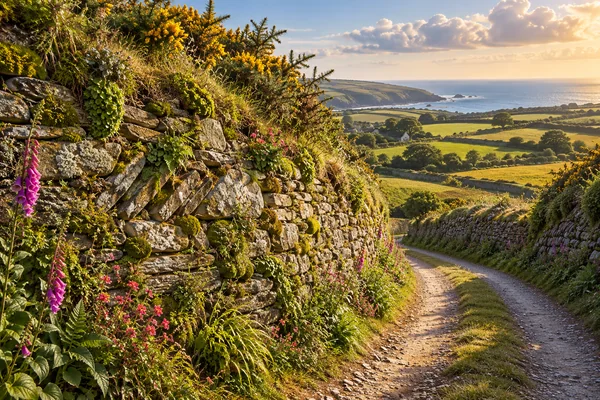
Quick answer: a Cornish hedge is not a hedge. It is a stone-faced bank filled with earth, built in a craft that has barely changed in three and a half thousand years. The earliest are around 3,500 years old, which makes them among the oldest man-made structures anywhere still doing the job they were built for. There are roughly 30,000 miles of them in Cornwall — the county’s largest semi-natural habitat, carrying over 500 native plant species. The craft that maintains them is now officially endangered. The best place to see one built properly is Kerdroya, a 56-metre labyrinth on Bodmin Moor.
You will drive between them for your entire visit and probably never look at one. Cornish hedges are the most overlooked thing in the Cornish landscape and arguably the most remarkable — older than most cathedrals, still functional, and built by hand. This is what they are, how they are made, and why the craft is in trouble. It sits alongside The Story of Cornwall and our rewilding guide.
Table of Contents
- A Cornish hedge is not a hedge
- The parts, and what to look for
- How old, honestly
- 30,000 miles, and Cornwall’s largest habitat
- The craft is officially endangered
- Kerdroya: where to go and see one properly
- Why a wall is worth caring about
- FAQ
- References and resources
A Cornish hedge is not a hedge
Start with the thing that confuses every visitor. What you are looking at is not a row of shrubs. It is an engineered earth bank with stone walls on both faces, and whatever grows on top is incidental — welcome, but not the structure.
The Cornwall Landscape Partnership defines it as a stone-faced earth and rab-filled bank, rab being a stony local subsoil. The detail that matters is the shape: a Cornish hedge is about twice as wide at its base as at its top, with a concave batter — the faces curve inward as they rise. Traditionally there were ditches on either side.
That curve is not decoration. Correctly laid stone and the right batter shed rainfall so that the proper amount soaks into the core rather than washing it out. A hedge built with straight faces fails. One built properly stands for millennia, which is not a figure of speech.
The parts, and what to look for
Once you know the vocabulary you cannot stop noticing them.
- Grounders — the large stones forming the base course. These are the bones of the hedge, and at Zennor in West Penwith the National Trust has dated grounders still in position to roughly 4,000 years ago.
- Outriders — stones deliberately left overhanging the face, which make the hedge harder for livestock to climb. You see these on the north coast around Hartland.
- Rab fill — the subsoil or clay-shale core between the two stone faces.
- The batter — the inward curve of each face as it rises.
- The top — turf, thorn, gorse or whatever has colonised, which adds height and a stock-proof prickle.
Styles vary by area, and a practised eye can place a hedge geographically by how the stone is laid. That regional variation is itself part of what is being lost.
How old, honestly
You will see a lot of confident numbers. Here is what the sources actually say.
| Source | Age given |
|---|---|
| Cornwall Landscape Partnership | The earliest are about 3,500 years old |
| National Trust dating at Zennor | Grounders placed roughly 4,000 years ago |
So the honest version is 3,500 to 4,000 years, with the oldest confirmed examples in West Penwith. Either way they are broadly contemporary with the later Egyptian pyramids, which is the comparison everyone reaches for and which is, for once, fair.
One claim worth handling carefully. Cornish hedges are often called the oldest man-made structures on earth still in use for their original purpose. The Cornwall Landscape Partnership describes them as among the oldest, which is the version we would stand behind. We could find no independent study ranking them against every other structure in the world, so treat the stronger version as a popular claim rather than settled fact.
30,000 miles, and Cornwall’s largest habitat
The scale is the part that surprises people. There are roughly 30,000 miles of Cornish hedge, which makes them collectively Cornwall’s largest semi-natural habitat — bigger than its woodland, its moorland or its dunes.
What lives on them:
- Over 500 native plant species grow on Cornish hedges, including Western Ramping Fumitory, which is endemic — it grows here and essentially nowhere else.
- Wildlife corridors for adders, harvest mice, bats and hedgehogs, letting animals move across farmed land that would otherwise be impassable.
- Habitat for small mammals, reptiles, birds and insects, including pollinators and the predatory species that control crop pests.
That last point is the one farmers make: a hedge is not just a boundary, it is the pest-control and pollination infrastructure of the field it encloses. Our permaculture guide makes the same argument at garden scale, and the wildlife calendar covers what you will see on them month by month.
More than 150 miles have been lost since 1995. That is the number that should worry people.
The craft is officially endangered
Building and repairing these is a skilled trade with its own guild, the Guild of Cornish Hedgers. When the Kerdroya project went looking for hedgers, the Guild had just thirteen working members.
Cornish hedging is now listed as endangered on the Heritage Crafts Red List — the UK register of traditional crafts at risk of dying out. A structure that has survived three and a half millennia is threatened less by weather than by nobody being left who can rebuild it.
There is some better news: the Kerdroya project has had more than a hundred people learning the traditional craft on site, which is the most deliberate attempt at succession the trade has had in a long time.
Kerdroya: where to go and see one properly
If you want to understand Cornish hedging in an afternoon, go here.
Kerdroya is a permanent land-art installation at Colliford Lake on Bodmin Moor: a classical labyrinth 56 metres across, built entirely from Cornish hedge, with a 10-metre circular space at its heart looking out over the moor and the lake. You walk a single meandering path to the middle.
It was commissioned in 2018 as ‘Diamond Landscapes’, marking sixty years since Cornwall’s protected landscape was designated in 1959, and built by Golden Tree Productions with volunteers, community groups and local hedgers. The metalwork at the centre is by sculptors Gary and Thomas Thrussell. The National Trust, Cornwall Council and South West Water were partners, and the site itself was a disused car park turned back into wildlife habitat.
The point of it is that the walls are the exhibit: different sections demonstrate different regional hedging styles, so you can see in one place what normally takes a county-wide drive to compare. There is also a 12-site trail of restored hedges across all twelve sections of the protected landscape. Check access arrangements before travelling. While you are on the moor, our Green Desert piece and stargazing guide are both relevant.
Why a wall is worth caring about
Cornwall’s identity is usually sold as coastline. The hedges are the other half of it: they are why the farmland looks the way it does, why the lanes are sunken and blind, and why the fields are small and irregular. The field patterns of West Penwith enclosed by these banks are among the oldest continuously farmed landscapes in Britain.
They are also a working argument against the idea that conservation and farming are opposed. A Cornish hedge is a stock-proof boundary, a shelter belt, a drainage feature and a nature reserve at once, built from materials dug out of the field it borders. Our rewilding guide and growing space guide both come at that from different directions, and the tin mining heritage guide covers the other great Cornish landscape craft.
The next time you are stuck in a passing place on a single-track lane, look at the wall beside the car. There is a reasonable chance somebody placed the stone at its base before Stonehenge was finished.
FAQ
Q: What is a Cornish hedge?
A: Not a hedge in the usual sense. It is a stone-faced bank filled with earth and rab, a stony local subsoil, built about twice as wide at the base as at the top with inward-curving faces. Vegetation on top is a bonus rather than the structure.
Q: How old are Cornish hedges?
A: Between about 3,500 and 4,000 years for the oldest. The Cornwall Landscape Partnership gives 3,500 years as the conservative figure, and the National Trust has dated grounders still in place at Zennor in West Penwith to roughly 4,000 years ago.
Q: How many miles of Cornish hedge are there?
A: About 30,000 miles, which makes them collectively Cornwall’s largest semi-natural habitat. More than 150 miles have been lost since 1995.
Q: What wildlife lives in Cornish hedges?
A: Over 500 native plant species grow on them, including the endemic Western Ramping Fumitory. They act as wildlife corridors for adders, harvest mice, bats and hedgehogs, and support reptiles, birds, pollinators and pest-controlling insects.
Q: Is Cornish hedging a dying craft?
A: It is officially at risk. Cornish hedging is listed as endangered on the Heritage Crafts Red List, and the Guild of Cornish Hedgers had just thirteen working members when the Kerdroya project approached them. Over a hundred people have since trained on that project.
Q: Where can I see a Cornish hedge properly?
A: Kerdroya at Colliford Lake on Bodmin Moor: a 56-metre classical labyrinth built entirely from Cornish hedge, with different sections showing different regional styles. There is also a trail of twelve restored hedges across the protected landscape.
Q: What are grounders and outriders?
A: Grounders are the large stones forming the base course of a hedge — the oldest part, and at Zennor dated to around 4,000 years ago. Outriders are stones left deliberately overhanging the face to stop livestock climbing it.
References and resources
- Cornwall Landscape Partnership — Cornish Hedges: cornwall-landscape.org
- Cornwall Landscape Partnership — Kerdroya: cornwall-landscape.org
- Heritage Crafts — the Red List of Endangered Crafts: heritagecrafts.org.uk
- Cornwall Wildlife Trust: www.cornwallwildlifetrust.org.uk